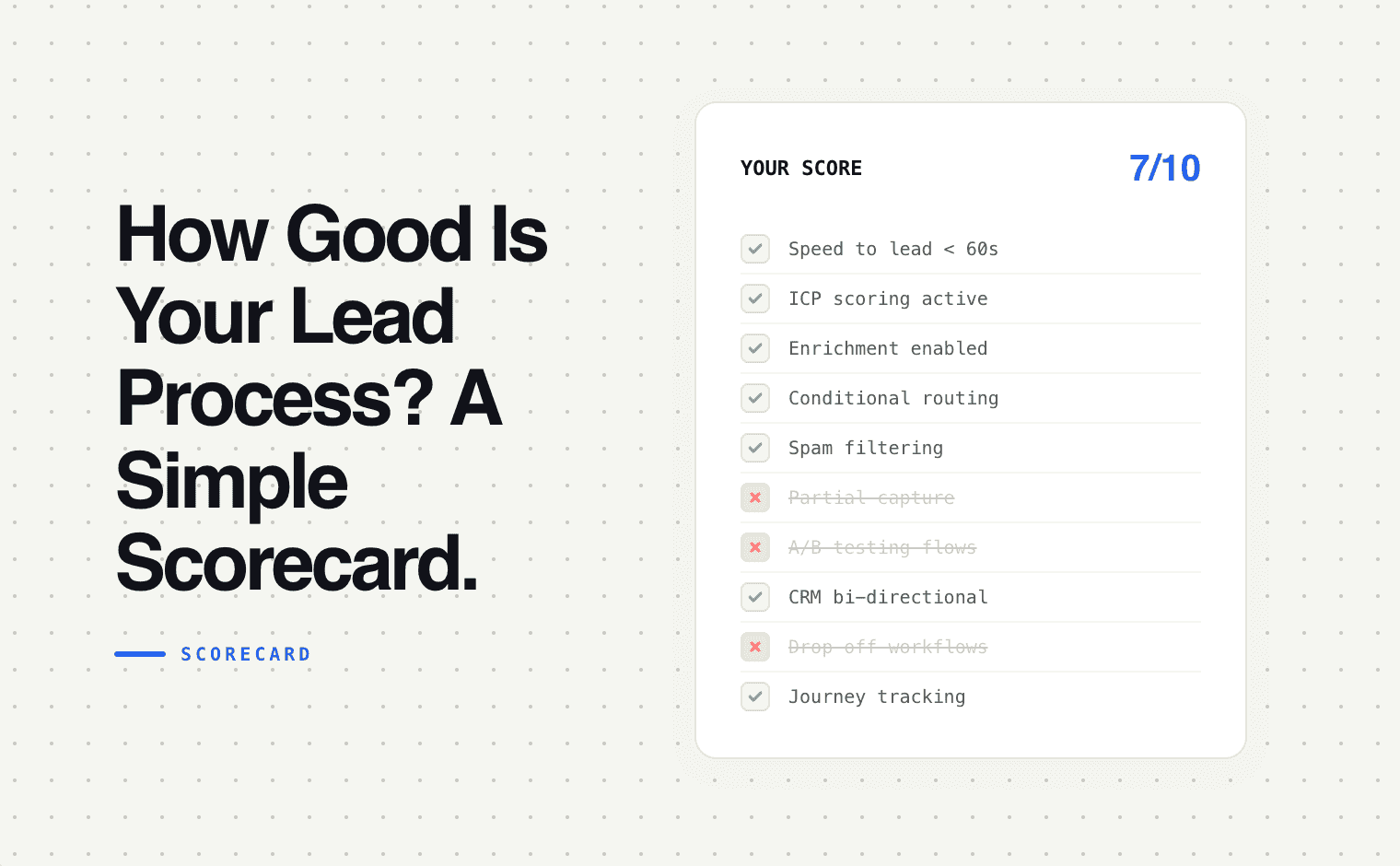
Most teams know their lead process has problems. They can feel it — leads falling through cracks, reps complaining about quality, pipeline that doesn't match ad spend. But they can't point to exactly where it's breaking or how bad it actually is.
This is a simple diagnostic. Ten yes-or-no questions, followed by a scoring framework. It takes 5 minutes. By the end, you'll know whether your lead ops need a tune-up or a rebuild.
The checklist
Answer each question honestly. "Sort of" counts as no.
1. Do you know your average speed-to-lead — the time between form submission and first rep outreach? Most teams don't measure this. If you don't have a number, that's your first problem.
2. Is your average speed-to-lead under 5 minutes? If you don't know, it almost certainly isn't. The companies that measure it are the ones that have already fixed it.
3. Does every lead source — website, ads, third-party, events — flow through the same capture system? If different campaigns use different form tools with different fields, your data is fragmented before it even reaches the CRM.
4. Are leads qualified before they reach a rep? Not enriched — qualified. Does the lead come with budget, timeline, use case, or company size data captured at the form level? Or does the rep have to ask all of that on the first call?
5. Does your routing logic account for more than round-robin? Territory, deal size, product interest, rep availability — if your routing is just "next person in line," you're matching leads to reps by luck.
6. Can you change a routing rule and have it take effect immediately? If updating routing requires a Salesforce admin, a Zapier rebuild, or a ticket to engineering, your system can't keep up with your business.
7. Does every lead get a personalized response within 60 seconds? Not a generic autoresponder. A message that references what they asked about, who's going to help them, and what happens next.
8. Can you trace a single lead from ad click to form fill to rep conversation to outcome? Full-funnel visibility. If you need to pull data from 3+ platforms to build this view, you don't really have it.
9. Do you know your cost per meeting booked — not cost per lead? CPL is a vanity metric if half your leads never get a conversation. Cost per meeting booked tells you what you're actually paying for pipeline.
10. Have you tested any part of your lead flow in the last 6 months? Form fields, routing logic, response timing, qualification criteria — any controlled test, not just a gut-feel change.
Score yourself
Count your "yes" answers, then find your range.
| Score | Rating | What it means |
|---|---|---|
| 9–10 | Dialed in | Your lead ops are a competitive advantage. You're in the top 5% of B2B teams. Focus on testing and marginal optimization. |
| 7–8 | Solid foundation | Core infrastructure works. You likely have 1–2 gaps — speed-to-lead or full-funnel visibility are the usual ones. Fix those and you're elite. |
| 5–6 | Common gaps | This is where most $10M–$50M companies land. The pieces exist but they're not connected. Leads are leaking at the seams between systems. |
| 3–4 | Significant issues | Multiple parts of the flow are broken or manual. You're losing a measurable percentage of your ad spend to infrastructure failure. |
| 0–2 | Full rebuild needed | Your lead process is costing you more than your lead generation. Every improvement here will have outsized ROI because the baseline is so low. |
Most teams reading this will land between 3 and 6. That's not a judgment — it's the reality of how lead ops gets built at most companies. Duct tape, Zapier, and good intentions.
What the scores actually tell you
The checklist is designed so that questions 1–4 test your capture and qualification layer, questions 5–7 test your routing and response layer, and questions 8–10 test your measurement and optimization layer.
If you said "no" mostly in 1–4, your problem is at the top of the flow — leads enter the system with bad data, no qualification, and no urgency. Fixing capture and qualification will have the highest immediate impact.
If you said "no" mostly in 5–7, your capture might be fine but leads die in routing. They go to the wrong rep, wait too long, or get a generic response that kills momentum. Routing and response are where speed-to-lead lives.
If you said "no" mostly in 8–10, you might have decent infrastructure but no way to measure or improve it. You're flying blind — making decisions on gut feel instead of data.
Most teams have problems in all three layers. That's because the layers are connected — bad capture leads to bad routing leads to bad measurement. Fixing one without fixing the others just moves the bottleneck.
Where Surface fits
Surface was built to cover all three layers — capture, routing, and measurement — in one system. If your score landed below 7, most of your "no" answers map directly to gaps that Surface closes.
If you scored yourself honestly and didn't like the number, that's the starting point. The next step is picking the layer where you're losing the most and fixing it first.