
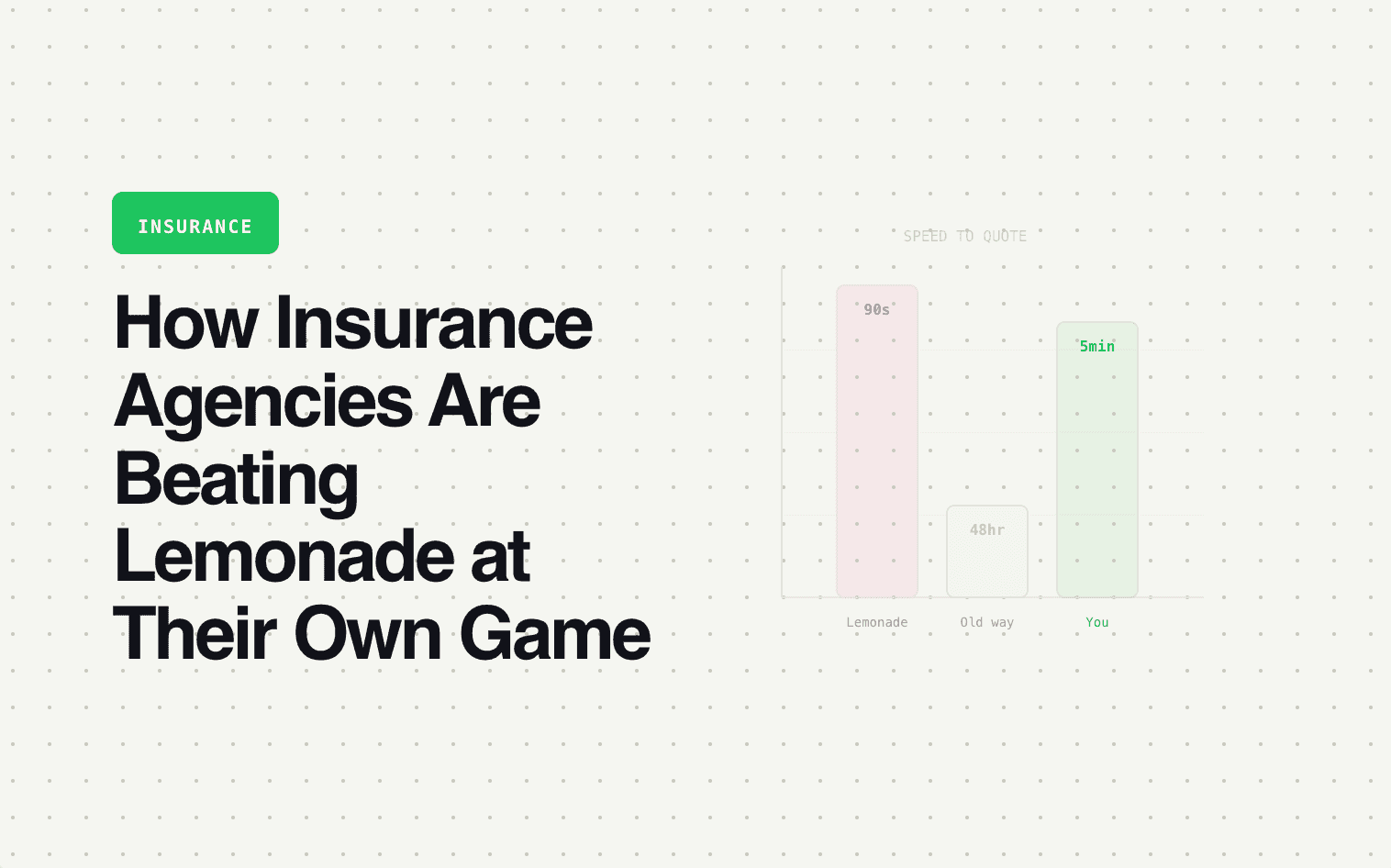
Lemonade, Root, and the other direct-to-consumer insurance carriers built their entire pitch on one thing: speed. Apply in 90 seconds. Get a quote in 3 minutes. Buy a policy before lunch.
Independent agencies have been losing market share to these carriers — not because their coverage is worse (it's usually better) or their prices are higher (they're often competitive), but because the buying experience is painfully slow by comparison. A prospect fills out a "Get a Quote" form, waits hours for a callback, spends 20 minutes on the phone giving the agent information the form should have captured, and then waits another day for the actual quote.
The agencies fighting back aren't hiring faster. They're building intake systems that match direct-to-consumer speed while offering the expertise and coverage options that carriers like Lemonade can't.
What the direct-to-consumer carriers got right
They made one strategic decision: capture all qualifying data upfront, in a self-service flow, and deliver a result immediately.
Lemonade's signup asks for address, property details, coverage preferences, and personal info in a conversational interface. By the end of the flow, the applicant has a quote. No waiting. No callback. No "someone will be in touch."
This works for simple, standardized policies. It falls apart for complex needs — multi-line coverage, commercial policies, unusual risk profiles, or anything requiring underwriting judgment. That's where independent agencies have the advantage. They just haven't built the experience to match.
What agencies can steal from the DTC playbook
Progressive risk capture on the form
Instead of name, email, phone, and "what type of insurance do you need?" — build forms that capture the actual risk data agents need to quote.
For auto: vehicle year/make/model, number of drivers, zip code, current coverage level, driving record (any accidents or tickets?). For home: property type, year built, square footage, zip code, current coverage, claims history. For life: age, tobacco use, general health status, coverage amount.
This data used to require a 20-minute phone call. On a multi-step form, it takes 2–3 minutes. The prospect doesn't mind answering because they expect it — they've been trained by Lemonade to provide details in exchange for a fast result.
Instant ballpark quote (not a binding quote — an expectation-setter)
After the form, show a ballpark range: "Based on your profile, most drivers in your area with similar coverage pay $120–$180/month." This isn't a binding quote. It's an expectation-setter that keeps the prospect engaged while the agent prepares the real quote.
The prospect gets something immediately (directional pricing). The agent gets a pre-qualified lead with full risk data. Both sides win.
Agent routing by license and carrier
The prospect's state and coverage type determine which agent can actually help them. Route by: state license (agents are licensed by state), carrier appointments (not every agent can write every carrier), line specialization (personal vs. commercial), and availability.
A commercial liability inquiry in Florida goes to a Florida-licensed producer with commercial carrier appointments — not into a generic queue.
Quote abandonment recovery
Insurance quote forms are longer than most B2B forms, so abandonment rates are higher — 35–50% of people who start don't finish. Capture partial submissions (any field completed before exit) and trigger recovery:
10 minutes after abandonment: "You were 2 minutes away from your quote. Pick up where you left off: [link]."
24 hours: "Still looking for coverage? Here's a simplified way to connect: [one-click scheduling link]."
72 hours: Final nudge with a different angle: "Most people in [zip code] save $X when they compare quotes. Want to see yours?"
Recovery rates of 15–25% are realistic — and these are leads you already paid to generate.
The results agencies are seeing
| Metric | Traditional intake | Surface-powered intake |
|---|---|---|
| Time from form submit to agent contact | 3–8 hours | Under 5 minutes |
| Quote completion rate | 35–45% | 55–65% (with abandonment recovery) |
| Quote-to-bind rate | 12–18% | 22–30% |
| Agent time per lead (pre-qualification) | 15–30 minutes | 2–3 minutes (data already captured) |
| Cost per bound policy | $300–$500 | $120–$200 |
The agencies winning aren't competing with Lemonade on technology. They're competing on experience — matching the speed while offering the expertise, carrier options, and advocacy that a direct-to-consumer chatbot can't provide.
Where Surface fits
Surface powers the intake experience that lets agencies compete on speed: multi-line quote forms with conditional risk questions, agent routing by license and carrier appointments, instant response with ballpark pricing, and quote abandonment recovery. All pushing pre-qualified leads into the agency management system.
The DTC carriers built a better front door. Surface lets agencies build one too — without the $100M in venture capital.