You saw the demo. The AI agent qualified a lead, routed it to the right rep, and sent a personalized follow-up — all in 10 seconds. Impressive. You bought it, deployed it, and two months later your sales team is complaining about leads going to the wrong people, follow-ups that sound unhinged, and a routing logic nobody can explain or override.
The demo worked. Production didn't.
This is the current state of GTM agents. The technology is real. The gap is in deployment, monitoring, and knowing when to use an agent versus a deterministic rule. Most teams skip all three.
Why demos lie
A GTM agent demo runs on clean data, a small lead set, and perfect conditions. Production runs on messy CRM data, 15 lead sources with inconsistent fields, reps who change territories without telling anyone, and edge cases the agent was never trained on.
The agent that routed beautifully in a sandbox starts hallucinating routing decisions when it encounters a lead with missing fields, an ambiguous company name, or a territory that was restructured last quarter. It doesn't throw an error. It just routes the lead somewhere — confidently, silently, wrongly.
This is the core problem with deploying agents into lead ops without guardrails. They don't fail loudly. They fail quietly, and the damage accumulates for weeks before anyone notices.
The failure modes nobody talks about
Here's what actually goes wrong when GTM agents hit production:
| Failure mode | What happens | How long it goes unnoticed |
|---|---|---|
| Hallucinated routing | Agent routes based on inferred data that's wrong — guesses territory, assumes deal size | Weeks. Reps just think they're getting bad leads. |
| Stale logic | Territories, reps, or qualification criteria change but the agent's context doesn't update | Until someone audits — often months |
| Silent breakdowns | Integration fails, agent stops processing a lead source, no alert fires | Days to weeks. Leads pile up unrouted. |
| Confidence without accuracy | Agent qualifies a lead as "high intent" based on shallow signals, skips real qualification | Ongoing. Inflates pipeline, wastes rep time. |
| Ungovernable personalization | Agent generates follow-up messages that are off-brand, factually wrong, or just weird | Until a prospect screenshots it and sends it to your team |
None of these show up in a demo. All of them show up in production.
What to measure
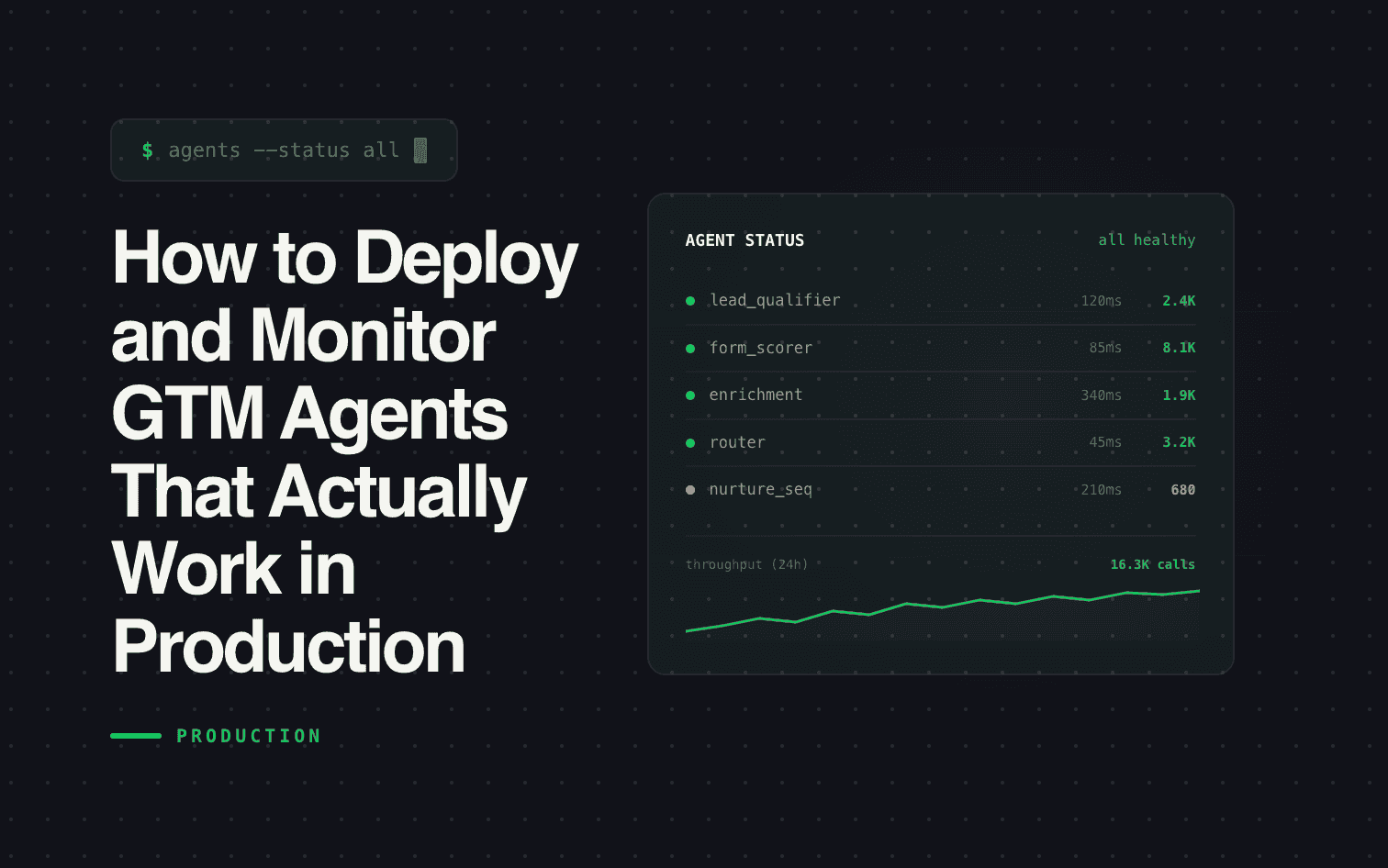
If you're running a GTM agent in your lead workflow, you need 5 metrics — and you need them in a dashboard, not a quarterly audit.
Routing accuracy. What percentage of leads were routed to the correct rep based on your actual rules? Pull a sample weekly. If accuracy drops below 90%, the agent is costing you more than it's saving.
Response latency. How long from form submission to first outreach? The agent should make this faster, not slower. If latency creeps up, something in the chain is breaking.
Fallback rate. How often does the agent fail to make a decision and dump the lead into a default queue? A healthy fallback rate is under 5%. Over 15% means the agent can't handle your actual lead diversity.
Qualification drift. Are the agent's qualification decisions consistent over time? Compare the agent's "high intent" labels against actual conversion rates monthly. If they diverge, the agent is pattern-matching on the wrong signals.
Override rate. How often do reps or managers manually re-route or re-qualify a lead the agent already processed? High override rates mean the team doesn't trust the agent — and they're probably right.
When to use agents vs. deterministic rules
Not everything in lead ops needs AI. This is the part most vendors won't tell you.
Use deterministic rules when the logic is clear and stable. If a lead from zip code 78701 should always go to Rep A, that's a rule. If leads under $10K ARR should route to the SMB team, that's a rule. Rules are fast, transparent, auditable, and they don't hallucinate.
Use agents when the decision requires judgment across multiple ambiguous inputs. If you need to evaluate a lead's company description, job title, stated use case, and browsing behavior to determine product fit — that's a reasonable agent use case. The inputs are unstructured and the logic can't be reduced to a simple if/then.
The best production setups use both. Deterministic rules handle the 80% of routing that's straightforward. Agents handle the 20% that requires interpretation. And there's a monitoring layer watching both.
Where Surface fits
Surface was built as the production infrastructure layer for lead ops — capture, qualification, routing, and response in one system with built-in monitoring.
That means deterministic routing rules that are transparent and instantly editable, agent-assisted qualification where it adds value, and a monitoring layer that tracks accuracy, latency, and drift in real time — not after a quarterly review.
If you've deployed a GTM agent and your main feedback channel is reps complaining in Slack, you don't have a production system. You have a prototype. That's the gap Surface was built to close.