
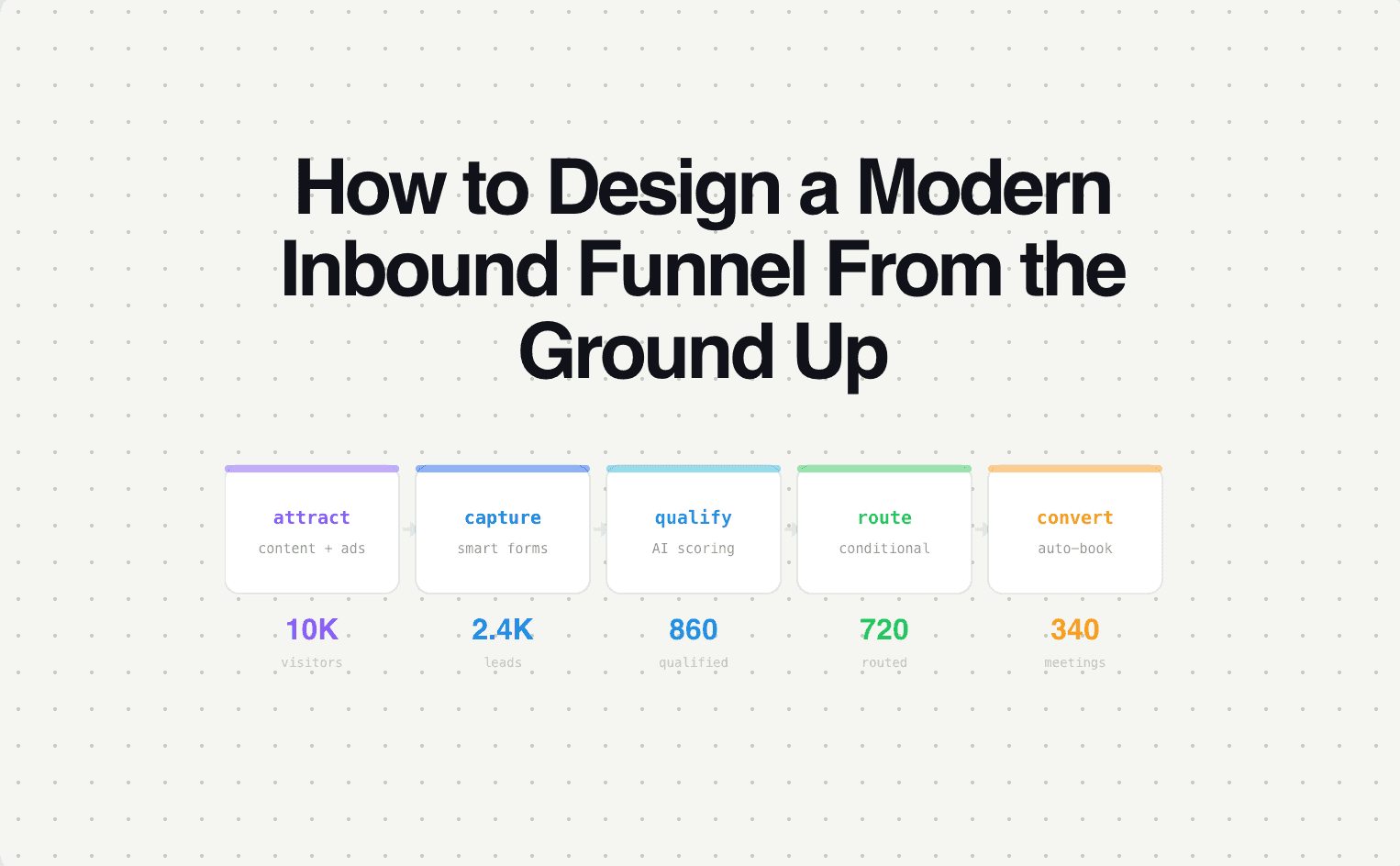
Most inbound funnels weren't designed. They were assembled — one tool at a time, one campaign at a time — until the "funnel" became a tangle of form tools, CRM workflows, Zapier connections, and spreadsheets that nobody fully understands and everyone's afraid to touch.
If you're building a new funnel or rebuilding a broken one, this is the architecture that works in 2025. It's not complicated, but it requires thinking about the funnel as one connected system instead of a series of independent tools.
The old funnel vs. the modern funnel
The difference isn't the stages — it's how they're connected.
| Stage | Old approach | Modern approach |
|---|---|---|
| Capture | Static form on a dedicated page. One format, one offer, one size fits all. | Multiple capture formats — contextual forms, exit-intent, embedded scheduling — triggered by visitor behavior |
| Qualification | SDR reviews the lead manually, makes a call to ask qualifying questions | Qualifying questions asked on the form. Lead is scored and segmented at capture. |
| Enrichment | Runs after routing — sometimes hours later. Blocks nothing, informs nothing. | Runs in parallel with qualification. Supplements the routing decision without blocking it. |
| Routing | Round-robin or manual assignment. No matching by territory, deal size, or product interest. | Attribute-based routing — territory, product, deal size, availability — evaluated in real time. |
| First response | Rep gets a CRM notification and calls when they see it. Average: 42 minutes to several hours. | Automated personalized response within 60 seconds. Rep follows up with full context. |
| Scheduling | Rep and lead go back and forth over email to find a time. | Embedded scheduling connected to routing — lead books on the matched rep's calendar in the same flow. |
The old funnel has 4–6 handoff gaps between tools. Each gap adds latency and creates a failure point. The modern funnel is one continuous flow — capture through meeting booked with no gaps.
Start with the outcome, not the top
Most teams design their funnel top-down: landing page → form → CRM → routing → follow-up. This creates a funnel optimized for capturing leads, not converting them.
Design bottom-up instead. Start with the outcome — a meeting booked on the right rep's calendar — and work backward.
What does the rep need to have a productive first conversation? Company size, budget, timeline, use case, and the lead's specific area of interest. If the rep doesn't have this, the first call becomes a qualification call instead of a sales conversation.
What routing logic puts the right lead with the right rep? Territory, product interest, deal size, and real-time availability. If you design routing first, you know exactly what data the form needs to collect.
What capture experience collects the right data without losing the visitor? A multi-step form with conditional logic that feels like a conversation, not an interrogation. The questions are determined by what routing and reps need downstream.
When you design backward, every element of the funnel serves the outcome. Nothing is captured that isn't used. Nothing is missing that the rep needs.
[IMAGE: A reverse-funnel diagram showing the design-backward approach: "Meeting booked" at the top, then "Rep needs: context, qualification data" → "Routing needs: territory, product, deal size" → "Form needs: qualifying questions + contact info" → "Capture needs: right format, right trigger, right moment." Arrows pointing upward. White background, blue (#4F6DF5) accent, flat design.]
The five layers of a modern inbound funnel
Layer 1: Capture. Multiple formats — demo request forms, contextual popups, exit-intent offers, embedded scheduling widgets, chatbot handoffs. Each format targets a different intent level. All formats feed into the same processing pipeline.
Layer 2: Qualification. Every lead is scored or segmented at the moment of capture based on form responses and enrichment data. High-intent leads route to sales immediately. Medium-intent leads enter a fast nurture track. Low-intent leads get automated resources.
Layer 3: Routing. Leads are matched to reps based on attributes — not assigned randomly. The routing engine evaluates territory, deal size, product interest, and rep availability in real time. If no match is found, the lead goes to a default queue with an SLA, not a black hole.
Layer 4: Response. The lead receives a personalized message within 60 seconds of form submission — referencing what they asked about and who's going to help them. This happens automatically, triggered by the routing decision.
Layer 5: Measurement. Every stage is instrumented. Speed-to-lead, routing accuracy, lead-to-meeting rate, and cost per meeting booked are tracked continuously — not in a quarterly report.
The non-negotiable: one connected system
The architecture only works if the layers are connected. If capture lives in Typeform, qualification happens in the CRM, routing runs through Zapier, and response is triggered by a separate email tool, you've rebuilt the old funnel with new labels.
The handoff between each layer is where leads leak. Eliminating handoffs — by running all five layers in one system — is what makes the modern funnel actually modern.
Where Surface fits
Surface was built to be the connected system — all five layers in one platform. Capture, qualification, routing, response, and measurement running as one continuous flow with no middleware, no sync delays, and no handoff gaps.
If you're designing a new funnel or rebuilding an old one, this is the architecture Surface delivers out of the box. The design work is in configuring the rules — not in wiring together the tools.