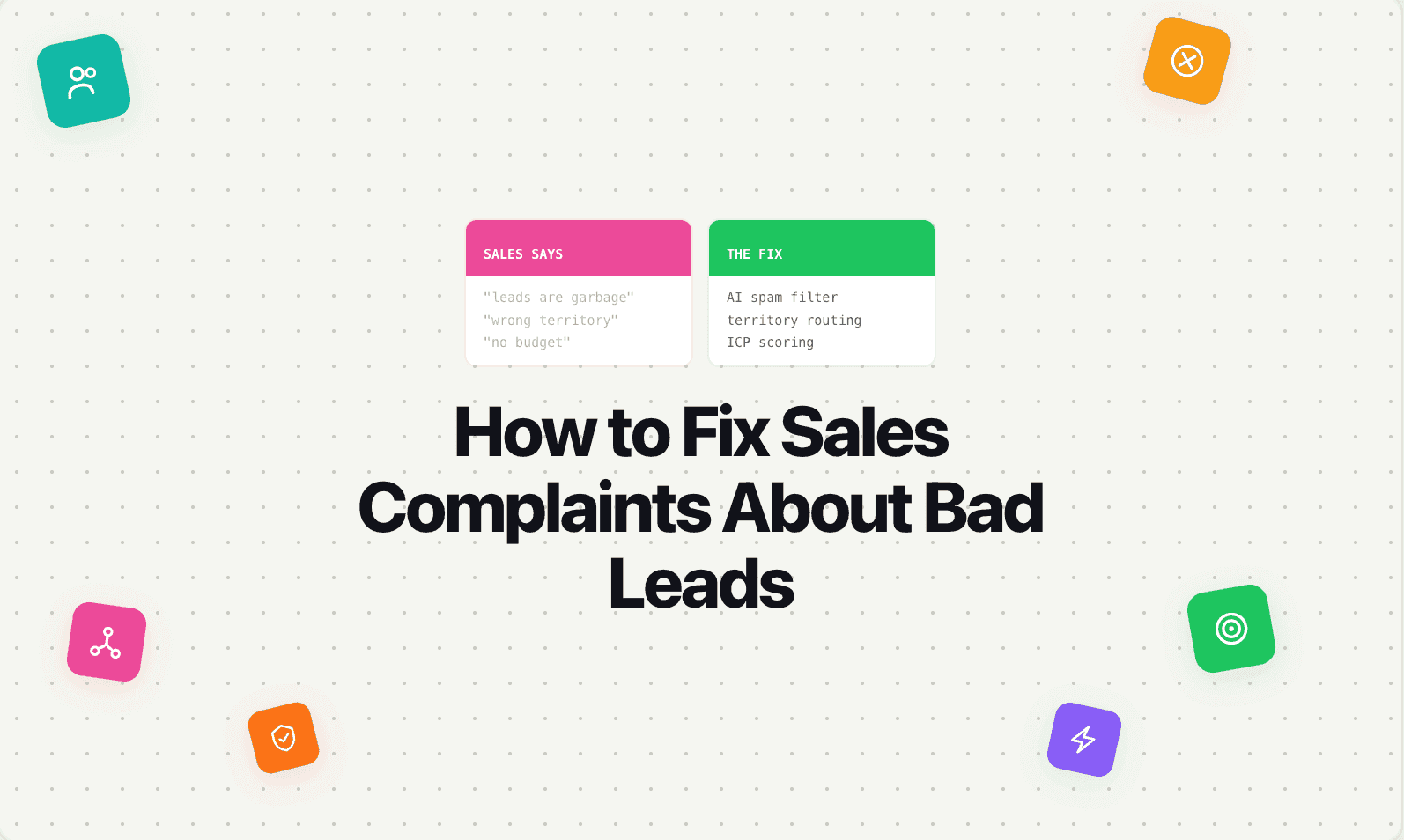
Every marketing team has heard it. "The leads are bad." It comes up in pipeline reviews, in Slack, in 1:1s with the CRO. Marketing points at the CPL and form volume. Sales points at their close rate and says half the leads they're getting aren't worth calling.
Both sides have a point. And neither side can fix it alone — because the problem usually isn't lead quality or sales effort. It's the gap between them.
What "bad leads" actually means
When a rep says a lead is bad, they usually mean one of five things. The fix is different for each.
| What the rep says | What they actually mean | What's broken |
|---|---|---|
| "This lead isn't in our ICP" | Company is too small, wrong industry, or wrong geo | No qualification at capture — form doesn't ask the questions that would filter this out |
| "This lead isn't ready to buy" | No budget, no timeline, just browsing | Lead scored on activity, not intent. Downloaded a whitepaper ≠ ready for a call |
| "I already talked to this person" | Duplicate lead or re-entry from a different campaign | No deduplication across lead sources |
| "This lead went to the wrong person" | Territory mismatch, product mismatch, deal size mismatch | Routing logic doesn't account for the variables that matter |
| "I can't get this person on the phone" | Lead submitted a form days ago and has moved on | Speed-to-lead too slow — lead went cold before anyone reached out |
The first two are quality problems. The last three are infrastructure problems. Most teams assume it's all quality and try to fix it by tightening ad targeting or raising the MQL bar. That helps with the first two — but it doesn't touch the last three, which are often the bigger issue.
[IMAGE: A simple pie chart or split bar showing "What sales calls 'bad leads'" — left segment labeled "Actually unqualified (40–50%)" and right segment labeled "Infrastructure failures — wrong rep, slow follow-up, duplicates (50–60%)." Clean, minimal, white background, blue (#4F6DF5) accent, flat design.]
The real diagnosis
Before you change your ad targeting or redefine your MQL criteria, run this audit:
Pull your last 100 leads that sales marked as "bad." Categorize each one using the five reasons above. Most teams find that 40–60% of "bad" leads are actually infrastructure failures — wrong routing, slow follow-up, or duplicates — not genuinely unqualified leads.
That means nearly half the leads sales is complaining about were real prospects who got a bad experience. They weren't bad leads. They were badly handled leads.
This is the diagnosis that changes the conversation from "marketing needs to send better leads" to "we need to fix what happens after the lead comes in."
Fix the infrastructure first
Add qualification questions to your forms. Budget range, company size, timeline, and use case — 3–4 questions that filter out genuinely unqualified leads at the point of capture. This addresses the "not in ICP" and "not ready to buy" complaints directly. When a lead makes it through a qualifying form, the rep can trust it's worth their time.
Fix your routing. If leads are going to the wrong rep, the rep's experience of "bad leads" is really an experience of "leads I shouldn't have gotten." Route by territory, product interest, deal size, and availability. When reps get leads that match their expertise, their perception of lead quality improves immediately — even if the leads themselves haven't changed.
Fix your speed-to-lead. A lead that was genuinely interested when they submitted the form becomes a "bad lead" when they're contacted 6 hours later and don't pick up. The lead didn't go bad — the window closed. Get response time under 60 seconds and a meaningful percentage of "bad leads" become booked meetings.
Deduplicate across sources. If the same person fills out a form on your website and also comes in through a third-party lead provider, and both get routed to different reps, the second rep will mark the lead as "bad — already in conversation." That's not a lead quality problem. It's a data hygiene problem that should be handled at capture.
Build shared visibility
The deeper issue behind the "bad leads" complaint is that marketing and sales are looking at different dashboards. Marketing sees form volume, CPL, and MQL count. Sales sees qualified opportunities and close rate. Nobody sees the full picture from capture through conversation through outcome.
When both teams can see the same data — how fast leads are contacted, how they're routed, what qualification data was captured, and which leads converted — the finger-pointing stops. Marketing can see when good leads die in routing. Sales can see that the lead they ignored at 5 PM on Friday was actually a perfect fit. The conversation shifts from "your leads are bad" to "here's where the process broke."
Where Surface fits
Surface gives both teams a shared view of the entire lead lifecycle — from form fill to meeting booked to outcome. Qualification happens at capture, routing matches leads to the right rep, and speed-to-lead is measured in seconds.
If your sales team is calling leads "bad" and your marketing team is pointing at CPL, the argument isn't going to be settled by either side. It's going to be settled by infrastructure that handles leads well enough that both teams can see what's actually happening. That's what Surface was built to do.