
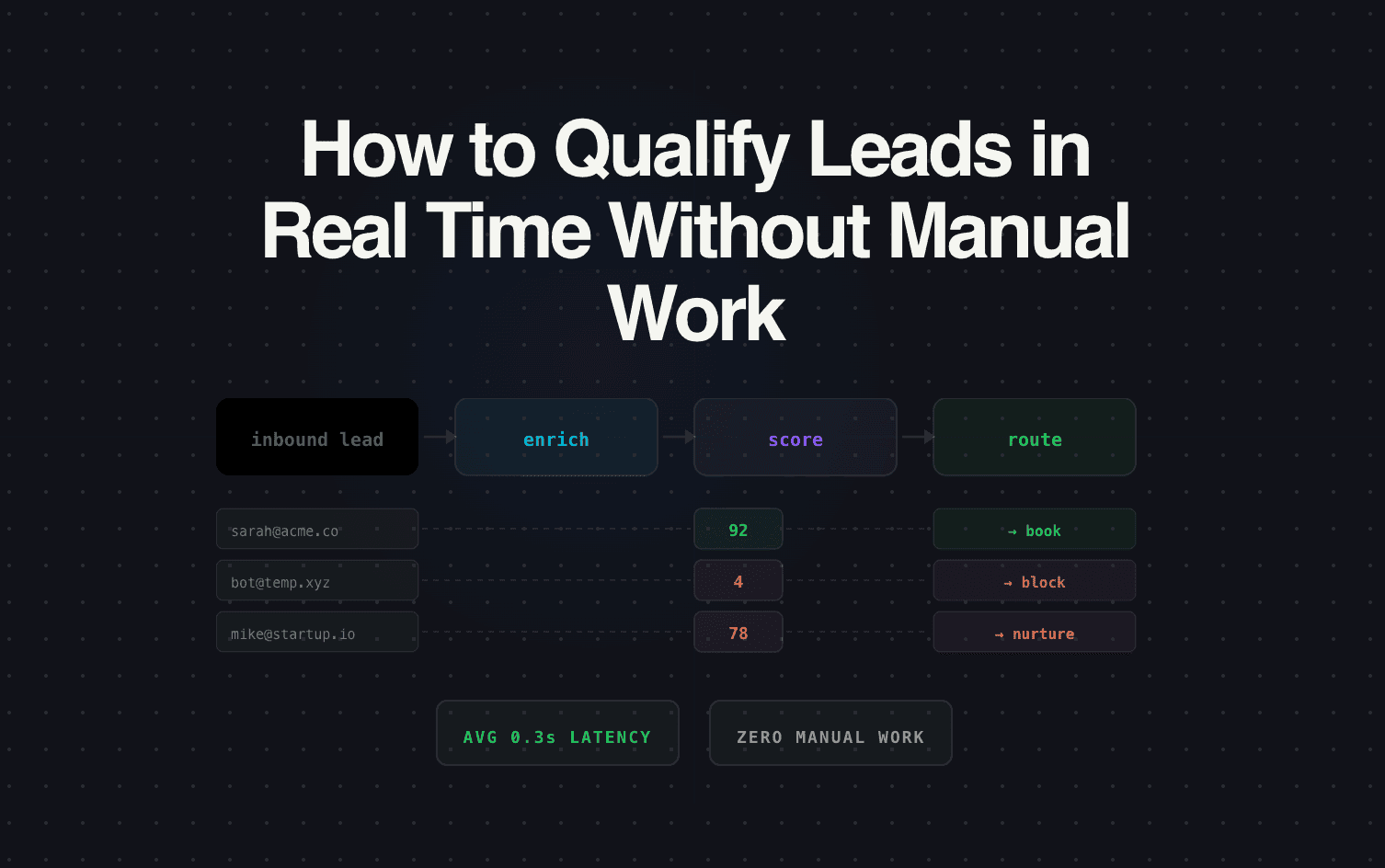
A lead comes in. Someone has to look at it, decide if it's worth sales' time, and route it. Maybe that's a marketing ops person. Maybe it's the rep themselves, spending 10 minutes Googling the company before deciding to call.
At 20 leads a day, you can eyeball it. At 200, you can't. And the leads that don't get reviewed fast enough sit in a queue getting colder by the minute while qualified prospects book meetings with your competitors.
The problem with how most teams qualify leads
Most B2B teams do one of three things. They send everything to sales unfiltered, which means reps waste half their day on leads that were never going to close. They build a lead scoring model with manual point values, which works for about a quarter before the ICP changes and nobody recalibrates it. Or they have someone in ops manually review every lead before routing it, which is accurate but slow and doesn't scale.
All three break for the same reason. Qualification is happening after the lead is already in the system. The form collects a name and email, dumps it into the CRM, and then your team scrambles to figure out what to do with it.
By the time anyone decides this lead is worth talking to, the prospect filled out two other forms somewhere else.
What real time qualification actually means
It means the lead is qualified before they finish the form. Not after submission. Not in a CRM workflow. During the form fill itself.
Here's what's actually happening behind the scenes when a prospect starts filling out a form with real time qualification:
They type their work email. Instantly, the system validates the domain. Does this company actually exist? Is it a disposable email provider? That alone filters out a chunk of junk. But it also triggers enrichment. From that one email, you now know the company name, employee count, industry, estimated revenue, HQ location, and tech stack. The prospect hasn't even moved to the next field yet.
They answer a few questions. Company size, their role, what they're looking for. The form uses conditional logic, so an enterprise VP sees different follow up questions than an individual contributor at a startup. Each answer narrows the qualification path.
By the time they reach the last step, the system has evaluated everything, their form responses, the enrichment data, the email signals, against your ICP criteria. The lead is already scored and classified. Qualified leads see a calendar and book. Disqualified leads get a polite thank you page. Edge cases get flagged for review.
The rep never has to decide if this lead is worth calling. That decision was made in real time, with better data than the rep would've had anyway.
Where the data comes from
This only works if there's enough signal to make a real decision. A name and email isn't enough. Here's what a properly set up real time qualification system is actually evaluating:
| Signal source | What it provides | When it's available |
|---|---|---|
| Email address | Domain validation, company match, disposable email detection | The second they type it |
| Real time enrichment | Employee count, industry, revenue, tech stack, HQ location | Within milliseconds of email entry |
| Form responses | Company size, role, use case, budget, timeline | As they answer each question |
| Conditional logic paths | Which branch they went down, what questions they saw | During the form fill |
| Behavioral data | Pages visited before the form, sessions, content consumed | Already captured before they started |
That's 15 to 20 data points available before the prospect clicks submit. Most teams don't have that data assembled until hours after submission, if ever.
The scoring decision
Once you have the data, the actual qualification decision is the easy part.
You define your ICP. Not as a point system with arbitrary values. Just describe what a good customer looks like. Series B+ SaaS companies. 50+ employees. VP or Director level. Evaluating lead ops or marketing automation tools.
Every lead gets evaluated against that definition using all the signals above. The output is simple: qualified, disqualified, or needs review. Not a number on a scale of 1 to 100 that nobody knows how to interpret. A clear decision your team can act on.
The qualified leads route to the right rep and see the right calendar. Immediately. The disqualified leads don't waste anyone's time. The edge cases get surfaced for a human to make the call, but that's 10 to 15% of leads, not 100%.
What this actually changes day to day
Your reps stop spending the first 15 minutes of every lead interaction researching whether the lead is worth their time. They open their calendar and every meeting is already with a qualified prospect. They have full context, company data, what the prospect told you, what pages they visited, before the call starts.
Marketing stops arguing with sales about lead quality. There's a clear, consistent standard that both teams agreed on. The leads that reach sales matched the ICP. The ones that didn't were filtered before they got there.
Ops stops maintaining a scoring model that breaks every time someone changes a form field. The qualification criteria live in one place, described in plain language, and update dynamically when the ICP shifts.
Where to start
Look at your last 50 leads. How many had enough data at the time of submission for someone to make a qualification decision without doing additional research? If the answer is less than half, the problem isn't your qualification process. It's your data collection.
Surface Labs runs enrichment, scoring, and routing inside the form. Leads get qualified in real time based on form responses and enriched company data, and they route to the right rep before the prospect leaves the page. If your team is still qualifying leads after they hit the CRM, it's probably worth a look.