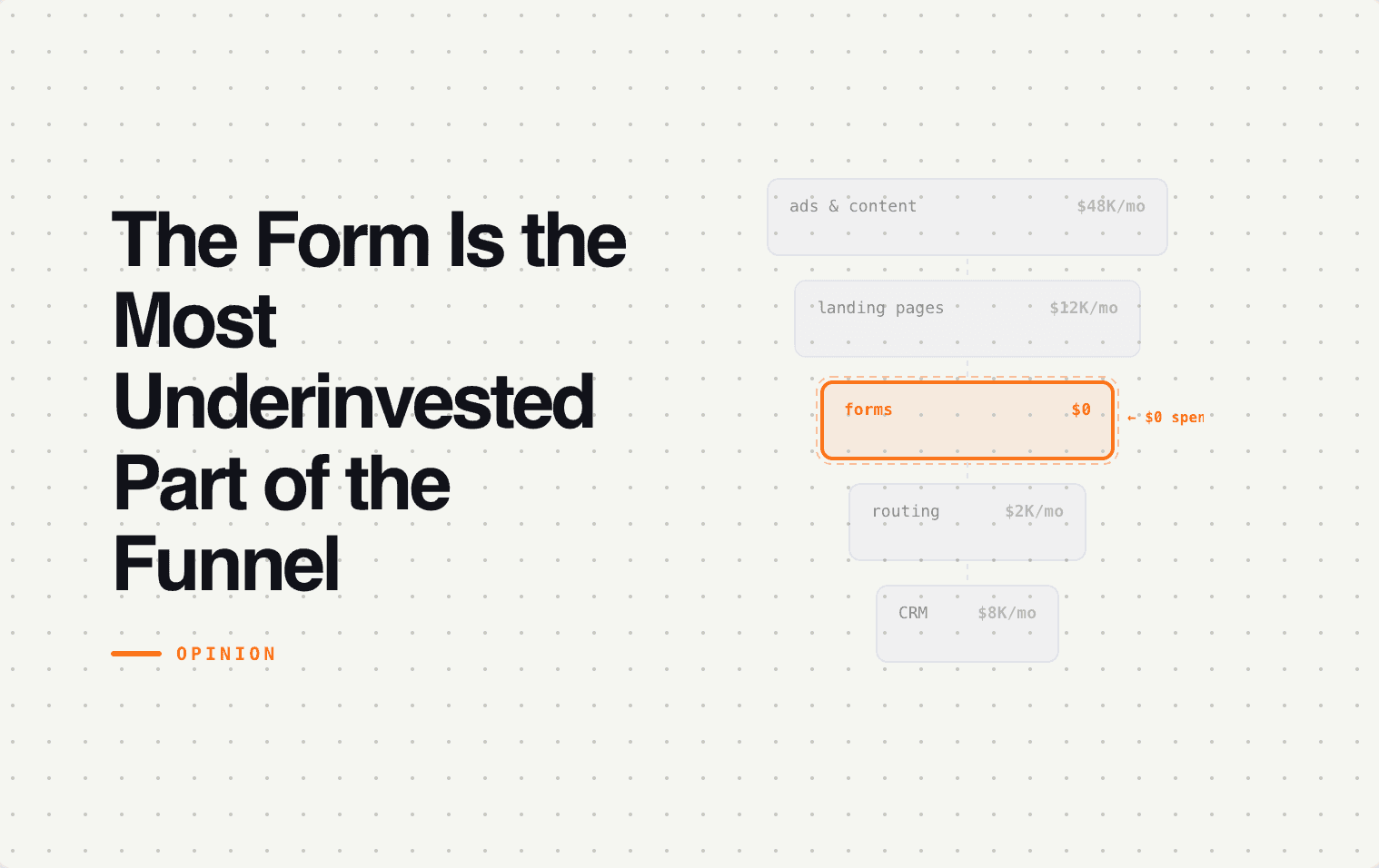
Your company spends $50K/month on ads. You have a dedicated team managing creative, targeting, and bid strategy. Your landing pages have been A/B tested 15 times. Your CRM has a full-time admin. Your sales team has engagement tools, call recording, and pipeline analytics.
And the form — the single conversion point that sits between all of that investment and actual pipeline — is a default HubSpot form that hasn't been updated since 2023. Four fields. No conditional logic. No qualification. No connection to routing. No scheduling. Just name, email, company, and a submit button.
The form is the most underinvested part of the funnel. And it's costing more than most teams realize.
Why forms get ignored
Forms get ignored because they feel solved. Every CRM comes with a form builder. It takes 5 minutes to create one. You drop it on a page, it collects submissions, and those submissions appear in the CRM. Done.
Except it's not done. That 5-minute form is a dead end — it captures data but doesn't qualify, doesn't route, doesn't respond, and doesn't schedule. Everything that happens after the submit button is handled by other tools, other teams, and other timelines. The form starts the process but contributes nothing to its success.
Teams invest in everything around the form — the traffic that drives people to it, the page that houses it, the CRM that receives its data, the reps who follow up on its submissions — but they treat the form itself as a commodity. A checkbox. The bare minimum between "visitor" and "lead."
What a form should actually do
A modern form isn't a data collection field. It's a conversion engine that does five jobs in one interaction.
Capture. Obviously. But smart capture means adapting to the visitor — showing different questions based on behavior, pre-filling known data from enrichment, and recovering abandoned submissions instead of losing them.
Qualify. The form should ask the 3–4 questions that determine whether this lead is worth sales' time and how urgently they should be contacted. Budget, timeline, company size, use case. These are the questions the SDR asks on the first call — moved upstream to the point of highest engagement.
Route. Based on the lead's answers, the form should determine which rep gets the lead. Territory from geography. Deal size from budget. Product match from use case. This decision should happen at form submission, not 30 minutes later in a CRM workflow.
Respond. The moment routing happens, the lead should get a personalized response — the matched rep's name, a reference to what they asked about, and a clear next step. Not "thanks, we'll be in touch."
Schedule. The lead should be able to book directly on the matched rep's calendar without leaving the form flow. The commitment that drove them to fill out the form is highest right now — any delay between submission and scheduling reduces the chance of a booked meeting.
Most forms do job 1 and nothing else. That's why the form-to-meeting rate is so low at most companies — the form starts the process but the process doesn't continue until a human intervenes.
The math on form underinvestment
Consider a company getting 200 demo form submissions per month.
With a basic form (capture only), the post-form process is manual: SDR reviews, calls to qualify, routes if appropriate, tries to schedule. Typical lead-to-meeting rate: 12%. Meetings booked: 24.
With a smart form (capture + qualify + route + respond + schedule), the process is continuous: lead submits, is qualified and routed in real time, gets an instant personalized response, and can book immediately. Typical lead-to-meeting rate: 30%. Meetings booked: 60.
Same traffic. Same ad spend. Same landing page. 36 additional meetings per month — from investing in the form.
At a $50K/month ad spend, the basic form produces meetings at $2,083 each. The smart form produces meetings at $833 each. The difference — $45K/month in effective savings — comes from a part of the funnel that most teams haven't touched in years.
Why this is a strategic investment, not a tactical tweak
Optimizing the form isn't the same as changing a button color. It's restructuring where qualification, routing, and scheduling happen in your funnel. When you move those functions to the form, you're not making a marginal improvement — you're eliminating entire process steps that currently depend on human speed and attention.
The SDR who used to spend 5 minutes qualifying every lead on the phone now gets leads pre-qualified with full context. The manager who used to manually reassign mis-routed leads doesn't need to. The lead who used to wait 4 hours for a follow-up email now books a meeting in 30 seconds.
The form is the leverage point. Everything upstream drives people to it. Everything downstream depends on what it captures and triggers. Underinvesting in it means underinvesting in the single point where all your marketing spend converts — or doesn't.
Where Surface fits
Surface was built to make the form do all five jobs — capture, qualify, route, respond, and schedule — in one continuous interaction. It replaces the default CRM form with a conversion engine that turns more of your existing traffic into qualified meetings.
If your form is still four fields and a submit button, that's the highest-ROI improvement sitting on your site right now.