
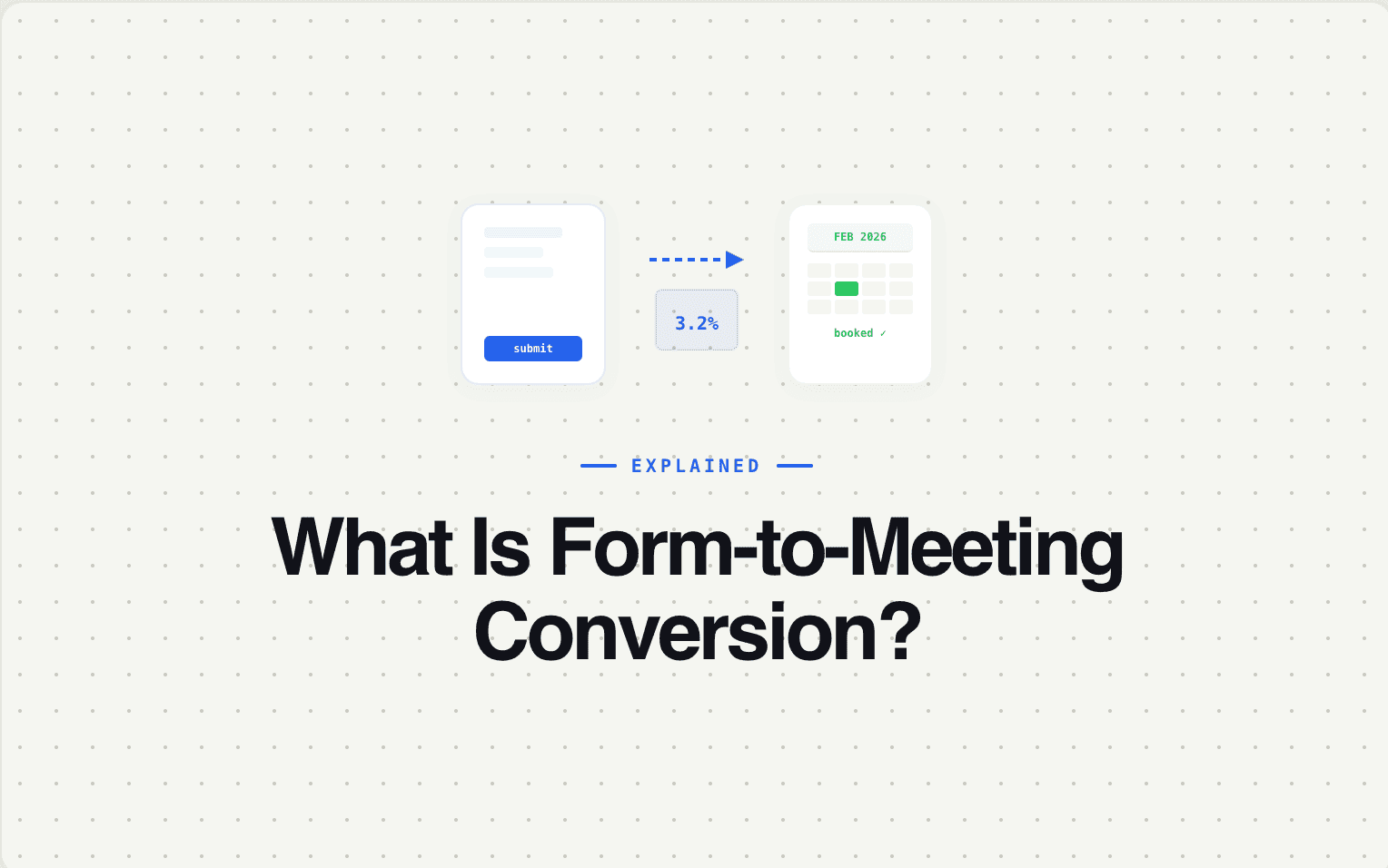
Form-to-meeting conversion is the percentage of people who fill out a form on your website and end up with a meeting booked on a sales rep's calendar. It's the most honest metric in B2B lead generation — and the one most teams don't track.
Why this metric matters
Most B2B marketing teams track form conversion rate (visitors who complete a form) and pipeline (deals in the CRM). But they don't connect the two. The gap between "someone filled out a form" and "someone booked a meeting" is where the majority of marketing spend gets wasted — and it's invisible in most dashboards.
A company generating 200 form submissions per month with a 12% form-to-meeting rate books 24 meetings. The same company with a 30% form-to-meeting rate books 60 meetings — from the same traffic, the same ads, the same spend. The difference is entirely in what happens after the form submit.
How to calculate it
The formula is simple:
Form-to-meeting rate = Meetings booked ÷ Form submissions × 100
If you got 200 form submissions last month and 30 resulted in booked meetings, your form-to-meeting rate is 15%.
For this metric to be useful, count only form submissions from high-intent forms — demo requests, contact forms, pricing inquiries. Don't include newsletter signups or content downloads, which have a different intent level and shouldn't be measured against meeting conversion.
What good looks like
| Form-to-meeting rate | Rating | What's typically happening |
|---|---|---|
| 30–40% | Top quartile | Qualification at capture, attribute-based routing, instant personalized response, embedded scheduling. Everything between form and meeting is automated and optimized. |
| 18–25% | Above average | Decent speed-to-lead, basic routing that mostly works, some qualification. Room for improvement in response personalization and scheduling connectivity. |
| 10–17% | Average | This is where most B2B teams land. Leads are captured but follow-up is slow, routing is round-robin, and there's no embedded scheduling. |
| 5–9% | Below average | Significant infrastructure gaps. Leads are waiting hours for follow-up, going to the wrong rep, or getting generic autoresponders. |
| Under 5% | Critical | Lead ops is effectively broken. Most form submissions never result in a real conversation. |
What drives form-to-meeting conversion
Five factors determine your form-to-meeting rate, in order of impact:
Speed-to-lead. How fast the lead is contacted after submitting. Under 60 seconds = top quartile. Over 30 minutes = significant conversion loss. This is the single highest-leverage variable.
Routing accuracy. Whether the lead gets matched to the right rep. Wrong rep = lower conversion + delay from manual reassignment.
Qualification at capture. Whether the form collects enough data to route intelligently and give the rep context. Name/email/company is not enough.
Response personalization. Whether the first message references what the lead asked about and who's going to help them, versus a generic "we'll be in touch."
Scheduling connectivity. Whether the lead can book directly on the matched rep's calendar in the form flow, versus waiting for a Calendly link in a follow-up email.
How to start tracking it
If you're not currently tracking form-to-meeting conversion, here's the minimum viable setup:
Step 1: Tag every form submission with a unique identifier that persists through to the CRM.
Step 2: Track when a meeting is booked for each form-submitted lead — either through calendar integration or manual tracking in the CRM.
Step 3: Calculate the rate monthly, broken down by form type and lead source. The breakdowns are more useful than the aggregate number because they tell you where the problem is.
If connecting form submission data to meeting data requires pulling from 3+ systems, that's a sign your tools aren't connected well enough to optimize this metric.
Where Surface fits
Surface tracks form-to-meeting conversion natively — because capture, routing, and scheduling all happen in one system. There's no stitching required. The metric is available in real time, segmented by form, source, and routing rule.
If you've never tracked your form-to-meeting rate, that's the most important number you're not measuring. Surface makes it the default metric, not an afterthought.