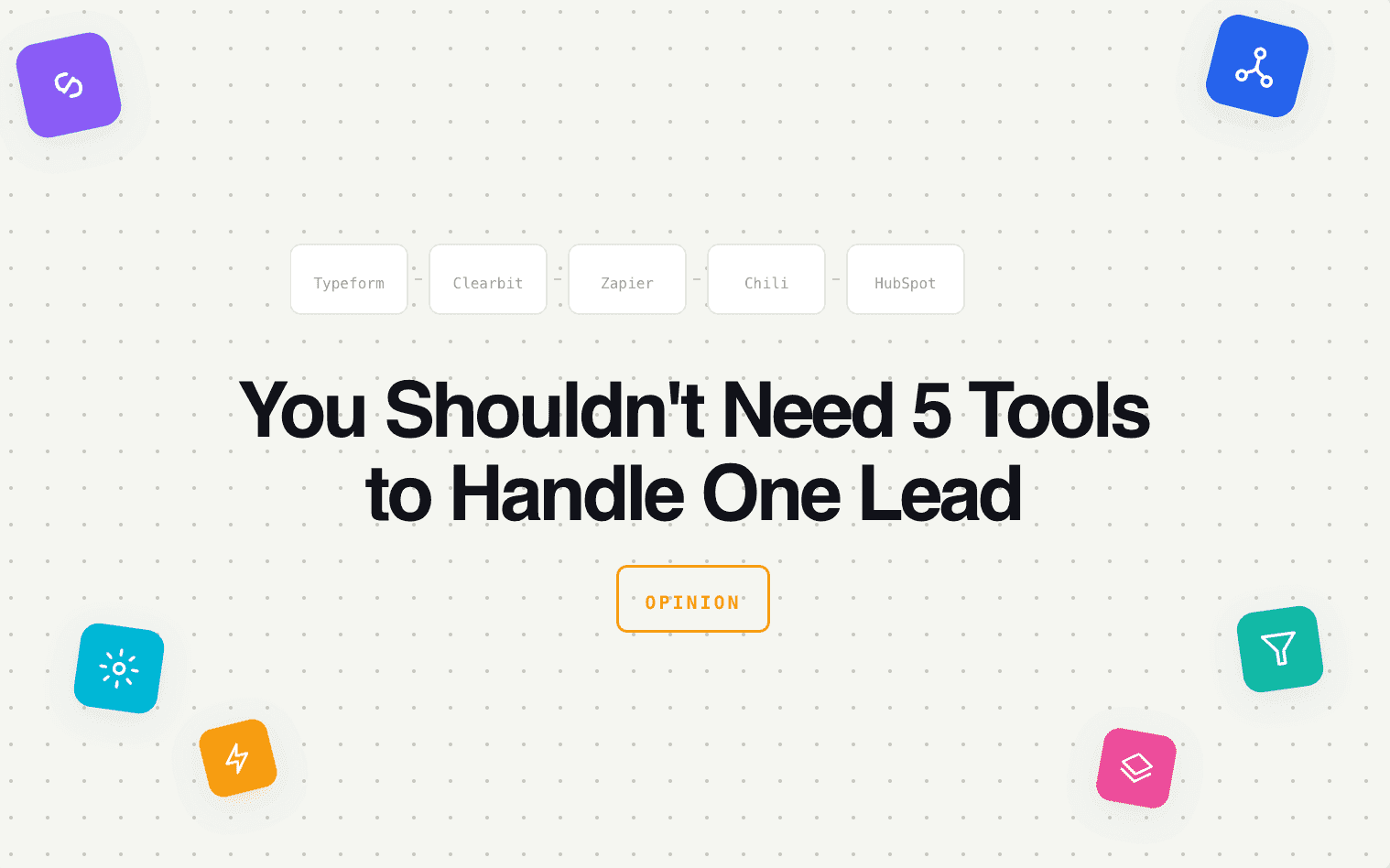
A visitor fills out your demo request form. Here's what happens next in the average B2B company:
Tool 1: Typeform captures the submission. Tool 2: Zapier pushes the data to HubSpot. Tool 3: Clearbit enriches the lead with company data. Tool 4: A HubSpot workflow routes the lead to a rep (or tries to — it round-robins because the routing logic can't handle anything more complex). Tool 5: The rep gets a Slack notification, opens the CRM, reviews the lead, and manually sends a Calendly link.
Five tools. Three integrations. Two potential failure points. And the lead is still waiting for a human to notice they exist.
This isn't a broken system. This is the default system. It's how most B2B companies handle inbound leads because each tool was adopted to solve a specific problem, and nobody stepped back to ask whether one tool could solve all of them.
What five tools actually costs
The direct costs are obvious — subscription fees for each tool, plus Zapier task costs for the middleware. Most teams spend $500–$2,000/month just on the stack between form and CRM.
But the indirect costs are bigger:
| Cost | What's happening | Annual impact |
|---|---|---|
| Latency | Each tool-to-tool handoff adds 1–5 minutes. A 5-tool chain adds 5–20 minutes before the lead is even assigned to a rep. | 3–5x lower contact rate vs. sub-60-second response |
| Failure risk | Each integration is a failure point. A Zapier that breaks, a webhook that times out, an API rate limit that silently drops leads. | 5–15% of leads lost to silent integration failures per quarter |
| Maintenance | Any change — new CRM field, updated routing rules, different form — requires updating multiple tools and testing every connection. | 5–10 hours/week of ops time spent maintaining integrations |
| Visibility gap | No single tool sees the full journey. Form data is in one system, routing data in another, outcomes in a third. | No way to measure cost per meeting or identify where leads drop off |
| Debugging time | When a lead doesn't get routed correctly, finding the failure requires checking each tool's logs individually. | 30–60 minutes per incident, happening weekly |
The total cost of the 5-tool chain isn't $500–$2,000/month in subscriptions. It's tens of thousands of dollars per year in lost leads, wasted ops time, and slower conversion — all because the tools weren't designed to work as one system.
Why this happened
Nobody set out to build a 5-tool lead flow. It happened incrementally:
"We need a form tool." Typeform. "We need to get form data into the CRM." Zapier. "We need better lead data." Clearbit. "We need to route leads to reps." CRM workflow. "We need faster notifications." Slack integration.
Each decision made sense individually. But collectively, they created an architecture where no single tool is responsible for the lead experience and no single team can see or control the full flow.
The tell is when someone asks "what happens after a lead fills out our form?" and nobody can answer confidently without checking three dashboards.
What one tool looks like
One tool doesn't mean one tool for everything — you still need a CRM, you still need an ad platform, you still need a website. "One tool" means one tool for the lead ops layer — the capture-to-meeting flow that currently requires 5.
In a consolidated setup:
The form captures and qualifies. Multi-step, conditional logic, qualifying questions built in. No separate form tool needed.
Enrichment runs at capture. Company data is appended in real time, supplementing the form responses. No separate enrichment integration needed.
Routing happens instantly. The lead is matched to the right rep based on form data + enrichment — territory, deal size, product interest, availability. No CRM workflow needed.
Response fires immediately. Personalized message within 60 seconds — rep's name, reference to what the lead asked about, scheduling link. No separate notification tool needed.
The CRM gets a clean, routed, enriched record. One sync, one integration, one record. The CRM does what it's good at — pipeline management and reporting — while the lead ops layer does everything upstream.
[IMAGE: A simple comparison. Left side: 5 disconnected tool icons (Form → Zapier → CRM → Enrichment → Slack) with dotted lines between them and a label "5 tools, 3 integrations, 15+ min latency." Right side: one unified icon labeled "Lead Ops" with a single arrow to a CRM icon and a label "1 tool, 1 integration, < 60 sec." White background, blue (#4F6DF5) accent, flat design.]
The consolidation test
Ask yourself these three questions:
Can you trace a lead from form submit to meeting booked without checking more than one system? If no, your tools aren't connected well enough to give you visibility.
Can you change a routing rule and have it take effect in under 5 minutes? If no, your routing logic is locked inside a tool that's too complex or too disconnected to be agile.
If one integration breaks tonight, will you know before a lead is lost? If no, your system has silent failure points that are costing you leads you'll never know about.
If you answered "no" to any of these, you're paying the 5-tool tax.
Where Surface fits
Surface replaces the 5-tool chain with one lead ops layer — capture, qualification, enrichment, routing, response, and CRM sync in a single system. One tool to manage. One integration to maintain. One place to see the full lead journey.
If your lead flow currently requires a Zapier flowchart to explain, Surface was built to replace it.