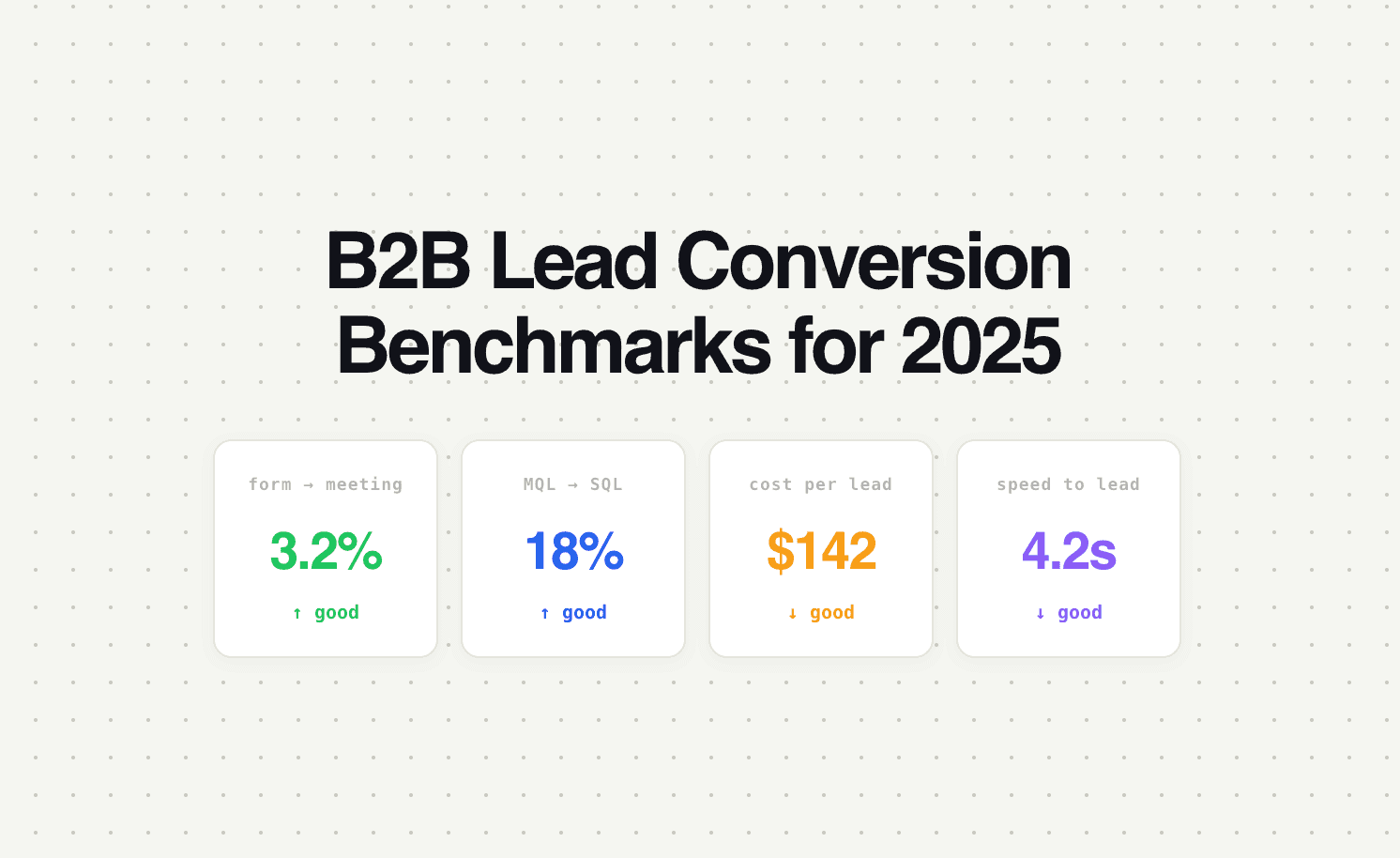
Most B2B marketing teams chase more traffic when the real opportunity sits in front of them: converting visitors they already have. If your site gets 10,000 monthly visitors at a 2% conversion rate, that's 200 leads. Push that to 3%, and you've added 100 leads per month without spending another dollar on ads.
The gap between average and high-performing B2B conversion rates comes down to systematic optimization across forms, lead capture, qualification, routing, and follow-up. This guide breaks down exactly how to improve your B2B website conversion rate using strategies that deliver 30-50% lifts in under two weeks.
What is B2B conversion rate optimization?
B2B conversion rate optimization is the process of increasing the percentage of website visitors who complete a desired action—filling out a demo request form, booking a meeting, downloading a resource, or starting a free trial. Unlike B2C, B2B CRO accounts for longer buying cycles, multiple stakeholders, and higher-value transactions that require trust and proof at every step.
According to First Page Sage's 2026 analysis of B2B conversion benchmarks, the median B2B conversion rate is 2.9%, with legal services topping the charts at 7.4%. B2B SaaS companies typically see visitor-to-lead rates around 1.5-2.5%, while top-performing companies consistently hit 8-15% conversion rates on demo request forms—a 3-5x difference from the average.
How to calculate your B2B conversion rate
The basic formula:
Conversion Rate = (Conversions ÷ Total Visitors) × 100
If your landing page received 1,000 visitors and 45 filled out your demo form, your conversion rate is 4.5%.
Track conversions at multiple funnel stages to identify where you're losing leads:
- Visitor-to-lead rate (form submissions)
- Lead-to-MQL rate (qualification)
- MQL-to-meeting rate (booked demos)
- Meeting-to-opportunity rate (pipeline creation)
Most teams focus only on top-of-funnel metrics and miss the breakage happening after form submission, where 30-40% of leads are lost to slow routing, poor qualification, or no follow-up.
9 proven ways to improve B2B conversion rates
1. Replace static forms with intelligent multi-step forms
Traditional single-page forms with 8+ fields create massive friction. Multi-step forms break the process into digestible chunks, reducing cognitive load and improving completion rates by 20-30%.
More importantly, intelligent forms capture partial submissions—email addresses and contact data from visitors who start your form but don't click submit. Research from Insiteful shows that 81% of users abandon forms after starting them, meaning you could be losing four out of every five potential leads without partial capture.
A Venture Harbour study found multi-step forms convert 86% higher than single-page equivalents, while some implementations documented conversion increases by up to 300%. The Zeigarnik effect—our psychological tendency to complete tasks we've started—drives users through sequential steps more effectively than confronting them with all fields at once.
Modern lead capture forms include:
- Progressive profiling that asks different questions to returning visitors
- Built-in qualification questions (company size, budget, timeline)
- Real-time enrichment to auto-fill company and role data
- Partial submission capture to recover abandoned form data
- Immediate routing and follow-up automation
Nextvia increased conversions by 37% simply by switching to a multi-step form that captured partial data and reduced initial friction.
2. Add qualification at the point of capture
Bad leads waste sales time and tank your conversion metrics. The solution isn't more post-submission filtering—it's building qualification into your forms before leads enter your pipeline.
High-performing teams ask 3-4 qualification questions right in the form:
- Company size or revenue range
- Current solution or tech stack
- Timeline to purchase
- Budget or buying authority
This serves two purposes: it filters out genuinely unqualified leads at capture, and it arms sales with the context they need to prioritize and personalize outreach. Lead scoring happens in real time, routing hot leads immediately and sending lower-intent contacts to nurture.
According to Landbase's 2026 lead qualification research, properly scored and qualified leads achieve 40% conversion rates versus 11% for unqualified prospects. Companies using automated lead qualification see an average 20% increase in lead conversion rates and 10% or greater revenue growth within 6-9 months.
3. Implement speed-to-lead automation
Speed-to-lead is the single strongest predictor of conversion. According to Kixie's 2025 research, responding within 60 seconds can boost conversions by 391%, while Harvard Business Review found the odds of qualifying a lead drop by 80% after the first 5 minutes. Yet the average B2B response time is 42-47 hours, with 55% of companies taking 5+ days or never responding at all.
The data is clear: 78% of customers buy from the vendor who responds first. Speed compounds the advantage.
The fix is automation:
- Instant lead routing to the right sales rep based on territory, product fit, or account ownership
- Auto-scheduled meetings embedded directly in forms or thank-you pages
- Immediate follow-up emails with relevant case studies and next steps
- Enrichment and deduplication to prevent spam leads from reaching sales calendars
Kintsugi prevented fake leads from spamming their sales calendar and increased pipeline by 30% by automating enrichment, routing, and qualification in real time.
4. Simplify your conversion path
Every extra click, field, or navigation option between your visitor and your conversion goal costs you leads. High-converting B2B landing pages share these traits:
- Focused messaging: One clear value proposition, not three competing offers
- Minimal form fields: 3-5 essential fields only (name, email, company)
- Single call-to-action: No competing CTAs or navigation that bleeds traffic
- Mobile-optimized design: 80% of B2B buyers use mobile during their purchasing journey, and mobile-optimized sites report a 20% increase in conversions
- Fast load times: Sites that load in 1 second convert 3x better than those taking 5 seconds. Each additional second of delay drops conversions by an average of 4.42%
Remove navigation bars on dedicated landing pages. Strip out sidebar CTAs. If the goal is a demo booking, make that the only action available.
The conversion gap between desktop (3.9%) and mobile (1.53%) presents an opportunity: 61% of users won't return to a mobile site with poor usability, but fixing mobile experience can close that gap and unlock leads from the 50%+ of B2B queries conducted on smartphones.
5. Use trust signals and social proof strategically
B2B buyers need proof before they'll share contact information. Every conversion point should be reinforced with credibility markers:
- Customer logos from recognizable brands in your target industry
- Quantified results ("37% higher conversion" not "improved performance")
- Third-party validation (G2 ratings, industry awards, certifications)
- Case studies linked near CTAs showing similar company profiles
- Security and privacy statements ("We never share your data" or GDPR compliance badges)
Place social proof near the form or CTA, not buried at the bottom of the page. The moment of highest doubt is right before clicking submit—that's when trust signals matter most. With 29% of form abandonment driven by security concerns, visibility into your data practices can be the difference between a lost visitor and a booked demo.
According to Genesys Growth's 2026 research, authentic, multi-format social proof—especially reviews and video testimonials—can boost B2B SaaS conversions by up to 270%. Companies displaying social proof see conversion rate increases of up to 34%.
6. Capture partial form submissions automatically
Over 76% of potential online sales are lost to form abandonment. Implementing partial capture can boost conversion rates by over 10% by capturing data as users type and enabling immediate follow-up.
Partial form submission capture works by saving form field data in real time as visitors fill out forms—even if they never click submit. This turns abandoned forms into actionable leads.
In our case studies at Surface Labs, websites that enabled partial submission capture increased conversion rates by over 10% simply by recovering leads who started but didn't complete forms. The data gets routed to your CRM automatically, triggering follow-up workflows to re-engage users within minutes of abandonment.
7. Optimize for high-intent pages first
Not all traffic is equal. Visitors on your pricing page, demo page, or product comparison pages convert at 3-5x higher rates than blog readers. Focus your optimization effort where intent is highest.
High-intent pages to prioritize:
- Demo request and pricing pages
- Product pages and feature comparison pages
- Case study pages (especially industry-specific)
- Bottom-of-funnel content (ROI calculators, implementation guides)
Run A/B tests on headlines, CTAs, form length, and proof placement on these pages before optimizing top-of-funnel content. A 10% lift on a pricing page with a 5% baseline conversion rate delivers more pipeline than a 20% lift on a blog post converting at 0.5%.
8. Run continuous A/B experiments on forms and CTAs
Conversion rate optimization isn't a one-time project—it's a continuous testing discipline. Top-performing B2B marketing teams run 4-8 experiments per quarter, testing:
- Form length (3 fields vs. 5 fields vs. multi-step)
- CTA copy ("Book a Demo" vs. "See How It Works" vs. "Get Started")
- CTA design (button color, size, placement)
- Headline variations emphasizing different benefits
- Proof placement (case study above form vs. below form)
The key is testing one variable at a time with statistically significant sample sizes. For a baseline 3% conversion rate, you need roughly 10,000 visitors per variation to detect a 20% lift with confidence. Use tools like Google Optimize, VWO, or Optimizely to manage experiments, and always link tests to revenue impact, not just conversion rate changes.
9. Leverage AI marketing agents to automate lead operations
Modern B2B conversion systems run on automation. AI marketing agents handle the repetitive tasks that slow down lead response and kill conversion rates:
- Lead enrichment: Appending firmographic data (company size, revenue, tech stack) the moment a lead submits
- Routing and assignment: Distributing leads to the right sales rep based on territory, product interest, or account ownership
- Follow-up sequencing: Sending personalized emails, case studies, and meeting reminders without manual intervention
- CRO experimentation: Running ongoing A/B tests, analyzing results, and implementing winning variations automatically
According to SQ Magazine's 2026 marketing automation report, teams using AI to automate their lead operations report 30-50% increases in conversion rates within the first month, primarily by eliminating delay and human error in the handoff from marketing to sales. When the average B2B response time is nearly two days and 78% of buyers choose the first responder, automation isn't optional—it's table stakes.
Companies using AI-powered lead qualification see an average 20% increase in conversion rates, with some organizations documenting improvements of up to 300% ROI from using AI in marketing and sales.
B2B CRO metrics to track
High-performing teams measure CRO success across multiple dimensions, not just top-line conversion rate.
Primary conversion metrics:
- Visitor-to-lead conversion rate by page and traffic source
- Form-to-meeting conversion rate (not just form submissions)
- Lead-to-MQL and MQL-to-SQL rates
- Cost per lead (CPL) and cost per meeting
Marketing efficiency metrics:
- Click-through rate (CTR) from ads to landing pages
- Bounce rate and time-on-page for key conversion pages
- Form abandonment rate and drop-off by field
- Speed-to-lead (time from form fill to first contact)
Track these metrics by traffic source, campaign, and page to identify which channels and tactics drive not just volume, but qualified pipeline. Many inbound funnels break between form submission and meeting booking—understanding where your funnel leaks helps you prioritize the right fixes.
Why traditional CRO tactics don't always work for B2B
B2B conversion optimization differs from B2C in three critical ways:
- Multiple stakeholders: B2B purchases typically involve 3-7 decision-makers, meaning your content must address different roles (end users, technical evaluators, budget holders) and pain points.
- Longer purchase cycles: B2B sales cycles span weeks or months, not minutes. Urgency tactics like countdown timers rarely work—trust-building content and proof are more effective.
- Higher deal values: With average contract values in the tens or hundreds of thousands of dollars, B2B buyers need more information, not less. Oversimplifying your messaging or hiding pricing can backfire.
The implication: B2B CRO prioritizes qualification, trust, and nurture over impulse and urgency. You're not trying to close a sale on the website—you're trying to start a conversation with qualified buyers.
Common B2B conversion rate mistakes to avoid
Even experienced marketing teams make these errors:
- Optimizing traffic before optimizing conversion: Adding more visitors to a broken funnel just scales the waste
- Focusing on form submissions instead of booked meetings: A high form fill rate means nothing if leads don't convert to pipeline
- Ignoring mobile experience: B2B buyers research on mobile, then convert on desktop—if your mobile site is slow or hard to navigate, you lose them before they ever reach a desktop
- Using generic, long forms: Asking for 10+ fields up front kills completion rates; progressive profiling and multi-step forms convert 20-30% better
- Skipping qualification questions: Unqualified leads waste sales time and hurt your actual conversion-to-revenue rate
- No follow-up automation: Manual handoffs create 30+ minute delays; automated routing and follow-ups convert 3x more leads
Your 30-day B2B CRO action plan
Week 1: Audit and benchmark
- Calculate your current conversion rates by funnel stage (visitor → lead → MQL → meeting → opportunity)
- Identify your highest-traffic, highest-intent pages (pricing, demo, product pages)
- Compare your performance to B2B conversion benchmarks to understand where you stand
Week 2: Implement quick wins
- Reduce form fields to 3-5 essential questions
- Add 2-3 qualification questions (company size, timeline, budget)
- Enable partial form submission capture to recover abandoned leads
- Place customer logos and quantified proof near your primary CTA
Week 3: Automate speed-to-lead
- Set up instant lead routing to sales based on territory or product fit
- Implement auto-follow-up emails with case studies and next steps
- Add real-time lead enrichment to append company and role data
- Connect your forms to your CRM and meeting scheduler
Week 4: Launch your first A/B test
- Test form length (3 fields vs. 5 fields) or CTA copy variations
- Run tests on your highest-traffic conversion pages first
- Measure impact on both form submissions and booked meetings
- Document wins and roll out successful variations site-wide
Ready to turn more visitors into pipeline?
Improving your B2B website conversion rate doesn't require more traffic or a complete site redesign. It requires a systematic approach to capturing leads, qualifying them in real time, and automating follow-up so no lead falls through the cracks.
Surface Labs helps high-growth B2B teams increase inbound conversions by 30-50% in under two weeks by replacing legacy forms with intelligent lead capture, automating routing and follow-up with AI agents, and consolidating lead data for attribution and optimization.
Book a demo to see how Surface can help you convert more of the traffic you already have.