Lead qualification at most B2B companies works like this: a lead fills out a form, enters the CRM, sits in a queue, and eventually an SDR calls them to ask budget, timeline, company size, and use case. That call takes 5–10 minutes. Half the time, the lead isn't qualified and the call was wasted. The other half, the lead is qualified but annoyed because they already told you what they wanted on the form — or would have, if you'd asked.
Manual qualification is the most expensive and slowest part of most lead flows. Moving it earlier — to the point of capture — makes everything downstream faster, cheaper, and more accurate.
What real-time qualification actually means
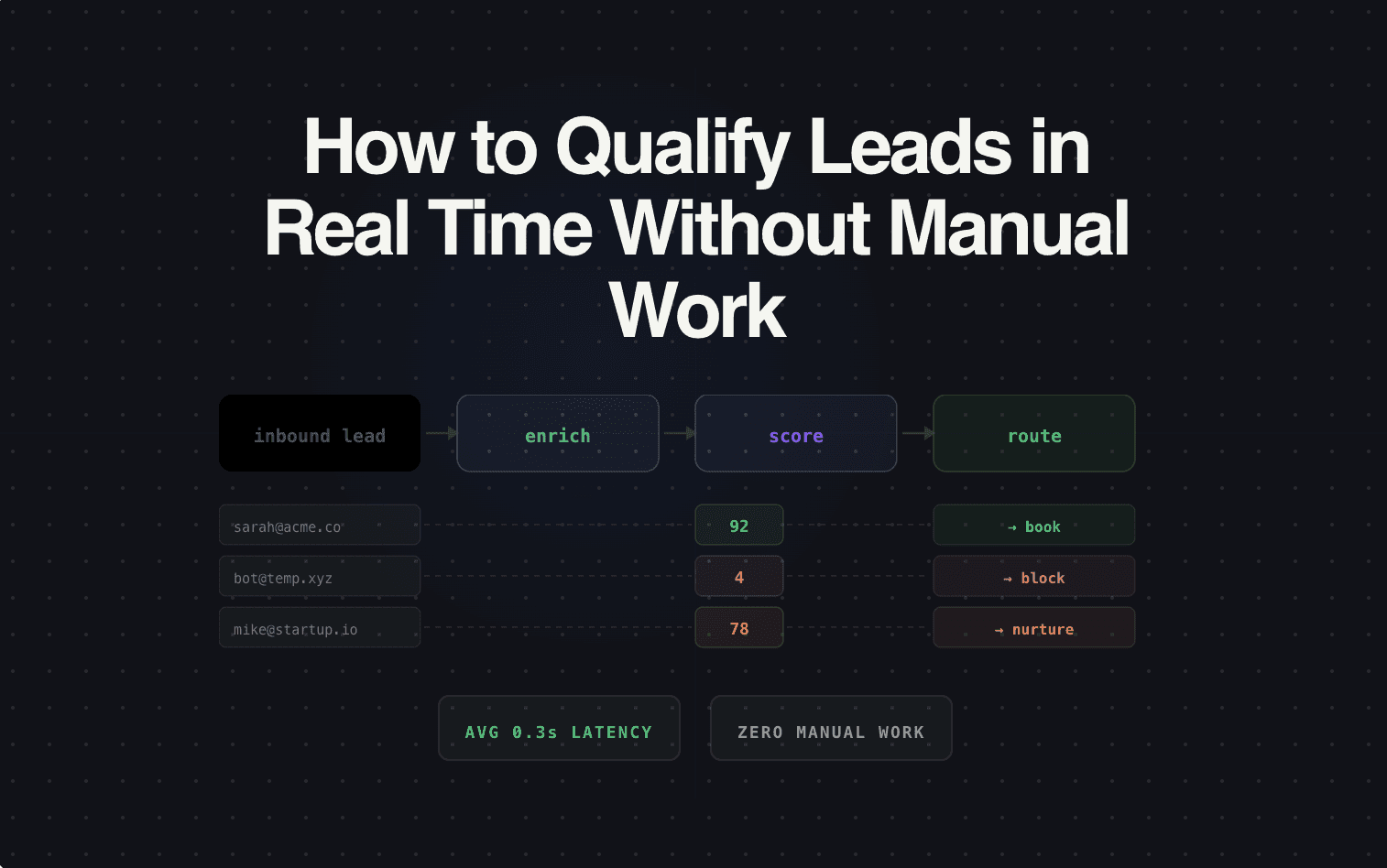
Real-time qualification means the lead is scored, segmented, and ready for routing the moment they complete the form. No human reviews the submission. No SDR makes a follow-up call to ask basic questions. The form itself collects the qualifying data, the system evaluates it against your criteria, and the lead is routed to the right person with full context.
This requires three things working together:
Smart form design. The form asks 3–4 qualifying questions in addition to contact info. These are the same questions your SDR would ask on the phone — budget range, company size, timeline, use case — captured upfront instead of after the fact.
Evaluation logic. The system scores or segments the lead based on their answers. "500+ employees, budget approved, evaluating this quarter" routes to an enterprise AE. "10 employees, no budget, just exploring" routes to a self-serve flow or nurture sequence.
Enrichment as a supplement. Third-party data (company revenue, employee count, industry, tech stack) fills in gaps that the lead didn't provide or verifies what they did provide. Enrichment should run in parallel — it supplements the qualification decision but doesn't block it.
The qualification framework
Not every qualifying question matters equally. Here's how to prioritize what to ask:
| Signal | How to capture it | Qualification weight | Why it matters |
|---|---|---|---|
| Timeline | Form field: "When are you looking to implement?" | Highest | A lead evaluating this month is 5–10x more likely to close than one evaluating "sometime this year." Most predictive signal. |
| Budget | Form field: "What's your approximate budget range?" | High | Eliminates mismatches early. A lead expecting $500/month doesn't need a call with your enterprise team. |
| Company size | Form field + enrichment verification | High | Determines segment tier and which team handles the lead. |
| Use case | Form field: "What are you looking to solve?" | Medium-high | Determines product fit and which rep or specialist is the best match. |
| Current tools | Form field: "What are you using today?" | Medium | Indicates sophistication level and competitive displacement opportunity. |
| Role / title | Form field or enrichment | Medium | Helps identify decision-makers vs. researchers. |
You don't need all six on every form. For demo request forms, timeline + budget + company size is usually enough. For lower-intent forms, company size alone can segment leads effectively.
Why conditional logic matters
A flat form with 8 fields feels like an interrogation. A multi-step form with conditional logic feels like a conversation.
If the lead selects "just exploring, no timeline," skip the budget question — it's irrelevant and would feel pushy. If they select "evaluating now, need a solution this quarter," ask about budget and current tools — they expect those questions at this stage.
Conditional logic serves two purposes: it improves the lead experience (fewer irrelevant questions) and it improves data quality (questions are contextually appropriate, so answers are more accurate).
What happens to the leads that don't qualify
Real-time qualification isn't just about finding the good leads faster. It's about handling every lead appropriately based on their actual situation.
Leads that qualify for sales get routed instantly to the right rep with full context. Leads that are interesting but not ready get entered into a nurture sequence with content matched to their use case and timeline. Leads that are clearly not a fit get filtered out before they waste rep time or enrichment credits.
Every lead gets a response that matches their intent level. The enterprise buyer gets a personalized message and a scheduling link within 30 seconds. The early-stage researcher gets a helpful resource and an invitation to book a call when they're ready. Neither gets ignored.
Where Surface fits
Surface handles real-time qualification natively — smart forms capture qualifying data, evaluation logic segments and scores the lead instantly, and routing triggers based on the qualification outcome. The entire process happens in the time it takes the lead to complete the form.
If your SDRs are spending 20+ hours a week on qualification calls that the form could have handled, that's time and cost Surface eliminates on day one.