Week of 7/21: Marketing Trends and Updates
Imagine the Monday meeting six months from now. The paid media lead asks, "Which campaigns lost efficient reach last week, and did the decline show up in pipeline?" The marketing agent checks Google Ads, the CRM, and the team's definitions, then returns a short answer with the underlying records. Someone asks the obvious follow-up: "Can you move the budget?" The room gets quieter. That question contains the whole operating problem.
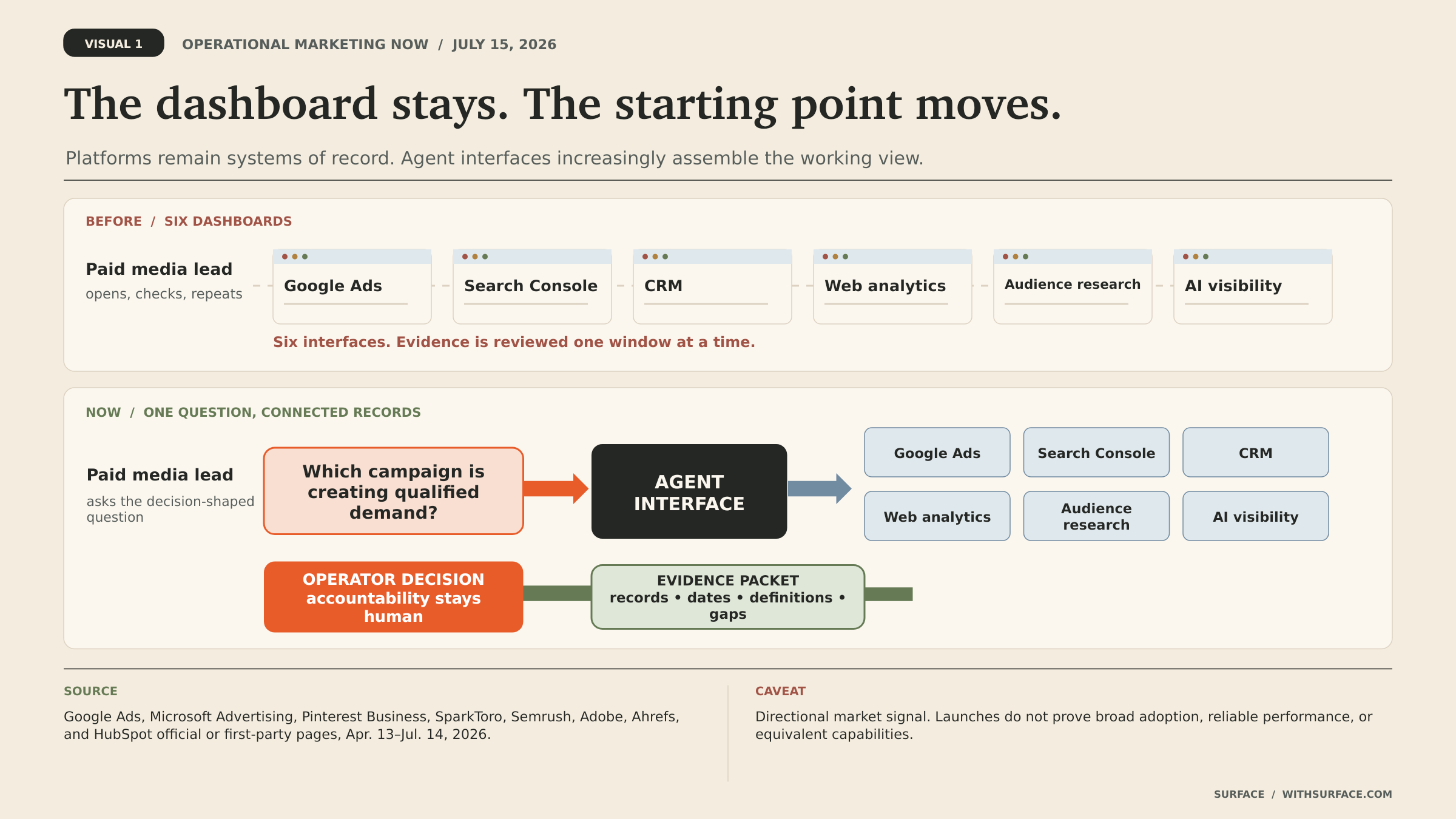
Marketers have spent years learning to work inside dashboards. We click through tabs, select a date range, export a CSV, reconcile naming conventions, and paste the conclusion into a deck. The software holds the data. The operator supplies the sequence, judgment, and institutional memory. A cluster of launches in late June and early July suggests that this arrangement is starting to change.
Google published a Google Ads MCP server that lets an AI agent retrieve and analyze campaign data through natural-language requests. Pinterest introduced Business Assistant and an MCP server for approved partners. Microsoft Advertising announced its own MCP server alongside tools for web intelligence and citation reporting. SparkToro opened audience research to compatible assistants, while Semrush connected search intelligence to Perplexity. Adobe and Salesforce described broader agent systems that span content, activation, customer data, and measurement.
The common feature is easy to miss beneath the product names. These companies are making the dashboard less important as the place where work begins. Their platforms remain the systems that store records, enforce permissions, and perform actions. The operator can increasingly ask a question somewhere else.
 ## The interface is moving before accountability does
MCP stands for Model Context Protocol. In plain English, it gives an AI application a consistent way to discover and use approved data or tools. A marketer can ask an assistant to compare campaigns, retrieve audience research, or inspect a CRM record without building a custom integration for every combination of assistant and platform. The protocol does not make the answer correct. It makes the connection reusable.
That distinction matters. A dashboard usually constrains the operator to known fields and actions. A conversational interface can compose a query, combine sources, summarize results, and suggest a next step. The flexibility is useful because real marketing questions rarely respect software boundaries. A lead's path might cross an ad platform, a landing page, a form, a CRM, and a sales conversation. Teams that care about lead journey tracking already know how much meaning disappears in those handoffs.
An agent can reduce the mechanical work of assembling the path. It can also conceal the assumptions. Which conversion event counted? Did the query use account time or UTC? Were test campaigns excluded? Did a missing CRM field mean "no opportunity" or "not synced yet"? A polished paragraph can make an unresolved definition feel settled.
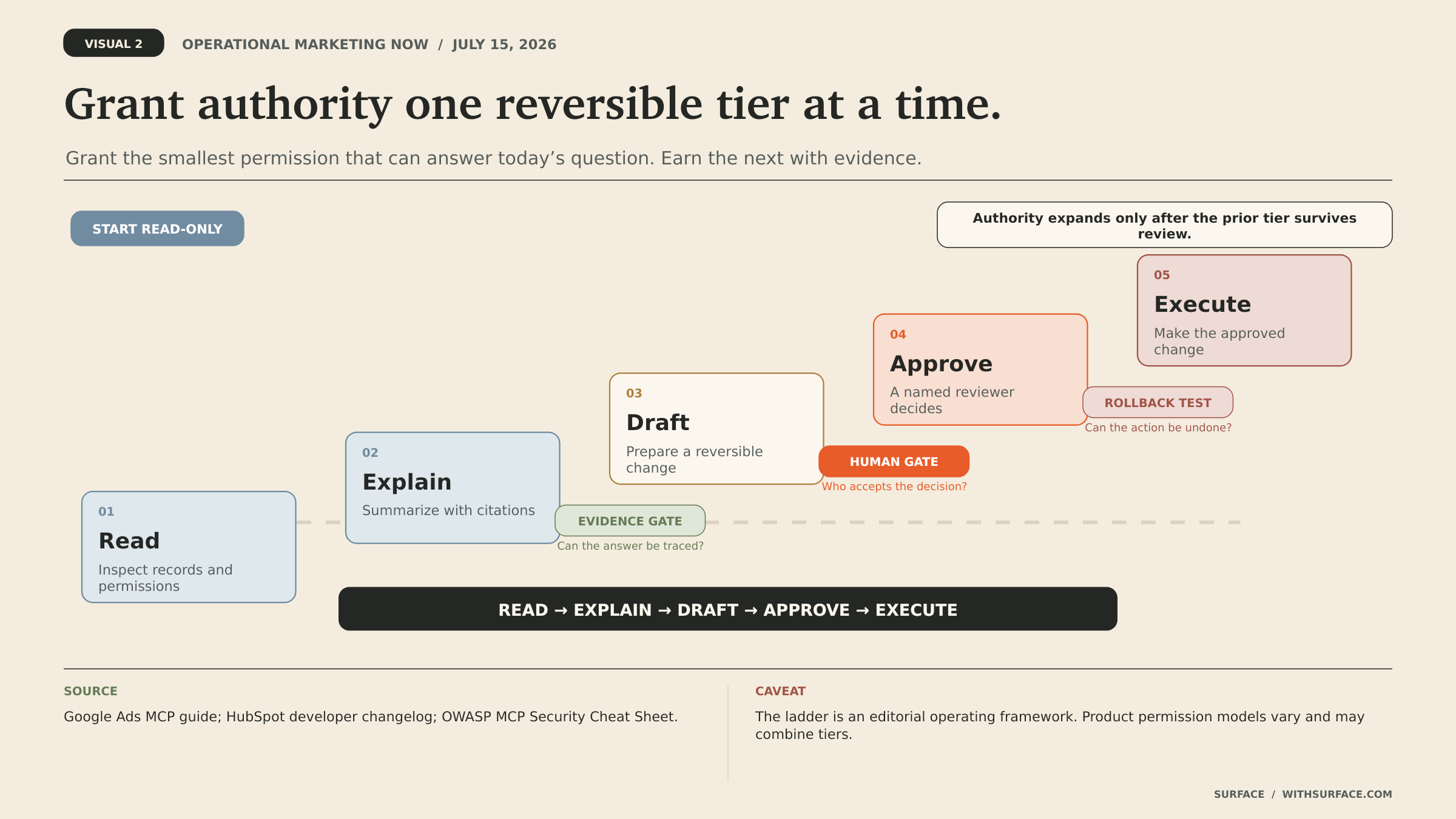
This is why the most revealing detail in Google's release is its current access mode: read-only. The server can discover accounts, retrieve metadata, and query campaign performance. It cannot change a bid or budget. That boundary is a product limitation today and a useful operating principle for teams starting their own experiments.
What changed this week
Three changes are known. First, several major marketing systems now expose official agent connections or agent-ready workflows. This is more substantial than a chatbot pasted onto a dashboard because the assistant can reach structured data and, in some products, approved actions. HubSpot's generally available remote MCP server shows the next stage: it offers expanded read and write access to parts of the CRM while respecting existing permissions, with some objects remaining read-only.
Second, useful context is broadening beyond the company website. Google's new Search Console properties for social and video platforms can show eligible teams how Instagram, TikTok, X, and YouTube content appears in Google Search and Discover. An operator can now inspect search performance across owned websites and third-party presences, then combine that evidence with audience and campaign data.
Third, marketers have at least one concrete portfolio example. Conversios says it built an MCP-based Performance Max audit workflow across 121 accounts in days without using its core engineering team. The Microsoft case study is vendor and customer reported, so it should not be treated as independent proof of performance. It still demonstrates a credible use case: inspect many accounts against the same audit logic, surface exceptions, and let a specialist decide what deserves action.
The broader conclusion remains inferred. We are likely moving toward a marketing environment where dashboards operate as back offices and evidence stores while agents become the common front door. The launches support that direction. They do not establish adoption, reliability, or business lift across ordinary teams.
 ## A useful agent produces inspectable decisions
Most teams will be tempted to measure the wrong thing first. They will count generated reports, automated tasks, or hours nominally saved. Those numbers are easy to produce and hard to connect to revenue. A faster wrong answer creates more cleanup.
The better unit is an inspectable decision. The agent should state the question, identify the sources and time ranges, expose definitions, show the relevant records, separate observation from interpretation, and route the recommendation to someone with authority. This resembles the discipline behind a useful AI visibility dashboard: coverage, source mix, freshness, and business relevance matter more than a single impressive score.
Consider an agent that flags a sudden drop in nonbrand conversions. A weak workflow writes, "Performance declined 18%, increase budget on the winning campaign." A sound workflow shows which conversion definition it used, compares the same weekday range, checks tracking health, distinguishes spend from demand, links the affected campaigns, and asks the channel owner whether a launch or sales-capacity constraint changed the context. The recommendation may still be wrong. At least the operator can inspect why it exists.
This is also where connected marketing and RevOps stop being adjacent specialties. The value of an agent depends on the quality of its underlying records. If campaign names drift, lifecycle stages conflict, or content lacks a stable taxonomy, the conversational layer makes those defects easier to query and easier to spread. Teams evaluating marketing integrations should ask whether each connection preserves identity, timestamps, permissions, and source lineage before asking what the assistant can generate.
Start with a narrow question and a reversible action
The first production pilot should feel almost disappointingly small. Choose one recurring decision with enough volume to matter and low enough stakes to review manually. Paid media teams might audit pacing and anomalies. Content teams might compare Search Console movement with page changes and current source coverage. RevOps teams might identify leads with broken routing fields while leaving the records untouched.
Define the expected answer before connecting a model. Write down the approved data sources, the business definitions, the exclusions, the freshness requirement, and the person who signs off. Run the agent against historical cases with known outcomes. Record unsupported claims, missing evidence, incorrect joins, and recommendations a specialist rejects. Then decide whether the workflow deserves live read access.
For teams building a connected operating layer, a marketing operations platform can bring research, content, lead journeys, and learning into durable shared context. The practical constraint is equally important. That context should remain legible enough that a marketer can find the source and challenge the conclusion.
Only after the read-only workflow performs reliably should the team consider a write action. Even then, begin with a draft, queue, or approval request. Let the agent prepare a budget change, CRM update, or content brief. Keep a human between recommendation and execution until the cost of an error, the rollback path, and the monitoring plan are understood.
What remains debated
The market has not settled whether MCP becomes the durable connection standard, one layer among several, or a transitional protocol. Availability also varies. Pinterest's server began with alpha partners. Microsoft's certification process is still preview documentation. Vendor announcements describe possibility more often than measured use.
The right response is neither dismissal nor a platform migration. Operators can treat the protocol as an interface choice while treating access control, evidence, and accountability as durable requirements. If the standard changes, those requirements survive.
For the next thirty days, inventory recurring questions that require three or more exports, choose one read-only pilot, assign a channel owner and a data owner, and measure decision quality. Track time to a reviewed answer, evidence completeness, specialist acceptance, exception rate, and any downstream business result. When the agent fails, preserve the trace. That record will teach the team more than another polished demo.
The dashboard is not disappearing. It is moving behind the conversation, where it may become more important as a source of truth and less visible as a workplace. The teams that benefit will keep the records sturdy, the permissions narrow, and the humans close enough to ask the second question.