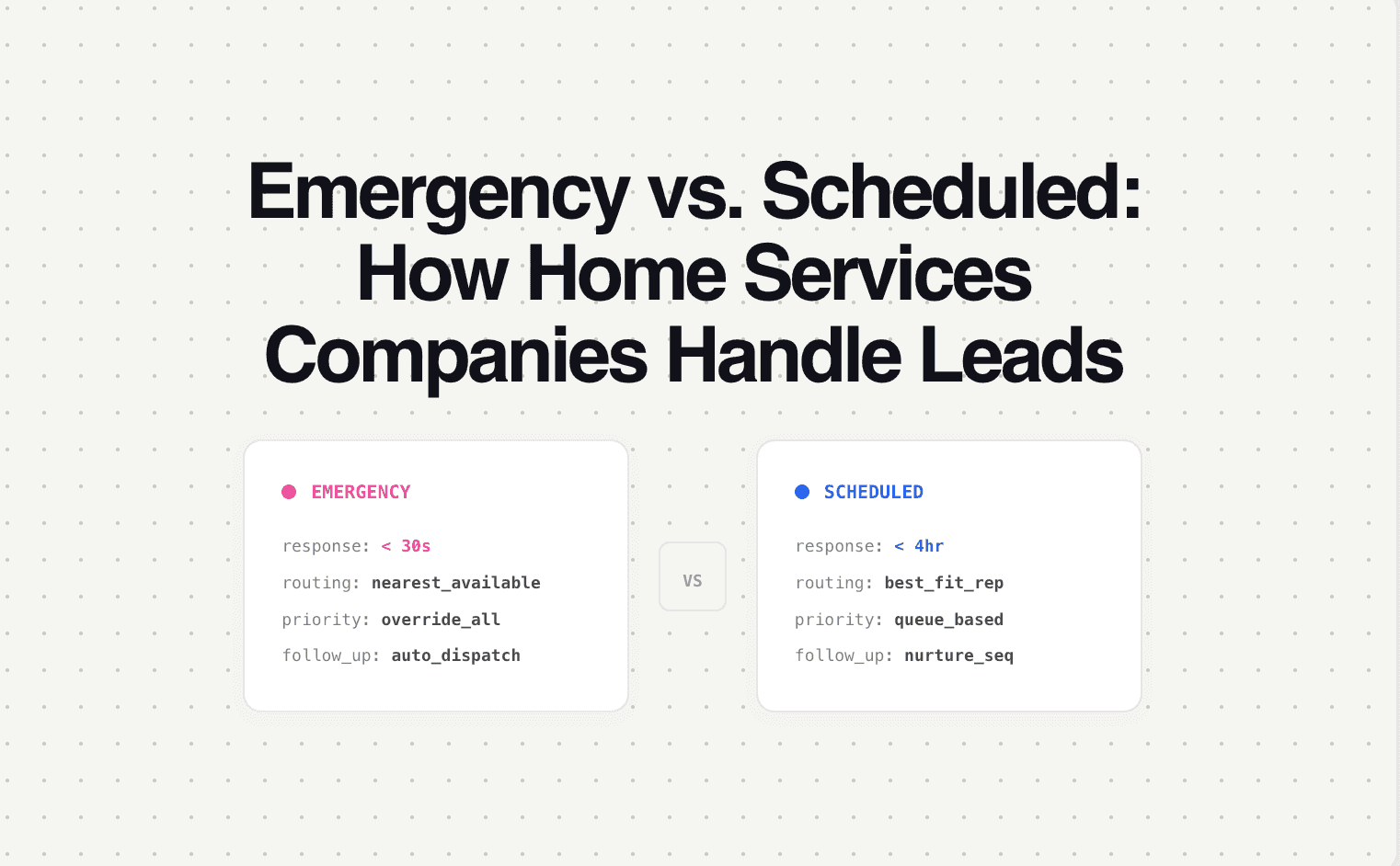
A burst pipe at midnight and a kitchen remodel quote request at 2 PM on a Tuesday are both "leads." But treating them the same — same form, same response time, same routing — is how home services companies lose emergency jobs to competitors and waste technician time on low-priority inquiries.
The highest-performing home services companies route every lead through one filter first: is this an emergency or is this scheduled work? Everything downstream — who gets notified, how fast, through what channel, and with what response — depends on that answer.
Why urgency-based routing changes everything
Most home services websites have one form: "Request a Service." Name, phone, address, "describe your issue." Every submission goes to the same inbox or dispatcher queue. The dispatcher reads each one, decides if it's urgent, figures out who's available, and calls the customer back.
That process works at 5 leads per day. At 20+ leads per day, the dispatcher becomes the bottleneck. Emergency calls sit behind scheduled requests. Response time degrades. The customer with the flooding basement calls the next company on Google because yours didn't pick up fast enough.
| Lead type | Customer expectation | What usually happens | What should happen |
|---|---|---|---|
| Emergency (burst pipe, no power, gas smell, AC out in 100°F) | Response in minutes. Someone en route within the hour. | Sits in queue behind scheduled requests. Callback in 30 min – 2 hours. | Instant notification to on-call tech. Text confirmation to customer within 3 minutes. Tech dispatched. |
| Same-day (toilet running, AC underperforming, flickering lights) | Response within a few hours. Service today or tomorrow. | Same queue as emergencies. Sometimes prioritized, sometimes not. | Auto-response with same-day availability. Routed to nearest available tech for the service type. |
| Scheduled project (remodel, installation, inspection, maintenance) | Response within 24–48 hours. Appointment next week is fine. | Same queue. Often gets fastest response because it's easiest to handle. | Automated response with scheduling link. Routed to project team, not emergency techs. |
The mistake most companies make: treating everything as medium priority. Emergencies get slower response than they need. Scheduled projects get faster response than they need (wasting high-value dispatch time). Nobody gets the right treatment.
Building the urgency filter
The form does the sorting. One question at the top changes the entire flow:
"How urgent is your request?"
- Emergency — I need help right now (active leak, no power, safety concern)
- Soon — I'd like service today or tomorrow
- Planned — I'm scheduling a project or maintenance
Each selection triggers a different path:
Emergency path: Minimized form (just contact info + brief description + address). Instant routing to on-call technician for that service area and service type. Customer gets a text within 2 minutes: "We've received your emergency request. A technician is being dispatched to your area. Expected response time: [X minutes]." Dispatcher gets a simultaneous notification with full details.
Same-day path: Standard form (contact info + service type + issue description + photos optional). Routed to nearest available tech matching the service type. Customer gets an auto-response: "We have availability today. Here are three time slots: [options]." Or if no same-day availability: "Our first available slot is tomorrow at [time]. Book here."
Scheduled path: Full project form (contact info + service type + scope description + photos + budget range + preferred timeline). Routed to the project estimator or team scheduler. Customer gets an auto-response within the hour with scheduling options for the next 1–2 weeks. No technician time wasted until the estimate appointment.
The routing logic
After urgency, route by service type and geography:
Service type matching: A plumbing emergency goes to a plumber, not an electrician. Obvious — but round-robin routing doesn't know the difference. The form captures service type, and routing sends it to the right crew.
Geographic matching: Route to the technician closest to the job address. This reduces drive time, gets the tech on-site faster, and improves daily job capacity.
Availability matching: Check real-time availability (calendar integration with field service management tools). Don't route an emergency to a tech who's in the middle of a 4-hour installation.
Capacity balancing: For same-day and scheduled work, distribute evenly across available techs to prevent overload. Emergency routing bypasses capacity limits — emergencies go to whoever is available, regardless of daily load.
Post-service automation
The lead flow doesn't end at dispatch. After job completion:
Immediate: Payment processing (if applicable) + satisfaction check: "How did the service go? Rate 1–5."
24 hours: Review request: "Would you leave us a review? Here's a direct link to Google." Companies that automate review requests see 3–5x more reviews than those relying on technicians to ask verbally.
Seasonal: Follow-up maintenance recommendations based on the completed service. Fixed an AC? Schedule a tune-up reminder for next spring. Repaired a water heater? Suggest a plumbing inspection in 6 months.
Where Surface fits
Surface handles the full home services lead flow: urgency-based form branching, service-type routing, geographic tech matching, instant customer response, and post-service automation. Connected to your field service management system (ServiceTitan, Housecall Pro, Jobber) so dispatched jobs flow directly into your existing workflow.
If your dispatcher is the bottleneck between lead and service, Surface removes the bottleneck.