July 20th Marketing Updates
A marketing MCP server is a connection layer that lets an AI application discover and use approved marketing data or tools. It might give an assistant permission to query Google Ads, retrieve audience research, inspect CRM contacts, or run an SEO report. The server defines what the assistant can reach and what actions it can request. It does not supply marketing judgment, guarantee a correct answer, or replace the underlying platform.
That definition matters because the acronym is spreading faster than operational understanding. In June, Google Ads, Microsoft Advertising, Pinterest, SparkToro, Semrush, and Adobe all announced or expanded agent connections. HubSpot had already made its remote MCP server generally available in April. A buyer could reasonably look at the launch list and assume that MCP is a new category of marketing software. It is closer to a common socket.
What MCP changes
Before MCP, a team connecting an assistant to several systems often built separate integrations for each pairing. One path connected an AI tool to the CRM. Another connected it to the ad platform. Each path required its own authentication, request format, tool descriptions, and maintenance. Anthropic introduced the Model Context Protocol as an open standard intended to reduce that repeated integration work.
The official MCP documentation describes a way for AI applications to connect with external data, tools, and workflows. A server exposes a set of capabilities. A compatible host can discover those capabilities and ask the server to use one. The host then gives the returned information to the model so it can construct an answer.
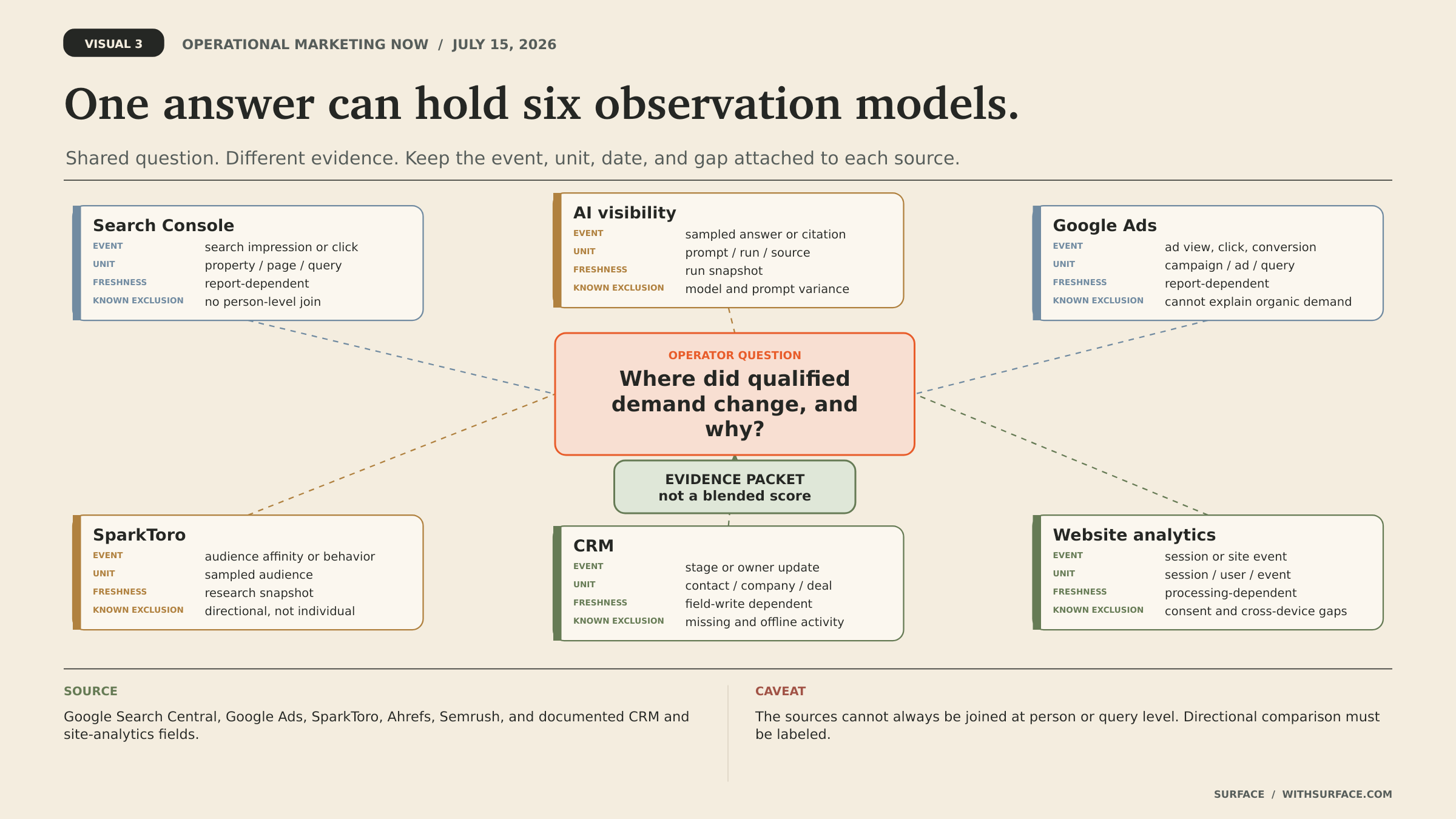
For a marketer, the visible experience may be simple: "Compare branded search spend with qualified pipeline for the last eight weeks." Behind that sentence, the system still has to authenticate, select fields, match dates, reconcile campaign identifiers, apply a definition of qualified pipeline, and return enough evidence for review. MCP can standardize part of the plumbing. It cannot resolve an undocumented funnel.
This is why teams reviewing inbound marketing tools should evaluate the connection separately from the assistant. A charming interface can sit on top of thin data access. A plain interface can expose reliable records with clear permissions. The second system may create more value.
 ## Three marketing use cases that are real today
The first credible use case is retrieval and analysis. Google's Ads MCP server lets an agent discover accounts, retrieve metadata, and query performance. The current release is read-only. A paid media lead could ask for campaigns with week-over-week conversion changes, then inspect the rows before making a change in Google Ads.
The second is research inside a planning workflow. SparkToro's server can run, retrieve, and compare audience-research reports. Semrush's connector gives Perplexity users access to search and competitive data. Instead of exporting files and teaching a general model what each column means, the operator can request current evidence through an approved connection. Teams evaluating generative engine optimization services should look for this kind of source access because useful recommendations require more than a prompt and a visibility score.
The third is record or workflow action. HubSpot's remote server supports expanded reading and writing across parts of the CRM while respecting existing HubSpot permissions. This is where the risk profile changes. Retrieving a contact and changing a lifecycle stage are different acts, even if the same chat window triggers both.
MCP is a permission surface
The most important buyer question is not "Does it support MCP?" Ask what the server exposes, under whose identity, with which scopes, and with what record of use. Google's server supports OAuth 2.0 or a service account. HubSpot uses OAuth 2.1 with PKCE. Pinterest started with approved alpha partners. These details determine whose authority the assistant borrows.
Microsoft's preview MCP certification process asks publishers to document authentication, setup, tool behavior, support, privacy, and testing. Certification will not eliminate operational risk, though the checklist points buyers toward the right evidence. A server should describe every tool, validate inputs, fail visibly, and produce logs someone can investigate.
The internal architecture deserves the same attention. A useful integration layer preserves stable identifiers, timestamps, account boundaries, and source lineage. If the assistant receives only a flattened summary, it may sound certain while losing the record needed to verify the answer.
How to evaluate a marketing MCP server
Start with the job. Write one sentence that names the decision, the systems required, the expected output, and the human who will review it. "Every Monday, identify paid campaigns with a material change in qualified pipeline efficiency and give the acquisition lead the source rows" is evaluable. "Use AI to optimize marketing" is an invitation to buy a demo.
Then inspect five areas:
- Capabilities: List the exact data objects and actions the server exposes. Separate reads, drafts, approvals, and direct writes.
- Identity and scope: Confirm whether access uses an individual account, service account, or shared credential. Apply the narrowest available scopes.
- Evidence: Require record IDs, source links, query windows, definitions, and an explicit note when data is missing.
- Control: Document approval gates, rate limits, allowed accounts, rollback paths, and the person who can disable access.
- Evaluation: Test known historical cases. Track incorrect joins, unsupported conclusions, failed tool calls, specialist rejection, and time to a reviewed answer.
Teams already trying to report AI visibility without fake precision will recognize the principle. A new interface does not remove sampling, data gaps, engine variance, or business context. The server should make uncertainty easier to see.
Choose the connection after the operating model
MCP can lower integration friction. That is useful. It can also make access look casual because a complex data request now resembles a sentence. Treat every marketing MCP server as an authenticated software integration with a model in the loop.
Begin with read access and a narrow question. Make the output cite its records. Give a channel specialist the right to reject the recommendation. If the workflow earns trust, allow the agent to create drafts or queue approvals before granting direct write access. A connected marketing operating system becomes valuable when it preserves context and makes decisions easier to inspect. The protocol is only the doorway.
Practical steps
- Inventory every proposed server, owner, host, credential type, scope, and connected account.
- Run a ten-case historical evaluation before using live data in a recurring workflow.
- Keep the first production use case read-only and require links or record IDs for material claims.
- Review permissions quarterly and after any role, agency, or vendor change.
- Add a kill switch, incident owner, and documented revocation path before enabling writes.