If you're evaluating tools to fix your lead ops, both of these names will come up. Salesforce Marketing Cloud is one of the most widely deployed marketing platforms in the world. Surface Labs is newer, smaller, and narrowly focused on lead capture and routing. They're not the same kind of tool — but they often end up on the same shortlist because teams are trying to solve the same problem: what happens between "lead fills out a form" and "rep has a conversation."
This is a fair comparison of where each platform fits, where each falls short, and which one actually solves the lead ops problem most teams are dealing with.
What Salesforce Marketing Cloud does well
SFMC is a full-suite marketing platform. Email campaigns, journey orchestration, audience segmentation, multi-channel messaging, analytics. If you need to build a 12-touch nurture sequence across email, SMS, and ads for 500,000 contacts, SFMC can do that. It's deeply integrated with Salesforce CRM, which matters if your sales team already lives in Salesforce.
For enterprise marketing teams running complex lifecycle campaigns at scale, SFMC is a serious platform. It wasn't built to be lightweight — it was built to be comprehensive.
What Surface Labs does well
Surface is built for one job: getting a lead from form fill to qualified, routed, and contacted in under 60 seconds. Capture, qualification, intelligent routing, and instant response — in a single system. It's not a marketing automation platform. It doesn't do email nurture or audience segmentation. It does the first 60 seconds of the lead lifecycle, and it does them fast.
Where the comparison gets interesting
Most teams evaluating SFMC aren't buying it for email nurture. They're buying it because they think it will fix their lead ops — the capture-to-conversation gap. That's where the comparison matters.
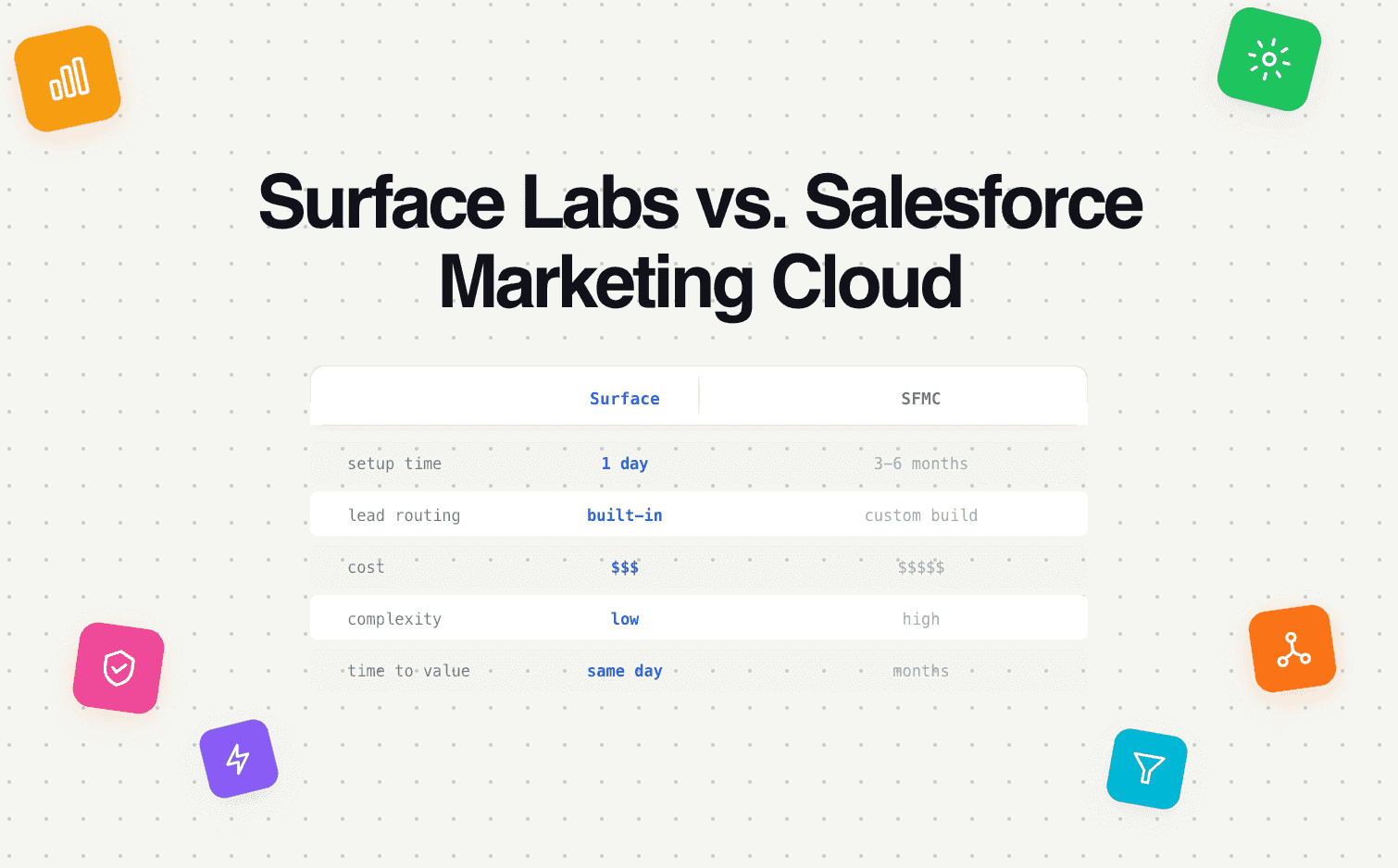
| Capability | Salesforce Marketing Cloud | Surface Labs |
|---|---|---|
| Lead capture / smart forms | Basic — web forms exist but aren't built for real-time qualification | Core product — forms with built-in qualification logic, conditional fields, real-time data capture |
| Lead routing | Not native. Requires Salesforce CRM + Flow Builder + custom config | Core product — rule-based and intelligent routing, real-time, configurable in minutes |
| Speed-to-lead | Depends on CRM workflows. Typical: minutes to hours. | Sub-60-second response by design |
| Instant personalized response | Possible through Journey Builder, but requires significant setup | Native — personalized response triggered at the moment of routing |
| Setup and time-to-value | 4–12 weeks with a dedicated admin or implementation partner | Hours to days. No dedicated admin required. |
| Ongoing maintenance | Requires SFMC-certified admin. Journey Builder, AMPscript, data extensions. | Self-serve. Non-technical ops teams can manage routing rules directly. |
| Email nurture / lifecycle campaigns | Best-in-class. This is what it was built for. | Not included. Not the product's job. |
| Multi-channel campaign orchestration | Deep — email, SMS, ads, push, social | Not included. |
| Pricing | $1,250–$4,200+/month depending on tier, plus implementation costs | Significantly lower. No implementation fees. |
SFMC wins on breadth. It does more things. But the things most teams need fixed — capture, qualification, routing, and speed-to-lead — aren't the things SFMC was built to do. They're possible inside SFMC, but they require custom configuration, a dedicated admin, and weeks of setup to get right.
The real question
If your lead ops problem is "we need better email nurture and lifecycle campaigns," SFMC is the right tool. It's purpose-built for that job and it does it well.
If your lead ops problem is "leads come in and sit for hours before anyone contacts them, routing is broken, and we're wasting ad spend on leads that never get a real conversation" — that's a different problem. And SFMC wasn't designed to solve it.
This is the pattern we see most often. A team buys SFMC expecting it to fix the capture-to-conversation pipeline. They spend 8 weeks on implementation. They hire or contract an SFMC admin. And then they realize the actual bottleneck — speed-to-lead, routing accuracy, qualification at capture — still isn't solved. Because those aren't marketing automation problems. They're lead infrastructure problems.
What teams actually end up doing
The most common setup we see at companies running both isn't an either/or. It's SFMC handling what it's good at — nurture sequences, lifecycle campaigns, audience management — and Surface handling the upstream layer that SFMC doesn't cover: real-time capture, qualification, routing, and instant response.
The lead hits Surface first. It gets qualified, routed, and contacted in seconds. Then it enters Salesforce CRM and SFMC for ongoing relationship management and nurture. Each tool does the job it was built for.
The honest summary
SFMC is a powerful platform if you need enterprise marketing automation. But it's not a lead ops tool — and treating it like one leads to months of implementation, ongoing admin overhead, and a capture-to-conversation gap that never actually gets closed.
Surface is a narrower tool that does one thing well: making sure every lead gets captured cleanly, qualified intelligently, routed correctly, and contacted in under a minute. If that's the problem you're solving, it's the faster, simpler, and cheaper answer.
If you're currently running SFMC and your leads are still sitting in a queue for hours before anyone follows up, the gap isn't in your marketing automation. It's in the layer that sits in front of it. That's what Surface was built for.