
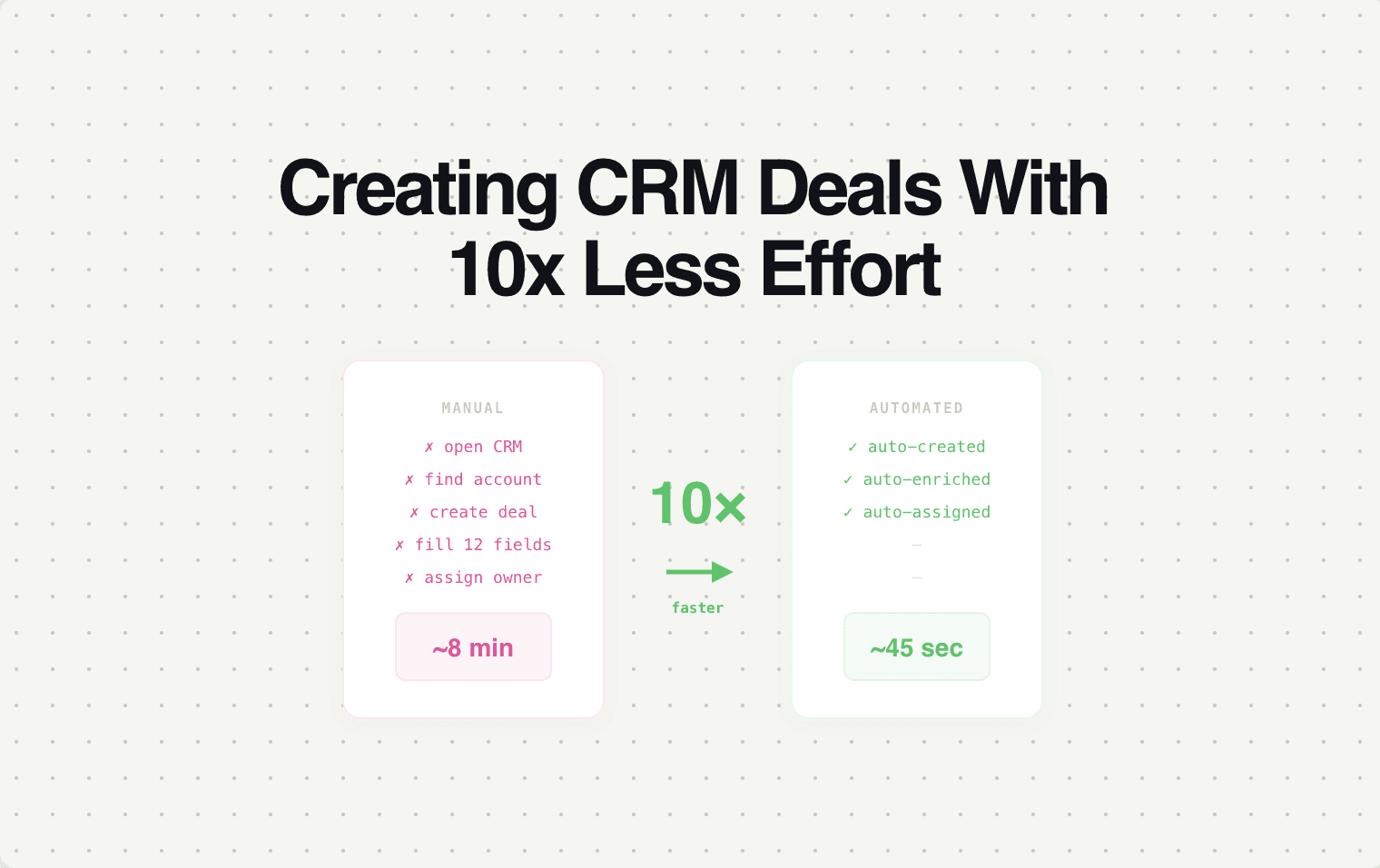
The middle school version: You know how annoying it is to fill out a long form at the doctor's office? That's what creating a "deal" in a CRM feels like for salespeople — lots of clicking, typing, and copying stuff from one place to another. With Surface, you just TELL the AI what happened (like talking to a friend) and it creates the whole deal for you. It fills in the company name, the deal amount, the stage, the contact — everything. It's like having a personal assistant who never gets tired.
The CRM data entry tax
Every sales rep knows this feeling. You just had a great call. The prospect is interested, the deal is real, and you need to log it in Salesforce before you forget the details. So you open Salesforce, click "New Opportunity," and spend the next 8 minutes filling in fields.
Account name — is it already in the system? Search. Find the wrong one. Search again. Create a new one. Contact name — link it to the account. Deal name — type something descriptive. Stage — pick from the dropdown. Amount — estimate based on the conversation. Close date — guess. Product interest — another dropdown. Source — where did this lead come from again? Notes — try to remember what they said.
8 minutes per deal. Our reps create 15–25 deals per week. That's 2–3 hours per week per rep on data entry. Across a 10-person team, that's 20–30 hours per week — nearly a full headcount — spent typing into CRM fields instead of selling.
And the data quality is terrible anyway. Reps rush through the fields. Close dates are always wrong. Amounts are rough guesses. Notes are sparse because nobody wants to type a paragraph after every call.
How Surface's AI deal creation works
After a call, a rep tells Surface what happened — in natural language:
"Just had a great call with Sarah Chen at Acme Corp. They're a 200-person SaaS company looking to replace their Zapier-based lead routing. Budget is around $30K, they want to start next quarter. She's the VP of Marketing and the decision-maker. Needs to get VP of Sales buy-in."
Surface takes that input and creates a fully populated CRM deal:
| CRM field | What Surface fills in | Where it gets the data |
|---|---|---|
| Account name | Acme Corp | Extracted from input. Matched to existing account or created new. |
| Contact name | Sarah Chen | Extracted. Linked to account. Title populated from enrichment. |
| Contact role | VP of Marketing — Decision Maker | Extracted from "she's the VP of Marketing and the decision-maker." |
| Deal name | Acme Corp — Lead Routing Platform | Generated from company + use case. |
| Amount | $30,000 | Extracted from "budget is around $30K." |
| Stage | Discovery / Qualified | Inferred from conversation description — they've had an initial call. |
| Close date | Q2 2026 | Inferred from "wants to start next quarter." |
| Product interest | Lead routing | Extracted from "looking to replace their Zapier-based lead routing." |
| Next steps | Get VP of Sales buy-in | Extracted from "needs to get VP of Sales buy-in." |
| Notes | Full conversation summary with key details preserved | Generated from the complete input. |
| Source | Outbound — cold email reply | Pulled from Surface's existing lead data if the contact exists. |
The rep reviews the populated deal for 30 seconds, confirms or edits anything that needs adjusting, and saves. Total time: under 2 minutes. Down from 8.
How it handles edge cases
Duplicate contacts. Surface checks the CRM before creating anything. If Sarah Chen at Acme Corp already exists, Surface links to the existing contact and account — it doesn't create duplicates. If there's a similar but not exact match ("S. Chen" vs. "Sarah Chen"), Surface flags it for the rep to confirm.
Missing fields. If the rep's input doesn't mention a close date, Surface doesn't guess randomly. It either infers from context ("next quarter" = Q2 2026) or leaves the field empty with a reminder for the rep to fill in later. Partial accuracy is better than confidently wrong data.
Multi-threaded deals. Enterprise deals often have multiple contacts. The rep can mention several: "Spoke with Sarah, the VP of Marketing. She's bringing in James Park, their VP of Sales, and Dave from procurement." Surface creates contact records for each, links them to the deal with appropriate roles, and flags the ones that need enrichment.
Existing pipeline. If a deal already exists for Acme Corp, Surface recognizes the account and asks whether this is an update to the existing deal or a new opportunity. It doesn't blindly create duplicates.
What our team does with the time back
When we rolled this out, we tracked how reps spent the 2–3 hours per week they got back. The answer was almost entirely more selling activity — more follow-up calls, more pipeline management, more deal advancement.
| Activity | Before (weekly per rep) | After (weekly per rep) |
|---|---|---|
| CRM data entry | 2.5 hours | 0.5 hours |
| Follow-up calls | 12 | 18 |
| Discovery calls | 8 | 10 |
| Pipeline review | 1 hour | 1.5 hours |
The 2 hours of saved admin time translated into 6 additional outbound activities per rep per week. Across the team, that's 60 additional touches per week — which compounds into pipeline.
But the bigger win was data quality. Because the AI captures details from natural language — including nuances the rep would normally skip in a manual entry — the deal records are actually more complete and more accurate. Notes are richer. Close dates are better calibrated. And because it takes 2 minutes instead of 8, reps actually do it after every call instead of batching at end of day and forgetting half the details.
Setting it up
The setup is straightforward: connect Surface to your CRM (Salesforce, HubSpot, Pipedrive). Map your deal fields — which ones are required, which are optional, and what the valid values are for dropdowns and picklists. Surface learns your field structure and uses it to populate deals accurately.
No custom development. No Apex triggers. No workflow chains. The AI handles the translation from natural language to structured CRM data.
Give your sales team hours back every week. See AI-powered deal creation in Surface.