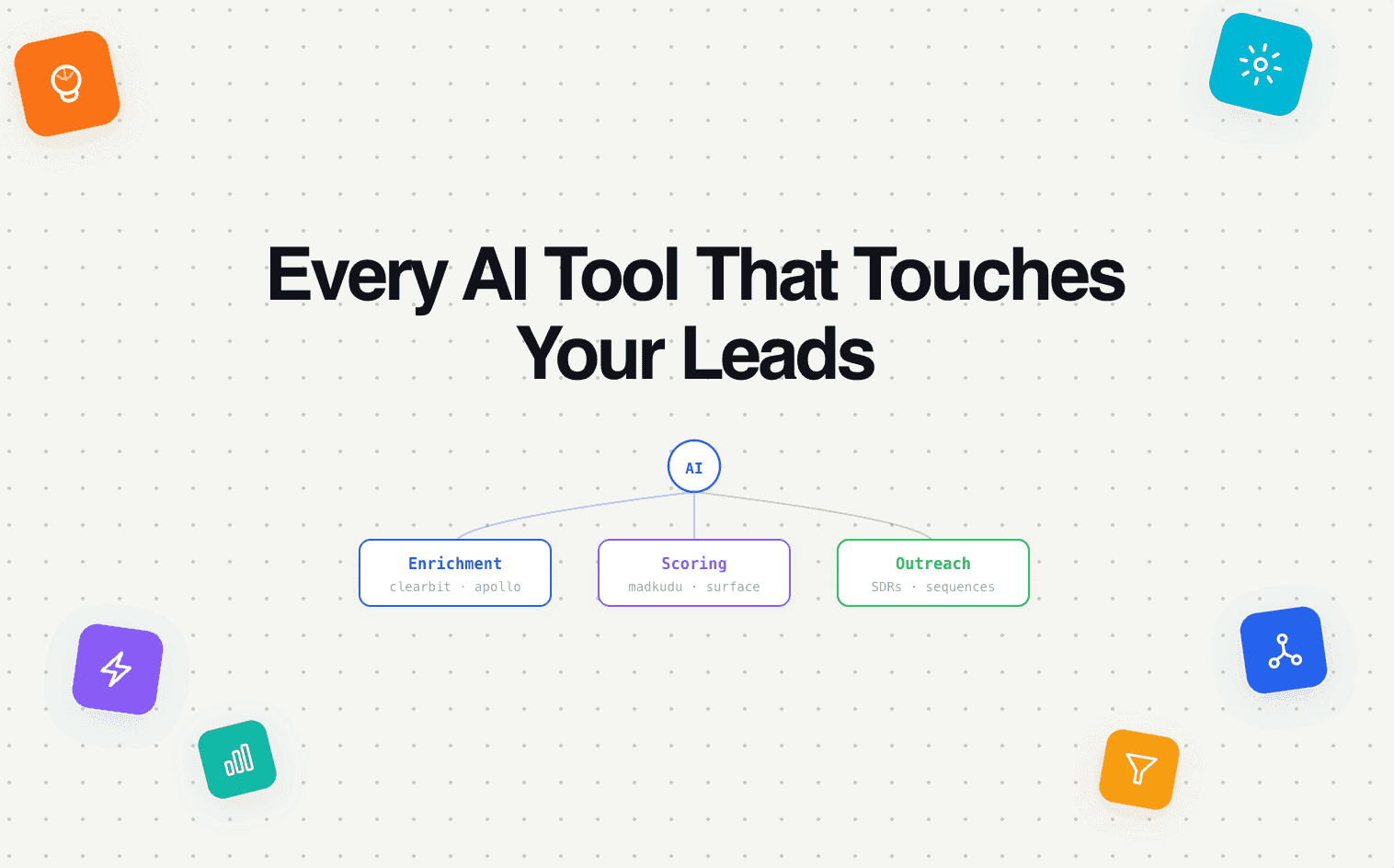
AI has quietly infiltrated every layer of the B2B lead flow. Not in the dramatic, "AI will replace your sales team" way the conference keynotes promise — but in the practical, "there are now 8 AI-powered tools between your ad click and your rep's phone call" way that nobody's mapped out.
If you're a marketing or revenue leader, you should know which AI tools are touching your leads, where they add value, and where they add complexity without actually improving conversion.
The AI lead flow map
Here's every layer where AI tools now operate in a typical B2B lead flow:
| Layer | What AI does here | Common tools | Value level |
|---|---|---|---|
| Ad targeting | Algorithmic audience optimization, lookalike modeling, bid management | Google Performance Max, Meta Advantage+, LinkedIn Predictive Audiences | High — but you have limited control. The platform's AI optimizes for its own metrics. |
| Content creation | Generates ad copy, landing page text, blog content, email sequences | Jasper, Copy.ai, ChatGPT, Claude | Medium — saves time on drafts. Quality varies. Requires human editing for anything customer-facing. |
| Visitor identification | Identifies anonymous website visitors by matching IP data to company databases | Clearbit Reveal, 6sense, Demandbase | Medium-high for ABM-focused teams. Less useful for high-volume inbound. |
| Chatbots / conversational AI | Engages visitors in real-time conversation, answers questions, captures intent signals | Drift, Intercom Fin, custom Claude/GPT bots | Medium — good for engagement, inconsistent for structured qualification and routing. |
| Form optimization | A/B tests form variants, predicts optimal field count, personalizes form experience | Limited standalone tools. Most testing happens in broader CRO platforms. | Low — this layer is underserved. Most "AI form" claims are basic conditional logic. |
| Enrichment | Appends company and contact data to leads using AI-matched databases | Clearbit, ZoomInfo, Apollo, Lusha | High — real value if used at the right moment (at capture, not hours later). |
| Lead scoring | Predicts lead quality or likelihood to convert based on behavioral and firmographic signals | HubSpot Predictive Scoring, Marketo, MadKudu, Infer | Medium — only as good as the data it's trained on. Most models are poorly calibrated. |
| Routing | Matches leads to reps using AI-evaluated criteria | Limited. Most routing is still rule-based. Some tools (Chili Piper, LeanData) add basic intelligence. | Low-medium — AI routing is nascent. Rule-based routing with the right variables outperforms most "AI routing" today. |
| Sales engagement | Prioritizes which leads to contact, generates personalized outreach, optimizes send times | Outreach, Salesloft, Apollo, Lavender | Medium-high for outbound. Less relevant for inbound where speed matters more than personalization. |
| Meeting scheduling | Suggests optimal times, handles rescheduling, sends reminders | Calendly, Chili Piper, Reclaim AI | Low AI involvement. Scheduling is largely a solved problem — the issue is getting leads to the scheduling step. |
That's 10 layers of AI between your ad budget and your rep's calendar. In theory, each one makes the flow smarter. In practice, they create a chain where no single tool owns the outcome and nobody has visibility across the full journey.
Where AI actually helps vs. where it's theater
The honest assessment: AI adds genuine value at the top of the flow (targeting, enrichment) and at the bottom (sales engagement for outbound). In the middle — qualification, routing, and the critical form-to-meeting transition — most "AI" is either basic automation with an AI label or genuine capability that's poorly integrated with the rest of the stack.
The lead scoring layer is the best example. HubSpot's predictive scoring sounds powerful, but it's trained on historical data that may not reflect your current ICP, and it scores leads after they've entered the CRM — not at the moment of capture when the score would actually affect routing and response speed. The AI is real. The timing makes it less useful than it should be.
What to actually do with this
Audit which AI tools are touching your leads. Most teams don't know. Walk the flow from ad platform to booked meeting and list every tool that uses AI in any capacity. You'll probably find 6–10.
Ask whether each one is improving the metric that matters. The metric is lead-to-meeting rate. If an AI tool doesn't measurably improve how many leads become booked meetings, it's adding complexity without value.
Focus AI investment on the bottleneck. For most teams, the bottleneck isn't targeting or content or scoring. It's the 60 seconds after form submission — qualification, routing, and response. If your AI spend is concentrated on ad optimization and content generation but you have zero AI in the capture-to-meeting layer, you're optimizing the wrong part of the funnel.
Where Surface fits
Surface applies intelligence where it matters most — at the moment of capture. Smart forms with conditional qualification, real-time routing, and instant personalized response. Not AI for AI's sake, but AI applied to the specific bottleneck that determines whether your leads become meetings.
If you've got 10 AI tools in your stack and your lead-to-meeting rate is still 12%, the problem isn't that you need an 11th. It's that the AI isn't applied to the right layer.