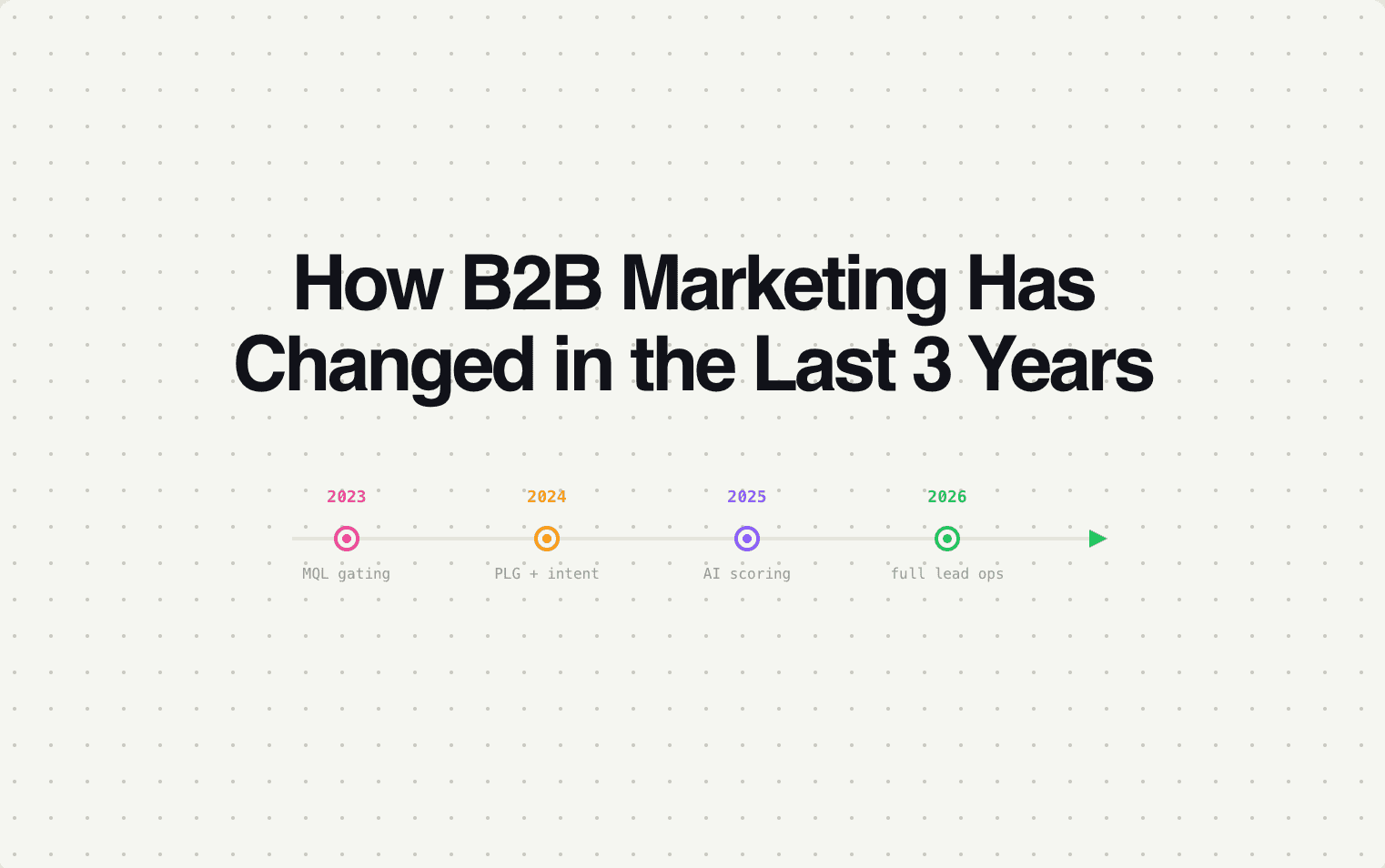
Three years ago — early 2022 — the B2B marketing playbook was still recognizable. Generate leads with content and paid campaigns. Score them with behavioral models. Nurture them through email sequences. Hand them to sales when they hit MQL threshold. The stack was stable, the metrics were familiar, and the biggest debates were about attribution models and content strategy.
Then three things happened simultaneously: AI went mainstream, ad costs spiked, and buyer behavior shifted permanently. The marketing function that exists today is fundamentally different from the one that existed in 2022 — and most teams haven't fully adapted.
Shift 1: AI collapsed the content moat
In 2022, content was a competitive advantage. Producing high-quality blog posts, whitepapers, and email sequences at scale required writers, editors, and ops people. Companies that invested in content outperformed those that didn't, because good content was hard to produce.
By 2025, every company can produce adequate content with AI tools. The floor has risen dramatically. A founder with Claude can produce a passable blog post in 10 minutes. An email sequence that used to take a copywriter a day takes an hour.
The implication: content is no longer a moat. Every company has it. The differentiation has shifted from "who produces the best content" to "who converts content-driven traffic most effectively." The companies winning aren't the ones with the best blog — they're the ones with the best infrastructure for turning blog readers into booked meetings.
Shift 2: Ad costs made efficiency existential
B2B CPCs across Google, Meta, and LinkedIn have risen 20–40% since 2022. For companies spending $50K–$200K/month on paid channels, this means the same budget generates fewer clicks than it did three years ago.
The response from most teams was predictable: optimize the ads. Better creative, tighter targeting, new channels. This helps at the margins. But the highest-leverage response — improving what happens after the click — has been largely ignored.
When a click cost $5, losing 40% of leads to slow follow-up was expensive but survivable. When a click costs $15–$50, the same 40% loss rate is catastrophic. The math changed, and the teams that adapted focused less on generating leads and more on converting them.
Shift 3: Buyers stopped waiting
The B2B buying process compressed. In 2022, a buyer might spend 3–4 weeks researching before filling out a form. By 2025, the same buyer does that research in 3–4 days — often in a single afternoon. They read your case studies, check G2 reviews, compare pricing, and submit a demo request all in one session.
This compression has two effects on marketing. First, the lead that fills out your form is further along in their decision than they used to be — they don't need nurture, they need a conversation. Second, they're evaluating you and two competitors simultaneously — the first company to respond with something useful wins the meeting.
Speed-to-lead went from "nice to have" to "the most important metric in the funnel." A 2022 response time of 4 hours was normal. In 2025, it's a death sentence — the buyer has already booked with a competitor.
What the adapted teams look like
The teams that have fully adapted to these three shifts share common characteristics:
They measure cost per meeting, not cost per lead. CPL tells you how much you paid for a form submission. Cost per meeting tells you how much you paid for pipeline. The teams that shifted to this metric discovered their "efficient" campaigns weren't efficient at all.
They qualify at capture, not in nurture. Instead of scoring leads over weeks of email engagement, they ask qualifying questions on the form — budget, timeline, company size — and route based on the answers immediately. The qualification that used to take 2 weeks now takes 30 seconds.
They respond in under 60 seconds. Automated capture-to-response pipelines that qualify, route, and respond before the lead closes the tab. No CRM notification delays. No rep availability dependencies.
They focus investment on the capture-to-meeting layer. The infrastructure between "form submission" and "meeting booked" is where they spend their optimization time — not on ad creative or email subject lines.
Where Surface fits
Surface was built for the post-2022 B2B marketing reality — where content is abundant, clicks are expensive, and buyers won't wait. Capture, qualification, routing, and instant response in one system that converts more of your existing traffic into pipeline.
If your marketing playbook still looks like 2022 — score leads, nurture them for weeks, hand them to sales — the market has moved on. Surface was built for where the market is now.