
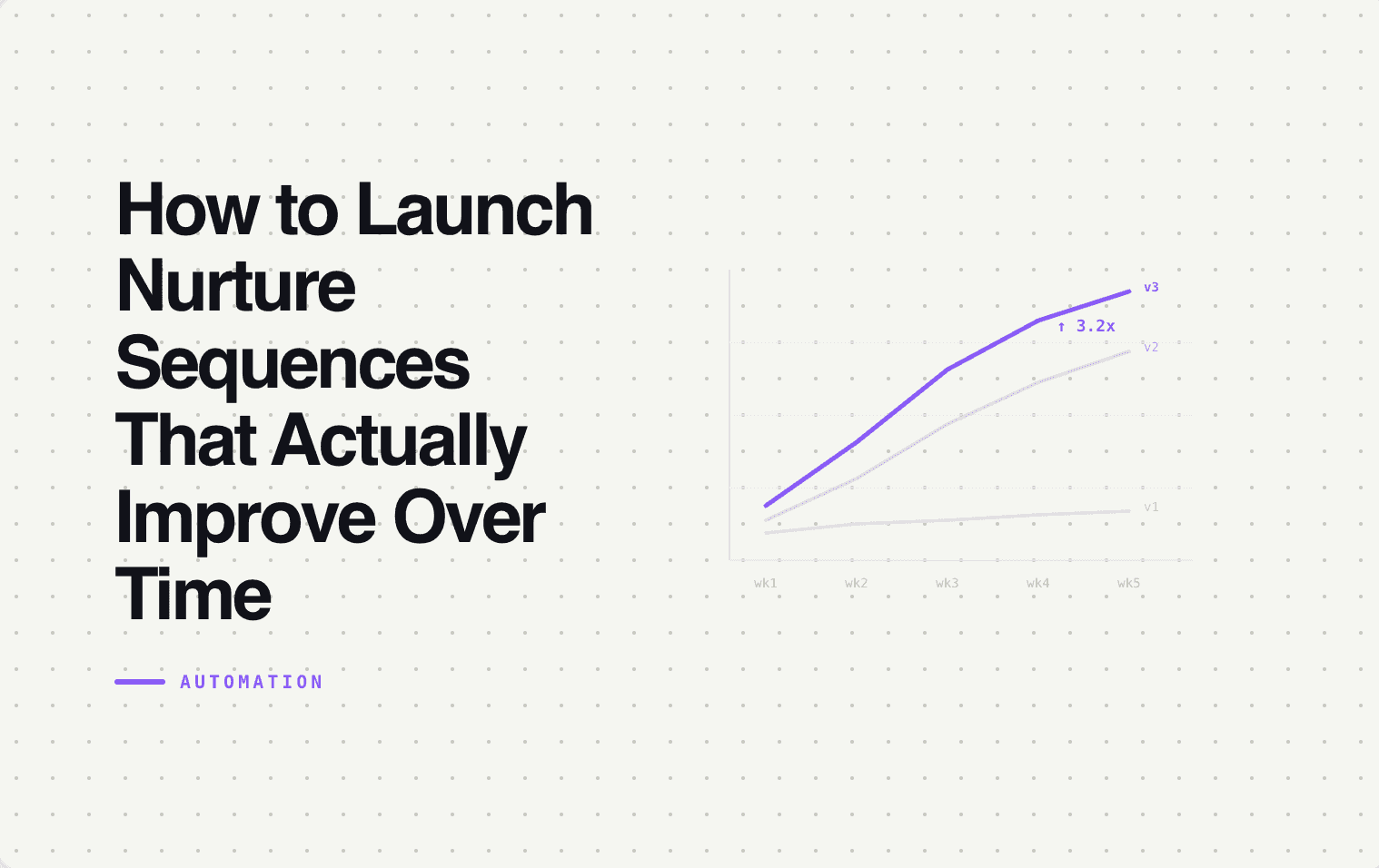
Your nurture sequence was built 8 months ago. Five emails, spaced 3 days apart, with the same subject lines and the same case study links. Nobody's looked at the performance data since launch. Open rates have quietly dropped 25%. The product features referenced in email #3 were updated two quarters ago. And every mid-market lead — regardless of industry, use case, or intent level — gets the exact same sequence.
Set-and-forget nurture is the default. It shouldn't be. Here's how to build sequences that get better over time without requiring a full-time ops person to babysit them.
Why nurture sequences decay
Every nurture sequence starts to decay the moment it launches. Three forces work against it:
Audience fatigue. The same emails sent to the same segment for months. Early recipients respond well because the content is fresh. Later recipients have seen similar messaging from competitors and their attention is harder to earn.
Content staleness. Product features change. Case studies age. Competitive positioning shifts. The emails reference a reality that no longer exists — and leads notice.
Static segmentation. The sequence treats "mid-market" as one audience. But a mid-market SaaS company and a mid-market manufacturing company have completely different pain points. Sending both the same nurture is lazy targeting that feels generic to both.
The fix isn't "rewrite the sequence every quarter." It's building the sequence with improvement mechanisms baked in from the start.
Build with variants from day one
Every email in the sequence should have at least two subject line variants. Not because you'll A/B test once and pick a winner — but because the system should continuously test, promote winners, and retire losers.
| Variant A | Variant B | What you're testing | |
|---|---|---|---|
| Email 1 (Intro) | "Quick question about 's lead flow" | ", noticed you were evaluating lead ops" | Personalization level — company name vs. first name |
| Email 2 (Case study) | Industry-matched case study | Best-performing case study overall | Relevance vs. social proof |
| Email 3 (Benchmark) | "How compares to benchmarks" | "Your lead-to-meeting rate vs. the average" | Specific vs. general framing |
| Email 4 (Direct ask) | Soft CTA — "happy to walk you through it" | Direct CTA — "book 15 minutes this week" | Low-pressure vs. high-urgency |
The system tracks open rates, reply rates, and downstream conversion for each variant. When one variant outperforms the other by a meaningful margin (30%+ difference with enough volume), it gets promoted — the underperformer gets paused and replaced with a new test.
This isn't one-time optimization. It's continuous — the sequence evolves based on what actually works with your audience, not what a marketer assumed would work 8 months ago.
Match content to the lead, not the segment
A nurture sequence for "mid-market leads" is too broad. The content should adapt based on what you know about each lead:
Industry matching. If the lead is in SaaS, send the SaaS case study. If they're in professional services, send the services case study. If you don't have a matching case study, send the one with the highest overall conversion rate. This requires a content pool — 3–5 case studies tagged by industry — not a single hardcoded link.
Use case matching. If the lead stated on the form that they're trying to fix lead routing, the nurture should reference routing problems and routing solutions. If they said they're trying to improve form conversion, the nurture should reference that. One-size-fits-all ignores data you already have.
Intent-level matching. A lead who submitted a demo request but didn't book should get a faster, more direct sequence — they were ready to talk and something stopped them. A lead who downloaded a whitepaper needs more education before a direct ask. Different starting intent levels need different cadences and different CTAs.
Set up automatic performance rules
Instead of reviewing nurture performance monthly in a spreadsheet, define rules that act automatically:
Variant promotion rule: If variant A has a reply rate 30% higher than variant B, and both have been sent to at least 75 people, promote A and pause B. This ensures the better-performing content reaches the majority of leads without waiting for a human review.
Content retirement rule: If a case study link's click-through rate drops below 1% for 30 consecutive days, flag it for replacement. The content may be stale, the company referenced may have changed, or the topic may no longer resonate.
Unsubscribe alert rule: If any single email in the sequence has an unsubscribe rate above 3%, pause it immediately and alert the team. Something about that email is actively pushing leads away.
Sequence completion rule: If fewer than 15% of leads who enter the sequence reach the final email (most are exiting early without converting), the sequence structure needs rethinking — not just the content.
What stays manual
Writing the emails. AI can generate drafts, but nurture emails need to be on-brand, strategically coherent, and grounded in real product knowledge. A human writes the content.
Strategic decisions. Adding a new sequence for a new segment, changing the overall nurture strategy, or deciding when to escalate from nurture to direct sales outreach — these require business context that automation can't provide.
Responding to flagged items. When the system pauses an underperforming variant or flags a high-unsubscribe email, someone needs to decide what to do — rewrite, replace, or remove. The system surfaces the problem. A human solves it.
Where Surface fits
Surface supports nurture sequences with built-in variant testing, content matching, and automatic performance rules. Sequences adapt based on lead attributes and real performance data — not static configurations that decay over time.
If your nurture sequence hasn't been updated in 6 months and you don't know which emails are performing, Surface gives you the infrastructure to make nurture a system that improves itself — with your team handling the strategy and content, not the optimization mechanics.