
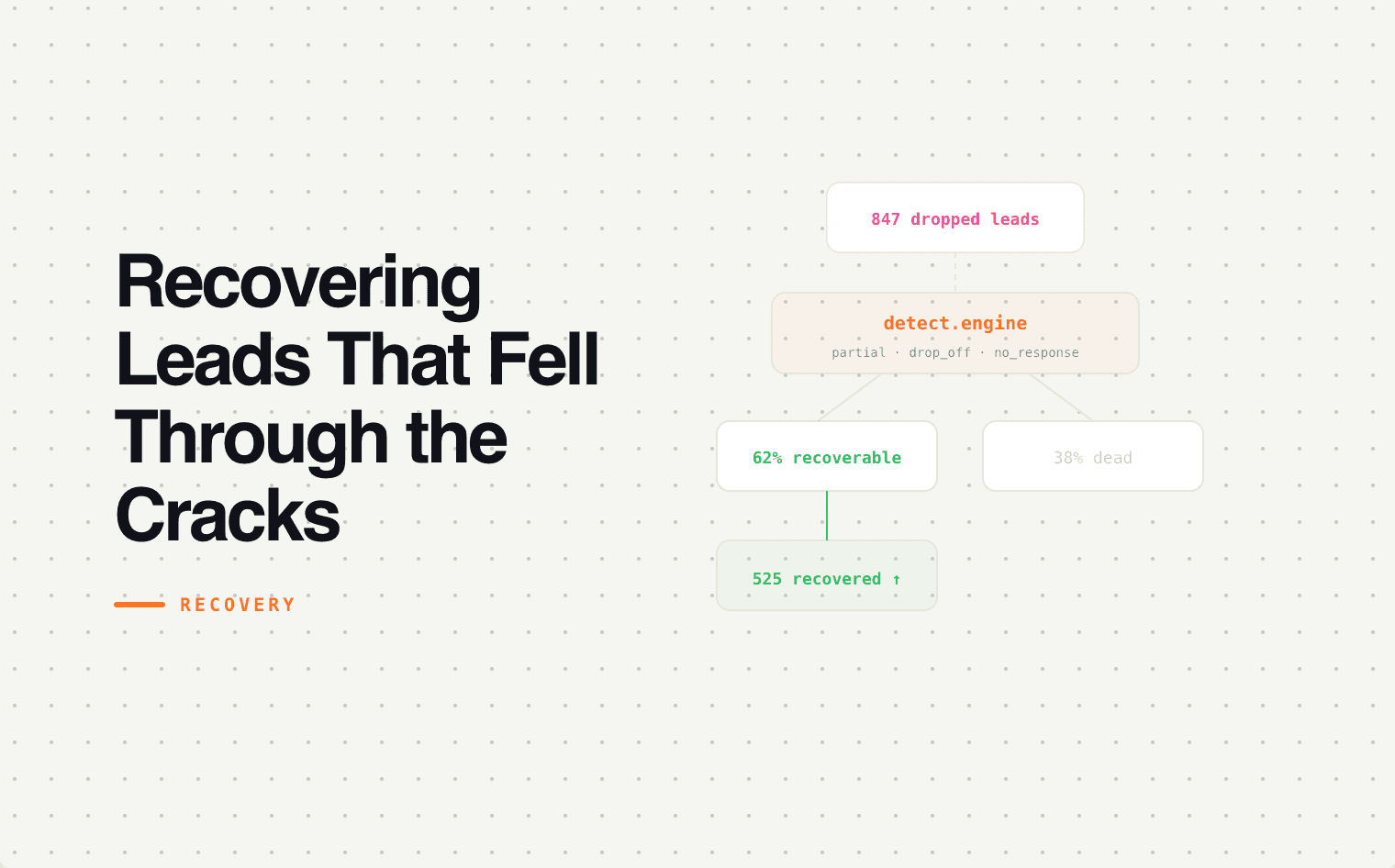
The middle school version: Picture a bucket with tiny holes in it. Water (your leads) slowly leaks out. Some people start filling out a form but quit halfway. Others visit your website a bunch but never sign up. Surface is like a net under the bucket — it catches those leaky leads and sends them friendly nudges to come back.
The silent revenue killer
Before we built lead recovery into Surface, we ran an audit. We wanted to know: how many leads are we losing to partial engagement? People who started but didn't finish. People who showed intent but never converted.
The numbers were worse than we expected.
| Leak type | Volume (monthly) | What was happening |
|---|---|---|
| Form abandonment | ~340 partial submissions | People entered their email (sometimes more) and then left before completing the form. The data evaporated. |
| Repeat visitors who never converted | ~1,200 identified visitors | People who visited 3+ times, viewed pricing, read case studies — and never filled out a form. High intent, zero capture. |
| Email opens without clicks | ~800 nurture recipients | People opening our emails consistently but never clicking through or engaging further. Stuck in a loop. |
| Meeting no-shows who went dark | ~40 per month | People who booked a meeting, didn't show, and never rescheduled. They were interested enough to book — what happened? |
Combined, that's over 2,300 leads per month with demonstrated interest that our existing tools (HubSpot, Customer.io) weren't recovering.
What HubSpot and Customer.io couldn't do
We tried building recovery workflows in HubSpot first. The problem: HubSpot can't capture partial form submissions. If someone types their email but doesn't hit submit, that data doesn't exist in HubSpot. It's gone.
Customer.io was better for behavioral triggers — we could fire emails based on page visit patterns. But it couldn't connect those behavioral signals to our lead ops pipeline. A repeat visitor would get a nurture email, but there was no path from that email to a qualified, routed lead. The recovery happened in a silo, disconnected from our routing and scheduling infrastructure.
The fundamental gap: these tools could send messages, but they couldn't close the loop — from recovery trigger to qualified lead to routed rep to booked meeting. They recovered attention but not pipeline.
How Surface recovers leads
We built our recovery system directly into Surface. Each leak type gets a specific recovery sequence:
Form abandonment recovery. Surface captures partial submissions — any field the visitor completed before leaving. If they entered an email (even without hitting submit), Surface saves it and triggers a recovery sequence within 5 minutes. The message is specific: "Looks like you didn't finish your request. Here's a link to pick up where you left off." Recovery rate: 22% of abandoned forms complete on the second attempt.
Repeat visitor triggers. When an identified visitor (cookied from a previous interaction or matched via enrichment) returns to the site for a 3rd+ visit and views high-intent pages (pricing, case studies, product), Surface triggers a contextual capture experience — not a generic popup, but a form that references what they've been looking at. "We noticed you've been exploring our routing features. Want to see how it works for your team?" Conversion rate on triggered captures: 8% — vs. 2% on generic forms.
Stale nurture re-engagement. For leads in email nurture who open consistently but never click, Surface detects the pattern after 3 opens with zero clicks and shifts the approach. Instead of another email, Surface triggers an on-site capture experience the next time they visit — a different format, a different offer, a different ask. This breaks the pattern that email alone couldn't break.
No-show recovery. When a lead books a meeting and doesn't show, Surface triggers a recovery sequence within 30 minutes: a brief, human message from the assigned rep ("Missed you today — here's a link to rebook whenever works") plus a follow-up 2 days later if they don't rebook. Recovery rate: 35% of no-shows rebook within a week.
The results
| Recovery type | Monthly volume recovered | Impact |
|---|---|---|
| Form abandonment | ~75 leads recovered | 22% recovery rate. These are high-intent leads who already started the form. |
| Repeat visitor capture | ~96 leads captured | 8% conversion on triggered experiences. Net new pipeline that didn't exist before. |
| Stale nurture re-engagement | ~45 leads reactivated | Broke the open-but-never-click loop for 5.6% of stuck leads monthly. |
| No-show rebooking | ~14 meetings recovered | 35% rebook rate. Each one is a conversation we would have lost entirely. |
Total: ~230 additional leads or meetings per month recovered from traffic and engagement we were already generating. No additional ad spend. No new campaigns. Just catching what was already leaking.
Why we're building this natively
We're building lead recovery as a native Surface feature because the existing tools treat recovery as a messaging problem (send more emails) when it's actually an infrastructure problem (capture the data, route it properly, and make the recovery flow as smooth as the primary flow).
Recovery should work the same way primary capture works — qualification, routing, instant response, and scheduling. A recovered lead should get the same treatment as a fresh lead, not a second-class nurture email.
Stop losing leads. See how Surface recovers revenue you didn't know you were missing.