Your marketing team spent thousands getting someone to fill out that form. The prospect is interested right now. They've got three tabs open comparing vendors. They just came out of an internal meeting where someone said "we need to fix this."
Then your team takes 42 hours to respond.
That's the average. Not the worst case — the average. By the time your rep sends a "thanks for reaching out" email, the prospect has already booked with someone else.
The 5-minute window most B2B teams miss
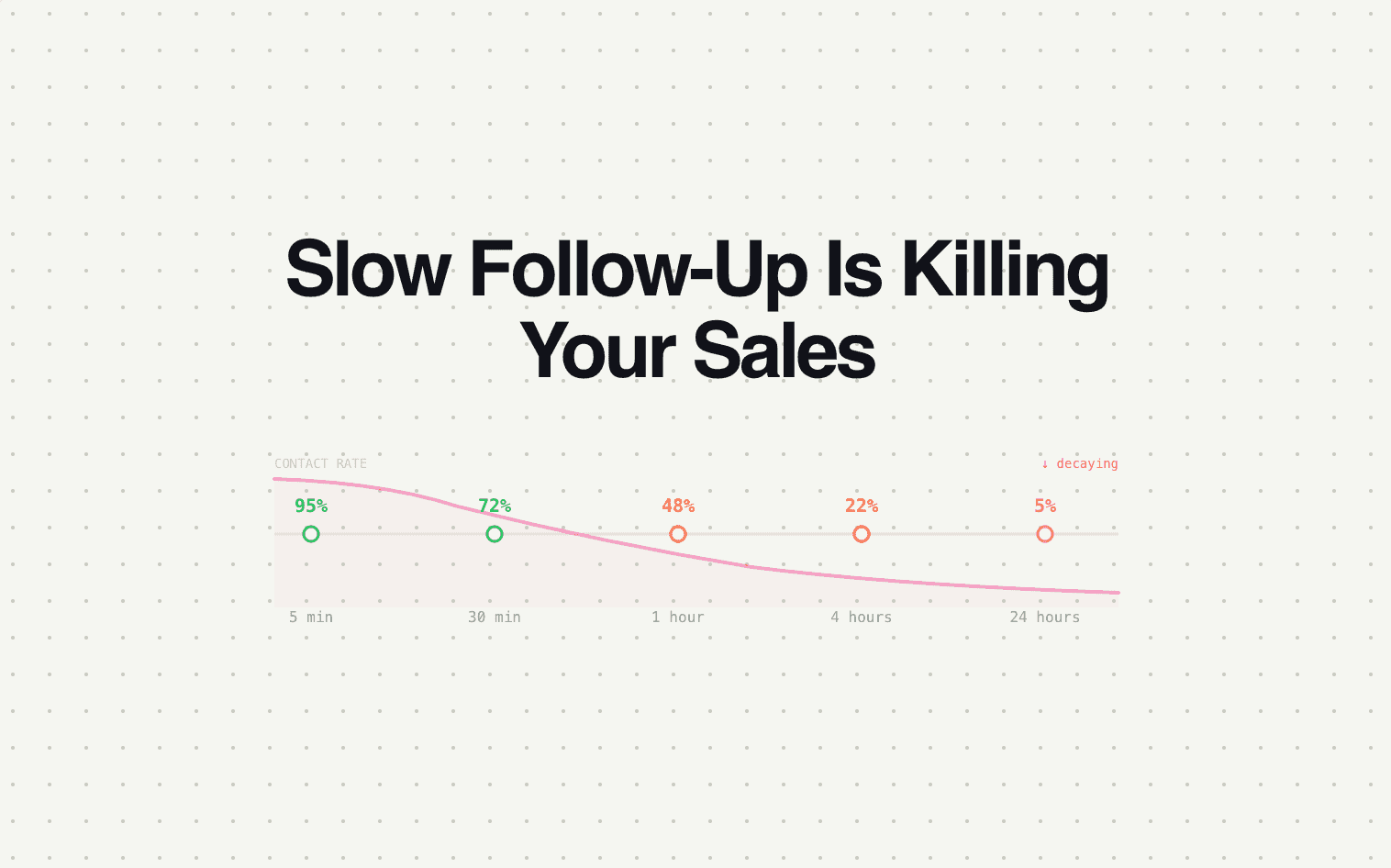
Leads contacted within 5 minutes are 21x more likely to convert than leads contacted after 30 minutes. After an hour, the odds drop off a cliff.
Harvard Business Review published this years ago. Drift confirmed it across 2,500+ B2B companies. The numbers haven't changed because the underlying behavior hasn't changed — when someone wants to buy, they want to talk now. Not tomorrow.
Five minutes is the window. Most teams aren't even close.
Why your lead response time is slow
Reps aren't sitting around ignoring leads. The system between "form submitted" and "rep sees it" is what's slow.
| Step | Time added | Where it breaks |
|---|---|---|
| Form to CRM sync | 1–3 minutes | Sync delays, missing fields |
| Routing workflow fires | 2–10 minutes | Complex branches, wrong assignment |
| Rep gets notified | 5 min to 4 hours | Email buried, rep in meetings |
| Rep researches the lead | 10–15 minutes | No enrichment data, manual lookup |
| Rep drafts outreach | 5–10 minutes | Generic template, no context |
| Total | 30 min to 48 hours | Prospect gone after 5 min |
Every step between form fill and first contact is time you're giving your competitor.
The math nobody does
500 leads a month at $50 each. $25,000 in acquisition cost. At 10% conversion, that's 50 meetings. Cost per meeting: $500.
Cut response time from hours to minutes. Research says that alone can 2–3x your conversion rate. Even conservatively — 10% to 20% — that's 100 meetings instead of 50. Same leads. Same spend.
At a $20K average deal size and 20% close rate, those 50 extra meetings are worth $200K in pipeline per month. $2.4M per year. From leads you already paid for.
How to fix it
Start with the highest-leverage fix.
Move scheduling into the form. Let prospects book a meeting before they leave the page. If the right calendar shows up based on their responses, response time becomes zero.
Enrich leads in real time. Reps spend 10–15 minutes researching every lead. Real-time enrichment appends company data the moment someone enters their email. That research step disappears.
Score leads automatically. Not every lead needs a five-minute response. But the ones that match your ICP do. Automatic scoring means reps know which leads to call first.
Speed-to-lead benchmarks
Most teams don't actually know their number. They track time-to-assignment, which only measures when the CRM assigns the lead — not when the rep actually does something about it. The real number, form fill to first human contact, is almost always worse than people think.
| Response time | Conversion impact |
|---|---|
| Under 5 minutes | 21x more likely to qualify the lead |
| 5–30 minutes | Still strong, drops with each minute |
| 30–60 minutes | Significantly lower probability |
| 1–4 hours | Most of the opportunity is gone |
| 24+ hours | Barely better than not responding |
| 42 hours (industry avg) | Where most B2B teams sit |
Where to start
Measure the real number. Not time-to-assignment — time from form fill to meeting booked. If you don't know it, that's the first problem.
Surface Labs collapses the entire chain into one step — enrichment, scoring, routing, and scheduling happen inside the form before the prospect leaves the page. If your current setup has more than two steps between form fill and meeting booked, it might be worth a look.