Marketo is one of the original enterprise marketing automation platforms. Acquired by Adobe, it powers marketing operations at thousands of mid-market and enterprise companies. It's powerful, deeply configurable, and — if you've ever tried to set it up — genuinely complex.
Surface Labs is not a marketing automation platform. It handles one thing: the capture-to-meeting layer that sits between your ad spend and your CRM. Different tools, different jobs — but they end up on the same shortlist because teams buying Marketo often expect it to solve lead conversion problems it wasn't designed for.
What Marketo does well
Marketo excels at enterprise-grade campaign orchestration. Multi-step nurture programs, behavioral triggers, dynamic content, account-based marketing, and advanced lead scoring — Marketo handles sophisticated marketing operations at scale.
Its integration with Salesforce is deep. Its reporting and attribution capabilities are built for organizations with complex, multi-touch buying journeys. And for marketing ops professionals who know the platform, it's one of the most flexible automation tools on the market.
The comparison that matters
Marketo's strength is in long-cycle marketing operations — nurturing a lead over weeks or months through content and engagement. Surface's strength is in the first 60 seconds — capturing, qualifying, routing, and responding to a lead the moment they raise their hand.
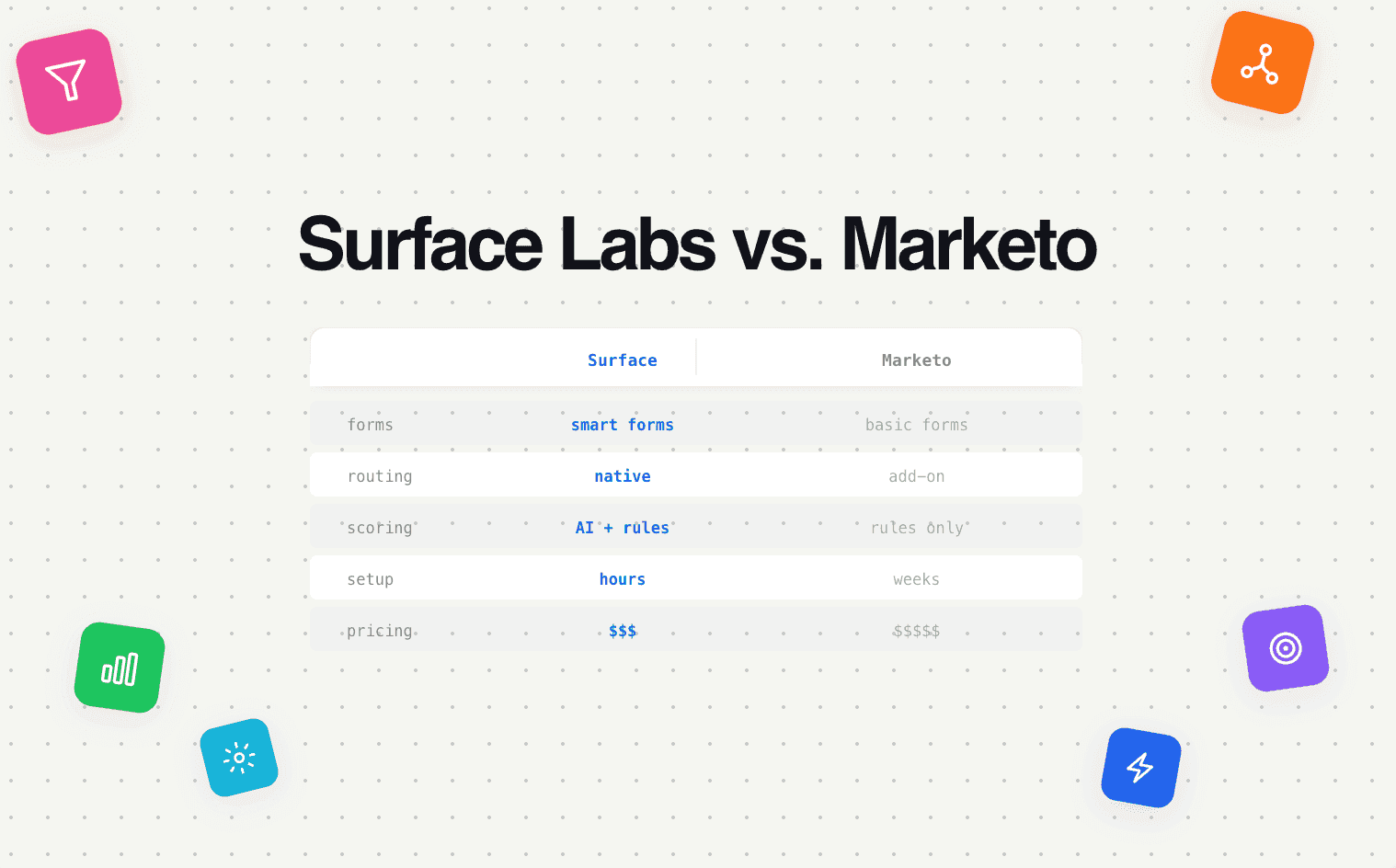
| Capability | Marketo | Surface Labs |
|---|---|---|
| Email nurture / drip campaigns | Enterprise-grade. Multi-track, behavior-triggered, dynamic content. | Not included. |
| Lead scoring | Sophisticated — behavioral + demographic, multiple scoring models, score decay | Real-time qualification at capture. Scores based on form responses + enrichment, not accumulated behavior. |
| Campaign orchestration | Deep — programs, channels, nested campaigns, A/B testing at scale | Not included. |
| Lead capture forms | Built in. Functional but basic. Not designed for real-time qualification or routing. | Core product — multi-step conditional forms with branching qualification logic |
| Intelligent routing | Not native. Requires Salesforce integration + custom flows or third-party tools. | Core product — real-time routing by territory, deal size, product, availability |
| Speed-to-lead | Depends on Marketo-to-Salesforce sync + CRM workflow. Typical: 15 min – hours. | Sub-60 seconds by design |
| Embedded scheduling | Not available. | Native — book on matched rep's calendar within the form flow |
| Setup and time-to-value | 8–16 weeks with a certified consultant or dedicated admin | Days. Self-serve configuration. |
| Ongoing maintenance | Requires Marketo-certified admin. Program logic, smart lists, token management. | Self-serve. Non-technical ops teams can manage routing and forms directly. |
| Pricing | $1,000–$4,000+/month plus implementation and admin costs | Significantly lower. No implementation fees. No admin required. |
Marketo wins on marketing automation depth. Surface wins on the real-time capture-to-meeting flow. They're not competing for the same job.
The real cost of Marketo
Marketo's licensing starts at roughly $1,000/month for small databases and scales to $4,000+/month for enterprise tiers. But the licensing is the smaller number.
Implementation runs $10K–$50K+ with a certified Marketo partner. The platform is complex enough that most teams can't self-implement — the program structure, scoring models, and Salesforce integration require specialist knowledge.
Ongoing admin requires a Marketo-certified professional — either a full-time hire ($80K–$130K/year) or a fractional consultant ($3K–$6K/month). Without one, the platform gradually decays — programs break, scoring models drift, and sync issues go undetected.
Total cost of ownership for a mid-market company on Marketo typically runs $80K–$200K/year when you include licensing, admin, and periodic consulting.
For companies that use Marketo's full capability set — complex nurture programs, ABM, multi-touch attribution — this investment can be justified. For companies that primarily need leads to reach the right rep faster, it's massive overkill.
What teams actually need from Marketo vs. what they use
This is the pattern we see: a company buys Marketo because they're "ready for enterprise marketing automation." They implement it over 3 months. They build a few email programs and a basic scoring model. And then the platform sits at 20–30% utilization because the team doesn't have the operational bandwidth to use its advanced features.
Meanwhile, the actual problem — leads sitting in Salesforce for hours before anyone contacts them, routing that doesn't match the sales structure, no qualification at capture — remains unsolved. Because those aren't marketing automation problems. They're lead ops problems.
Marketo can be configured to partially address these issues, but it requires custom programs, Salesforce flow integration, and ongoing maintenance by a specialist. Surface solves them natively, in days, without a specialist.
What the right setup looks like
The best-performing teams we see using Marketo run both platforms:
Marketo handles what it's built for — email nurture, scoring decay, ABM programs, and campaign attribution. Surface handles the real-time layer — capturing, qualifying, routing, and responding to leads at the moment of capture. Qualified leads flow from Surface into Salesforce, where Marketo picks them up for ongoing nurture.
Each tool does the job it was designed for. Neither is asked to do the other's job.
Where Surface fits
Surface is the real-time lead ops layer that Marketo doesn't provide. If you're on Marketo and your leads are still waiting hours for a response, the gap isn't in your marketing automation — it's in the layer that sits upstream. Surface closes it at a fraction of Marketo's cost, without the implementation timeline.