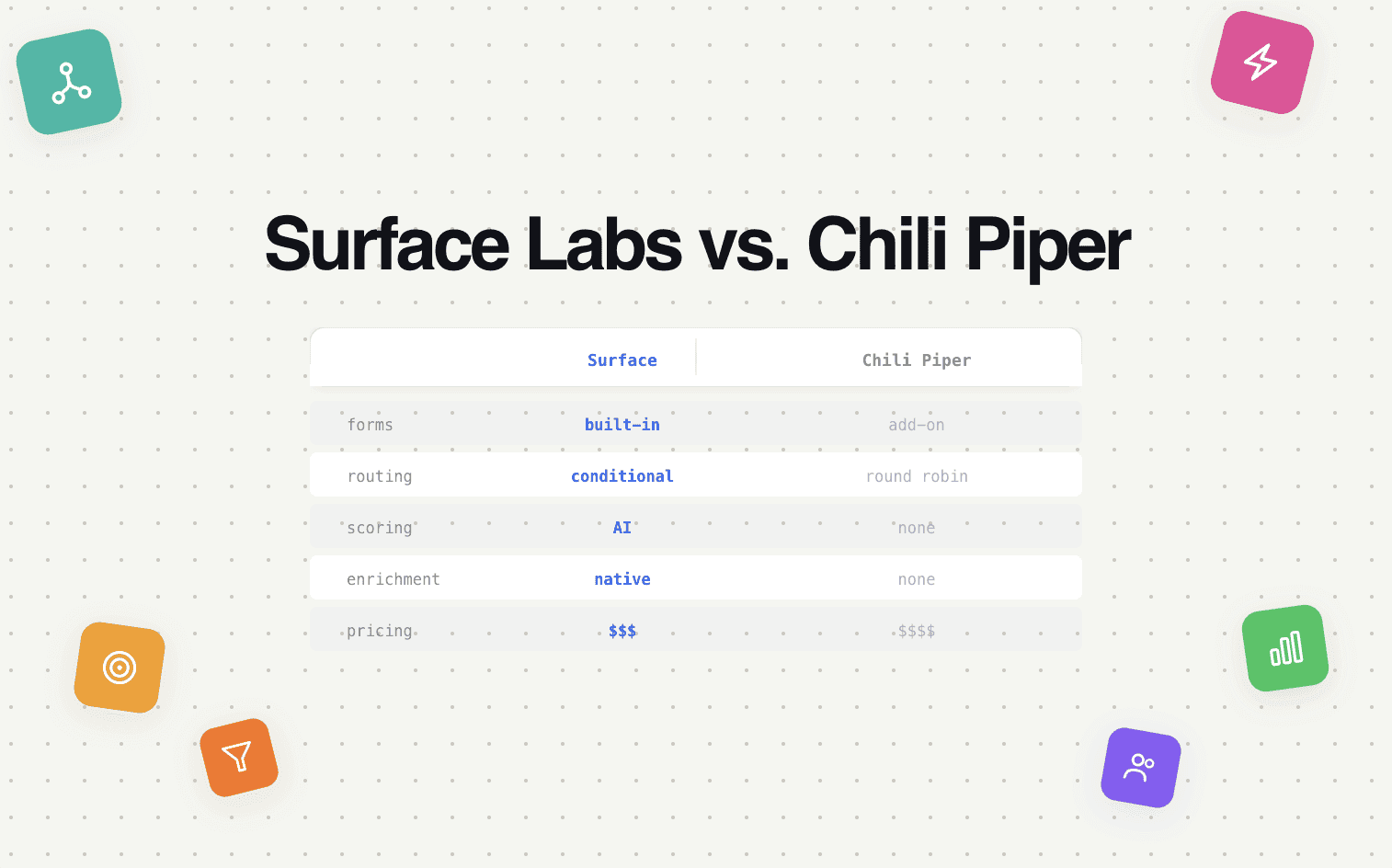
Chili Piper was the go-to for inbound lead routing and scheduling for years. They helped define the category.
But that was a different era. Chili Piper was built before AI-powered qualification, before built-in enrichment, before teams started demanding one platform instead of five. And for many teams, the legacy pricing model and growing complexity have become hard to justify.
Here's an honest breakdown of where each product fits.
What Chili Piper does well
Chili Piper nailed the core problem early: when someone fills out a form, get them to a sales rep and a calendar invite fast. Their Concierge product did this well and integrates with most major CRMs.
If all you need is a scheduling layer on top of your existing forms with basic routing, it still works.
The question is whether a legacy scheduling-and-routing tool is enough for how B2B teams operate today.
Where Chili Piper breaks down
The routing builder gets complicated fast
Chili Piper's routing uses a visual flow builder. For simple setups — a round robin across five reps — it's fine.
But add territories, account-based routing, ICP scoring, and fallback logic, and it becomes a sprawling diagram that's hard to read and harder to update.
With Surface Labs, you describe your routing logic in plain English to an AI assistant and it builds the rules for you. No dragging boxes. No tracing lines through a flowchart.
It's a routing tool, not a lead ops platform
Chili Piper handles one piece: getting a form fill to a calendar invite. It doesn't build the form, enrich the lead, filter spam, or qualify before routing.
So you still need a form tool, an enrichment tool, and a spam solution. Three or four extra tools, three or four extra integrations, three or four extra points of failure.
Surface Labs combines forms, enrichment, qualification, routing, spam filtering, and scheduling in one system. One lead comes in, everything happens in a single flow. No stitching. No middleware.
Seat-based pricing is a legacy model that punishes growth
Take a look at Chili Piper's pricing page:
Our team genuinely didn't know what to click on when we first saw this.
There are five separate products — Concierge, Chat, Distro, Handoff, and ChiliCal — each priced at $30/user/month, plus platform fees ranging from $150 to $1,000/month depending on the product. And their new Chat AI product is a flat $20,000/year.
Here's what the math actually looks like:
| Product | Per-seat cost | Platform fee | What it does |
|---|---|---|---|
| Concierge | $30/user/mo | $150–$1,000/mo | Qualify, route, and schedule |
| Chat | $30/user/mo | $1,000/mo | Chat with website visitors |
| Distro | $30/user/mo | $150/mo | Route Salesforce records |
| Handoff | $30/user/mo | $150/mo | Route and schedule on behalf of others |
| ChiliCal | $15/user/mo | — | Scheduling links |
| Chat AI | Flat fee | $150/mo | AI chatbot — $20,000/year |
Most teams need at least Concierge + Distro. For a 15-person sales team, that's $900/month in seat fees plus $150–$1,150 in platform fees — before you've added chat, handoff, or any add-ons. Scale to 30 reps and you're well past $2,000/month just for routing and scheduling. Scale to 50 and you're approaching six figures a year.
And here's the fine print at the bottom of their page: month-to-month contracts are only for new customers. Once you're in, you're locked into annual.
This is the core problem with legacy per-seat pricing. Your growth becomes their revenue. Every new hire, every new territory — the bill goes up, even though the software isn't doing anything different.
It locks you into their scheduler
When you use Chili Piper, you use Chili Piper's scheduling. If your team prefers Calendly, Cal.com, or HubSpot Meetings… too bad.
Surface Labs integrates with Chili Piper, Calendly, Cal.com, RevenueHero, Reclaim AI, SavvyCal, HubSpot Meetings, and Clari. Use whatever you want. Swap later. Your routing doesn't care.
Your data breaks and nobody tells you
Chili Piper sits between your forms and your CRM, mapping fields from one to the other. The problem: it has no way to make sure those fields stay in sync.
Someone renames a field in HubSpot. Someone changes a dropdown on the form. Chili Piper doesn't catch it. The mapping silently breaks. Leads flow in with missing data or wrong assignments — and nobody notices until a rep complains weeks later.
Side-by-side comparison
| Surface Labs | Chili Piper | |
|---|---|---|
| Lead routing | ✅ AI-assisted logic builder | ✅ Visual flow builder (gets messy fast) |
| Lead enrichment | ✅ Built-in | ❌ Needs a separate tool |
| Data sync protection | ✅ Can't publish broken mappings | ❌ Fails silently |
| Real-time observability | ✅ Built-in monitoring + alerts | ❌ |
| Scheduling | ✅ Works with any scheduler | ❌ Chili Piper scheduler only |
| AI-powered logic building | ✅ Describe routing in plain English | ❌ |
| CRM integration | ✅ HubSpot, Salesforce, etc. | ✅ HubSpot, Salesforce, etc. |
| Pricing model | Per-company (no seat charges) | Per-seat (legacy model) |
| Best for | Teams that want one platform for the full lead-to-meeting flow | Teams that just need basic scheduling + routing on top of existing forms |
Which one should you pick?
Chili Piper if you already have your forms, enrichment, and qualification handled elsewhere and just need a legacy scheduling layer with basic routing. Simple setup, small team, don't mind managing multiple tools.
Surface Labs if you want one system from form fill to meeting booked. Complex routing, growing sales team, tired of stitching tools together, or you'd rather tell an AI what your routing should do instead of building flowcharts by hand.
Chili Piper is a legacy scheduling and routing tool. Surface Labs is a modern lead operations platform. They started in the same place. They're going in very different directions.
Want to see how Surface Labs handles your routing? *Book a walkthrough *— we'll show you what your current flow looks like in our system and build you a new flow in Surface live on the call in under 15 minutes.