
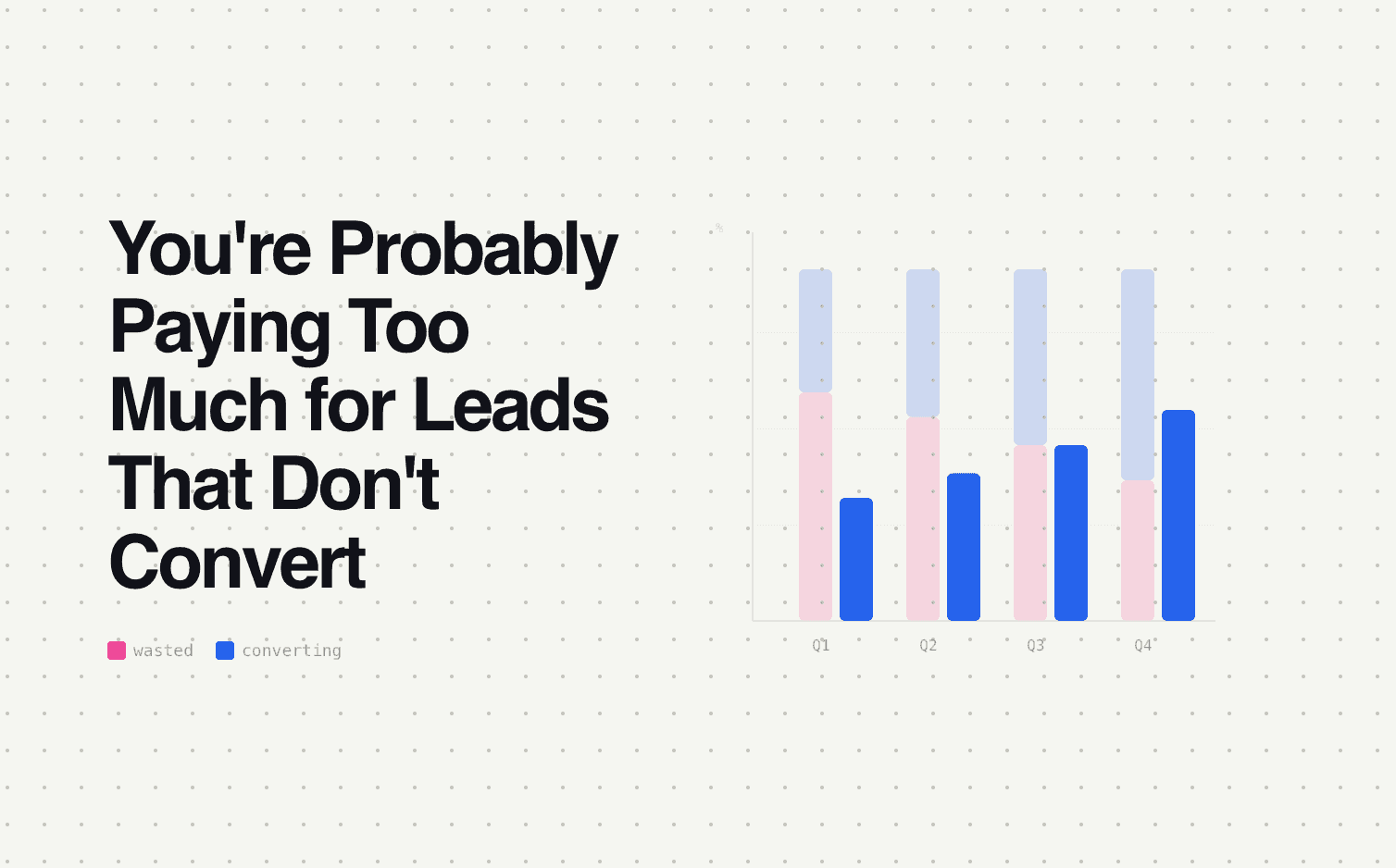
Your CPL looks fine. $80 from Google Ads. $120 from LinkedIn. $60 from content syndication. Marketing reports these numbers every month and they're within industry benchmarks. Nobody raises a flag.
But here's the number nobody reports: what does it cost to get a lead that actually books a meeting? Not a form submission. Not an MQL. A real conversation between a qualified buyer and the right rep on your team.
That number is almost always 5–10x higher than your CPL — and it's the one that actually determines whether your marketing spend is working.
The CPL illusion
CPL tells you how much you paid for a form submission. It's easy to measure, easy to benchmark, and easy to optimize. It's also deeply misleading because it treats every form submission as equal.
A $80 Google Ads lead who's a VP at a 500-person company evaluating this quarter is not the same as an $80 Google Ads lead who's a student researching a class project. Both cost $80. One is worth pursuing. The other burned $80 plus the enrichment cost, the SDR's time, and the rep's attention.
CPL doesn't differentiate. Cost per meeting does.
The real math
| Metric | What you report | What's actually happening |
|---|---|---|
| Monthly ad spend | $50,000 | $50,000 |
| Leads generated | 400 | 400 |
| CPL | $125 | $125 |
| Leads that get a timely response (under 5 min) | Not tracked | 160 (40%) |
| Leads routed to the correct rep | Not tracked | 120 (75% of contacted) |
| Leads where rep had qualifying context | Not tracked | 50 (42% of correctly routed) |
| Meetings booked | Maybe tracked | 22 |
| Cost per meeting booked | Not reported | $2,273 |
$125 CPL sounds efficient. $2,273 per meeting is not. The gap between those two numbers is where your marketing budget is leaking — and it's leaking in the infrastructure between form submission and sales conversation, not in the ads.
Where the money leaks
Leak 1: Leads that don't get a fast response. 60% of your leads are contacted after the 5-minute window where conversion rates are highest. Those leads cost the same to acquire but convert at 1/3 to 1/5 the rate. You're paying full price for leads and then degrading their value by responding too slowly.
Leak 2: Leads that go to the wrong rep. 25% of leads get round-robined to a rep who doesn't match their territory, deal size, or product interest. The rep either mishandles the conversation or reassigns — adding hours of delay. Those leads cost the same to acquire and produce a fraction of the meetings.
Leak 3: Leads that arrive without qualification data. The rep calls with no context — doesn't know the lead's budget, timeline, company size, or use case. The first 5 minutes of the call are wasted on questions the form should have asked. The lead gets impatient. The conversation feels like an interrogation, not a consultation.
Leak 4: Leads that get a generic response. "Thanks for reaching out, someone will be in touch shortly." The lead feels like a number, not a person. They close the tab and talk to the competitor who responded with a personalized message and a direct scheduling link.
Each leak doesn't just lose that individual lead — it inflates the cost of every meeting you do book. When you lose 60% of your leads to infrastructure failures, the 40% that do convert are carrying the full cost burden.
The fix: optimize for cost per meeting, not CPL
Shift your optimization target from "reduce cost per lead" to "reduce cost per meeting booked." This changes which levers you pull.
| Lever | Impact on CPL | Impact on cost per meeting |
|---|---|---|
| Tighten ad targeting | CPL may increase (smaller audience) | Cost per meeting likely decreases (better-fit leads convert at higher rates) |
| Improve speed-to-lead | No impact on CPL | Major reduction in cost per meeting — leads contacted in under 60 seconds convert 3–5x higher |
| Fix routing accuracy | No impact on CPL | Meaningful reduction — right rep = higher conversion, no reassignment delays |
| Add qualification to forms | CPL may increase slightly (fewer completions) | Major reduction — reps get qualified leads with context, conversion rate jumps |
| Connect scheduling to routing | No impact on CPL | Significant reduction — eliminating the scheduling gap recovers 15–25% of leads that would have gone cold |
Notice the pattern: the levers that most reduce cost per meeting don't touch your ads at all. They're all post-capture infrastructure improvements. You can cut your cost per meeting in half without changing a single ad campaign.
[IMAGE: A waterfall chart showing $50K ad spend → 400 leads ($125 CPL) → progressive losses at each stage (slow response, wrong routing, no qualification, generic response) → 22 meetings ($2,273 each). Then a second waterfall showing same $50K → 400 leads → minimal losses → 52 meetings ($962 each). White background, blue (#4F6DF5) accent, flat design.]
Where Surface fits
Surface is the infrastructure that plugs the leaks — capture with qualification, attribute-based routing, instant personalized response, and embedded scheduling. Every fix in this post is what Surface does by default.
If your marketing team reports CPL and your leadership team is happy, ask them one question: "What's our cost per meeting booked?" If nobody knows the answer, that's the most expensive blind spot in your budget. Surface makes it visible — and then makes it smaller.