
A Surface Labs capstone guide for content leads, single-person marketing operators, and GTM leaders who need content to earn attention, trust, and pipeline without surrendering the marketing craft to algorithm games.
Let's begin content marketing in summary
Content marketing in 2026 does not reward teams that treat visibility as the whole game. SEO still asks teams to earn referring domains, rankings, topical authority, and patient traffic over time. Answer engine optimization and AI search create faster, stranger windows of visibility, but people still build those windows from old-fashioned strategic materials: clear pages, credible claims, useful internal links, fresh evidence, structured answers, and brand authority that other people can verify.
We see the current moment through a simpler lens: content marketing still has to market. Content teams can win a citation, rank for a phrase, or appear in an AI answer and still fail if buyers land on a disconnected page, find no proof, receive no emotional reason to care, or cannot follow a path from curiosity to confidence. Content leads, solo operators, and GTM teams need content systems that respect how algorithms sort information and how humans decide whom to trust.
One sentence should hold the whole guide together: you will not find success with content if you do not consider the full landscape of your audience before writing it. That audience includes search systems, AI assistants, prospects, existing customers, sales teams, founders, product experts, and the internal people who have to explain the brand after marketing hands them a lead.
The Easy Content Marketing Mistake in 2026
A content lead opens a dashboard on Monday morning and sees a strange, familiar picture. The team published twenty new articles, earned a little traffic, triggered a few impressions in search, and still watched the best-fit buyer leave without booking a call. Someone in the meeting calls the experiment a visibility win, and everyone silently understands that the business needed something more than visibility.
That scene explains why this content marketing guide for 2026 cannot be another list of publishing hacks. Marketing teams have more tools, more templates, more synthetic drafts, more ways to summarize competitor pages, and more channels where buyers might encounter an answer. Marketers can make an article appear publishable faster than ever, which makes weak strategy more dangerous than ever because a bad idea can now move at the speed of software.
Teams should not treat this moment as a reason to abandon SEO, blogs, or owned media. Teams still need search visibility, and many teams still need the boring, patient work of earning links, improving rankings, publishing steadily, and building a site that search systems can crawl and buyers can understand. Teams also need to recognize that AEO and AI search introduce narrower and more volatile opportunities. A buyer might ask an AI assistant for recommendations before anyone on the marketing team sees a clean keyword report. An answer engine might cite a product page, a YouTube transcript, a comparison article, or a third-party mention. A human buyer might never click the first thing they see, but they might remember the brand that sounded specific enough to trust.
The mistake comes when teams flatten all of that into algorithmic victory. Content marketing still asks marketers to engage an audience by appealing to cognitive and emotional functions. People need clarity, pattern recognition, proof, memory, desire, caution, humor, and trust. Search systems can surface a page, but people decide whether the page was worth surfacing.
What Actually Changed in Content Marketing
The market moved from publishing discipline to system discipline. In 2017, many content programs still debated whether teams had documented strategies, cadence, personas, and basic SEO discipline. By 2026, marketers have moved into a messier world where owned media, video, email, social, events, communities, AI answers, and classic search all shape the route from discovery to trust. The shift is clean enough to name: teams moved from “publish regularly” toward building a durable trust engine across search, email, social, video, and AI surfaces.
External research points in the same direction. Content Marketing Institute reports that B2B marketers planned 2026 investment increases across AI-powered marketing tools, events and experiential marketing, and owned media, including websites, blogs, and email. That mix matters. Marketers are not only buying AI tools to make more things. Many teams are also putting budget behind owned channels and high-trust environments where buyers can spend enough time to believe something.
Enterprise teams reveal the operational version of the same story. Content Marketing Institute’s enterprise research found that enterprise marketers cited content relevance and quality, team skills, measurement, sales alignment, and customer understanding among the major factors improving effectiveness. Smaller content teams should tattoo the lesson somewhere near the CMS login: the team does not win because it produces more assets. People on the team win when they can decide what matters, create useful material, connect it to the buyer journey, measure whether anyone cared, and revise without turning the whole operation into committee theater.
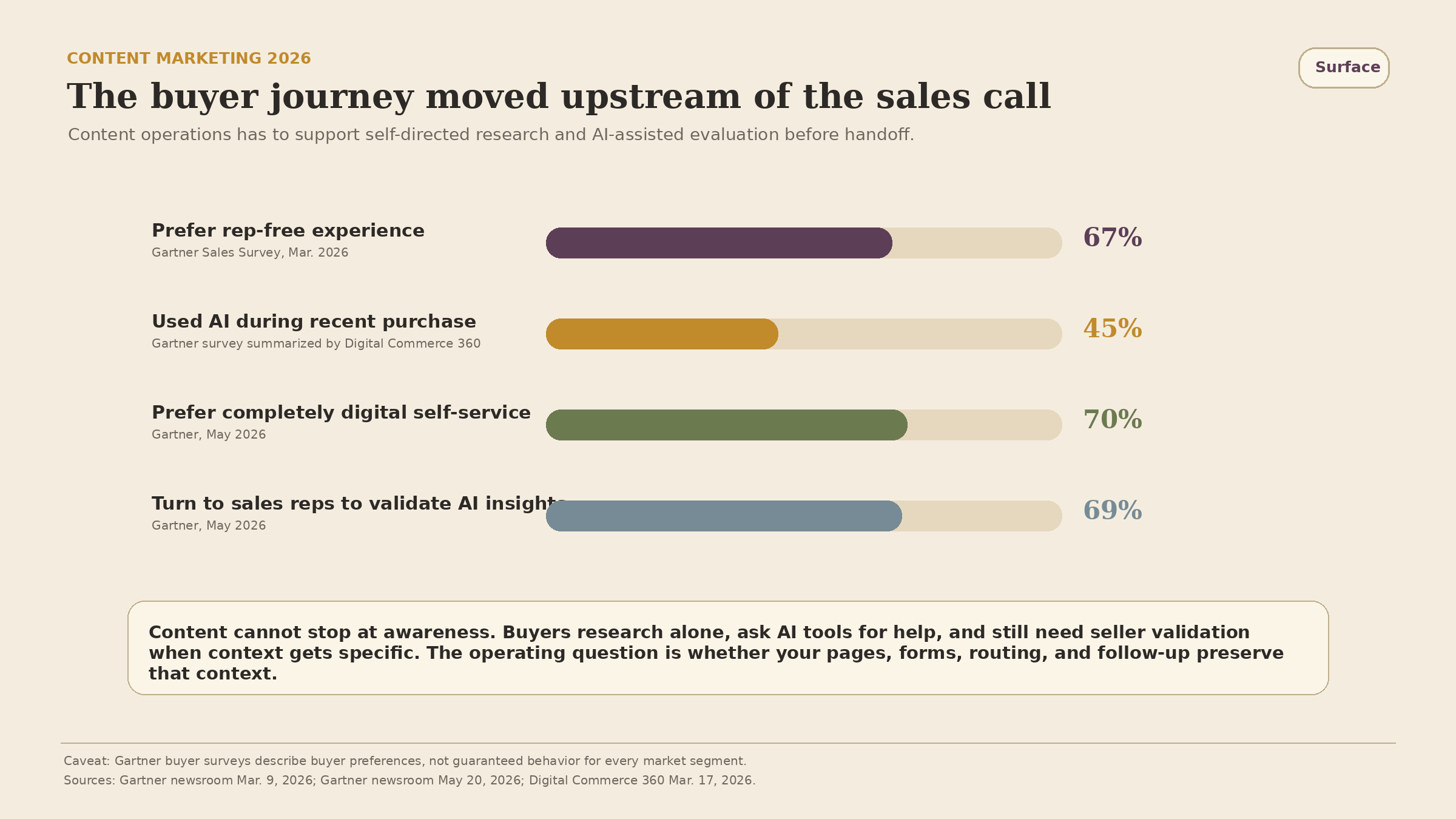
Buyers also changed how they gather confidence. Gartner reported in March 2026 that 67% of B2B buyers prefer a rep-free experience, and 45% used AI during a recent purchase. Gartner also reported in 2025 that buyers often prefer online self-service for general learning, while they still prefer seller input when they need contextual intelligence about fit. Content has to serve both moments. A blog can help a buyer learn without a rep, while a sales-enabled landing page, proof page, comparison page, or well-structured product page can help that buyer form enough confidence to involve a human.
What Stopped Working and What Works Now
The old content factory made a promise it could not keep. Teams could publish more, rank for more, and look busier. Buyers, search systems, and internal revenue teams eventually learned to distinguish motion from progress.
| What stopped working | What works now |
|---|---|
| Bulk publishing sprints that produce a burst of attention and then leave the site stale. | Consistent publishing and revision cycles that prove people still care about the site. |
| AI slop dressed up with headings, keyword stuffing, and the faint smell of competitor plagiarism. | Expert-backed content with original judgment, evidence, customer language, and a reason to exist. |
| Template addiction, where every page has the same rhythm, same claims, and same safe phrasing. | Templates as a baseline, with editors, subject matter experts, and operators adding specificity. |
| Thought leadership cosplay from people who do not want to think in public or talk to the market. | Genuine point of view from people who care, know the category, and can hold a real conversation. |
| Blog-only planning that sends every reader into the same generic CTA. | A linked system of blogs, landing pages, conversion pages, email, proof, and sales enablement. |
| Traffic-only reporting that celebrates pageviews while sales teams complain about fit. | Measurement across visibility, engagement, conversion quality, sales usefulness, and AI citation signals. |
Thinking about AI citations vs. SEO rankings gives marketers a useful way to understand the measurement shift. Ranking still matters, but ranking no longer describes the whole visibility field. Teams now need to understand where pages rank, where they are cited, where brands are mentioned, and whether the content actually shapes the answer buyers see.
The 2026 Content Marketing Operating Model
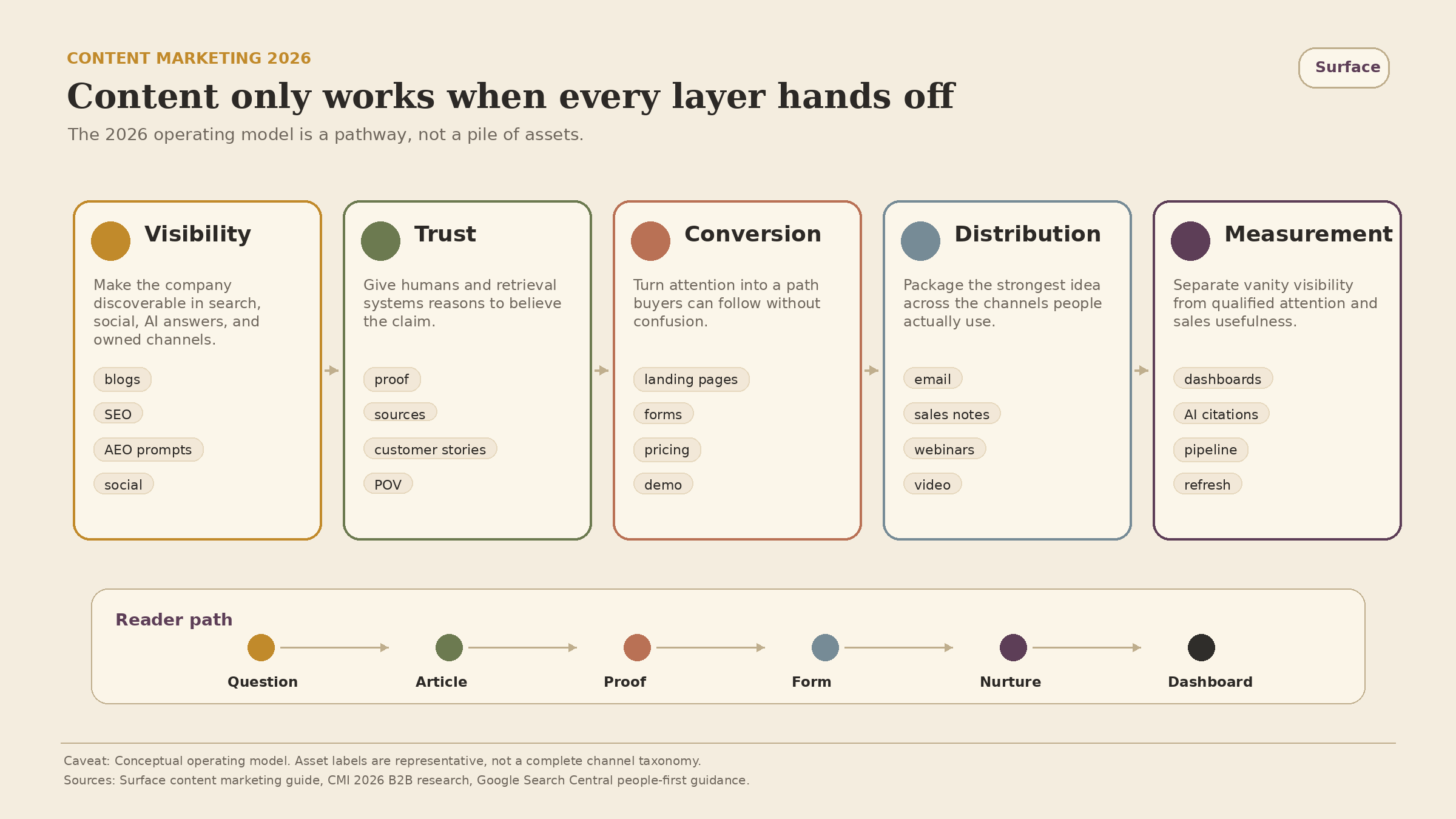
A strong 2026 content operation needs five layers. A small team can own all five without pretending each layer requires a separate department. A larger team can separate responsibilities, but leaders still need one operating model so everyone understands where content earns attention, where content earns trust, and where content helps a buyer act.
Visibility Layer
Content leads help search systems, AI assistants, communities, email subscribers, social readers, and partner channels discover the brand. This layer includes keyword strategy, AEO query mapping, glossary pages, educational blogs, refreshed explainers, structured answers, and distribution assets. Visibility content should answer real questions and create clean entry points, rather than chase every prompt or head term because a tool says the term exists.
Trust Layer
Marketing teams turn first contact into belief with expert commentary, customer stories, comparisons, proofs, data, founder or product POV, and clear source citations. Google’s people-first guidance asks creators to provide original information, reporting, research, analysis, and substantial value beyond rewriting sources. That standard maps well to human trust because buyers also notice when a page sounds like a paraphrase machine.
A reader who needs proof should be able to move naturally into customer stories, especially when a content page makes a claim about conversion, lead quality, funnel performance, or operational efficiency. A strong content system does not ask readers to trust every claim on tone alone.
Conversion Layer
GTM teams need landing pages, product pages, comparison pages, pricing narratives, proof pages, and contact pathways that help buyers move from interest to decision. A team can publish twenty useful blogs and still underperform when none of those blogs point to a strong landing page or a conversion page that explains what the company actually does.
Lead capture, qualification, routing, recovery, and nurture should sit inside this layer rather than being treated as a disconnected operations problem. Teams can drive readers into the site through search and AI visibility, but the business still needs a post-click path that turns traffic into demos.
Distribution Layer
Operators need to package good content across email, social, community, sales notes, webinars, video, and partner channels without creating duplicate spam. Email matters here because teams own the inbox relationship more directly than they own algorithmic reach. A newsletter, nurture sequence, or product update can reinforce memory even when a buyer does not click every message.
Thinking about AI Mode personalization and brand recommendations gives marketers another reason to care about owned touchpoints. If buyers carry useful product language, proof, and follow-up context into future AI-assisted research, email clarity and lifecycle communication become part of the visibility system.
Measurement Layer
Leaders need dashboards that tell them whether content created discoverability, qualified attention, assisted pipeline, useful sales conversations, citation visibility, and stronger buyer confidence. Teams should still track rankings and traffic, but they should also separate vanity visibility from content that actually engages or converts.
An AI visibility dashboard can help teams monitor how often AI systems mention a brand, which prompts produce competitor presence, and where content coverage needs to improve. That measurement should not replace business reporting. It should sit beside qualified lead reporting, form-to-meeting conversion, sales usefulness, and content-assisted pipeline.
The Cadence Rule: One Good, Two Great, Three Enough
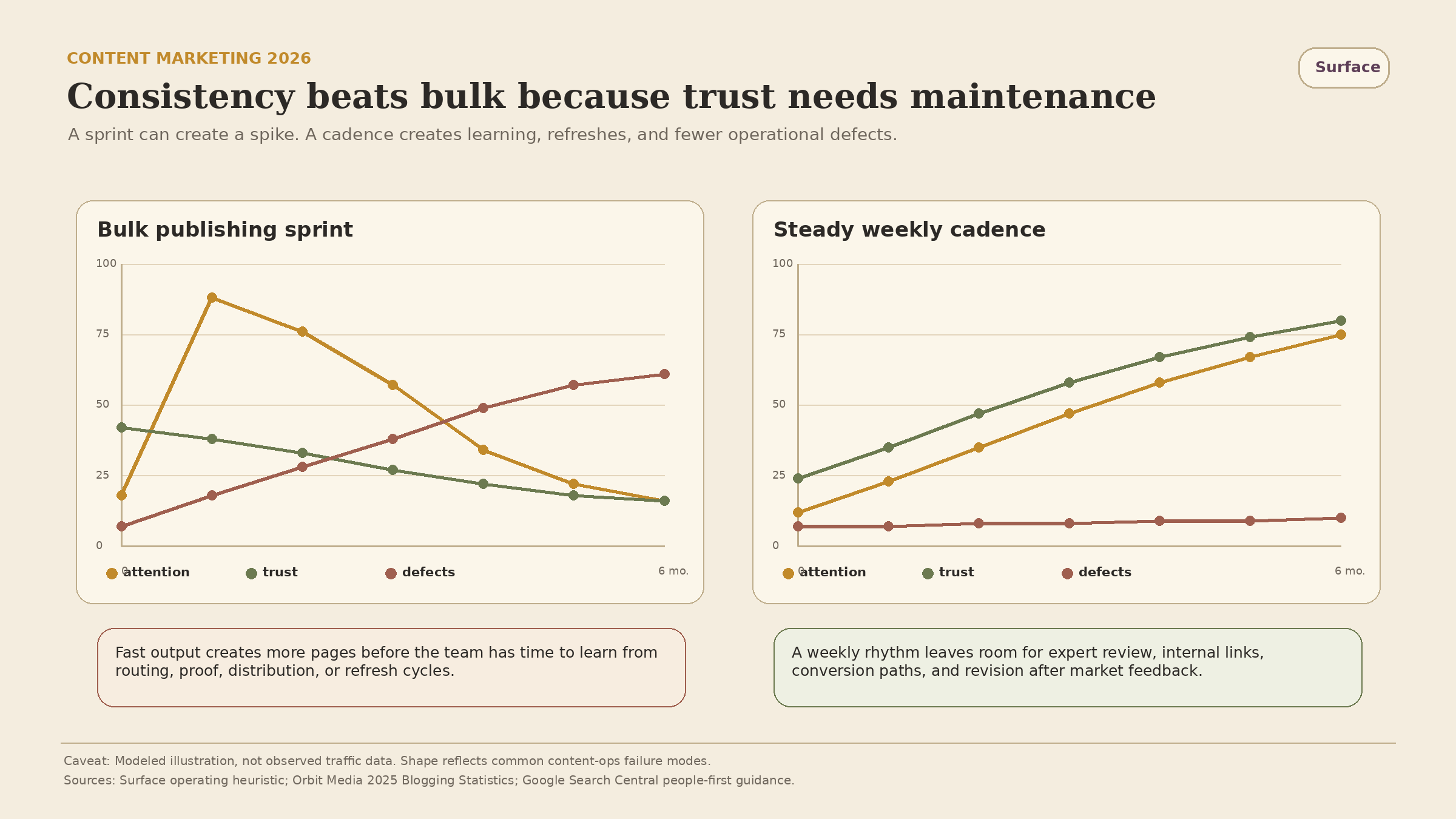
We have watched teams run straight into the content productivity cliff when they try to publish more than three high-quality pieces per week. One strong blog per week usually keeps a team moving. Two strong blogs per week gives a team more surface area and more learning cycles. Three strong blogs per week often marks the practical ceiling where most lean teams still preserve research quality, editorial judgment, internal review, distribution, and revision discipline.
Beyond that point, many teams stop making content and start managing a conveyor belt. Writers lose the time needed to understand the product. Editors lose the time needed to sharpen claims. Subject matter experts skim drafts instead of adding judgment. Operators push pages live without checking internal links, conversion paths, schema, images, or source freshness. The team may still publish, but the team no longer compounds trust.
Bulk publishing also creates a strategic illusion. A site can earn a temporary lift from a flood of new pages, especially when a team targets low-competition queries or emerging AI-search gaps. Teams often see sharp increases in traffic, citations, and earned impressions for a few months before the gains fall away when quality, consistency, and trust signals fail to hold. The lesson is not that volume never matters. The lesson is that consistency beats bulk every time when people have to keep reading, trusting, and converting after the sprint ends.
A healthier cadence turns publishing into a rhythm instead of a stunt. Marketers publish new material, update old material, watch which questions return, revise conversion paths, and turn the best ideas into email, sales enablement, social commentary, webinars, and product messaging. That rhythm gives both algorithms and humans a reason to believe the company remains alive inside its own category.
Intent Beats Length, Templates, and Volume
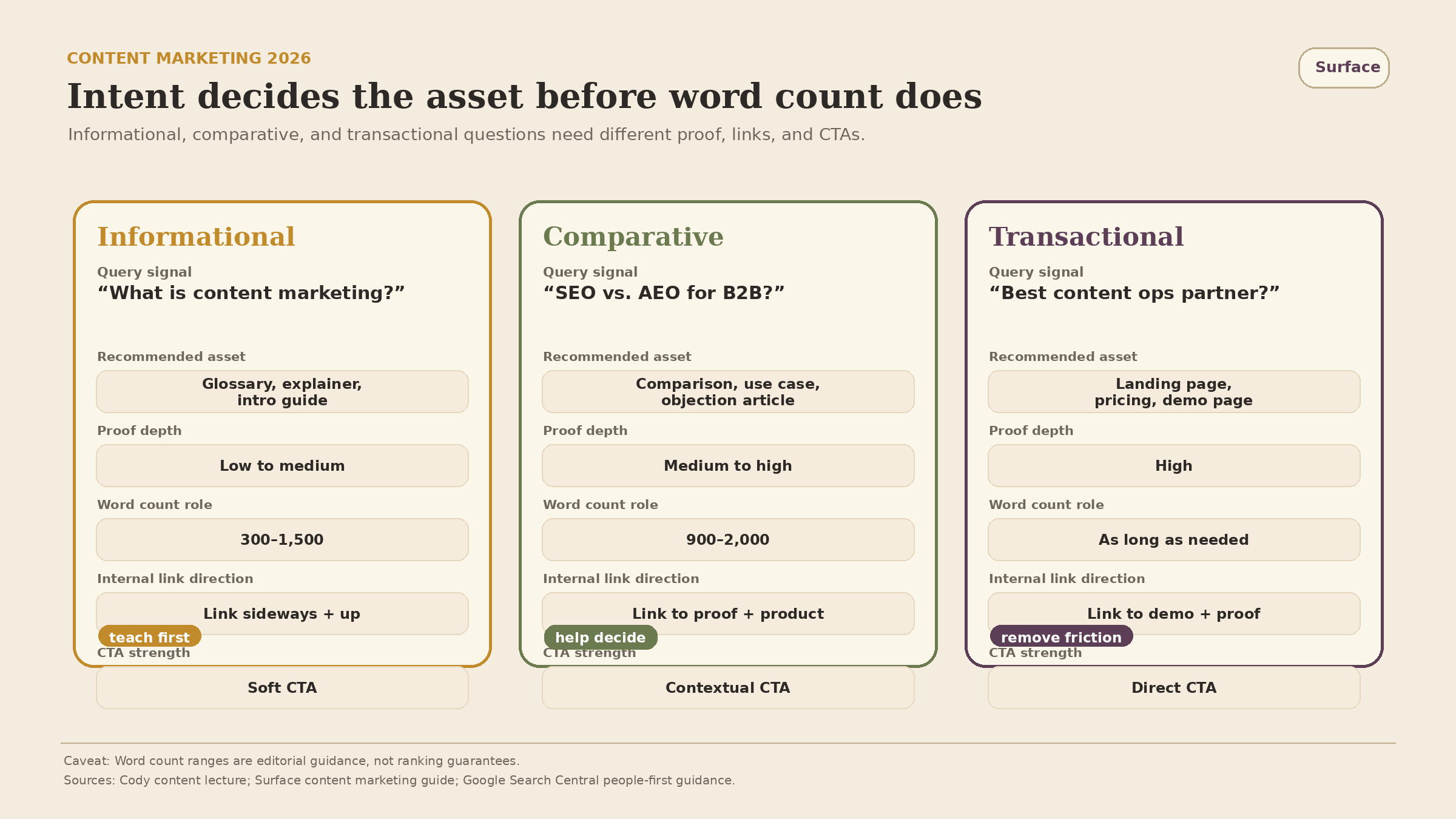
Content strategy begins when marketers stop treating every query like it deserves the same answer. Someone who searches “what is content marketing” needs a different page than someone who searches “best content marketing operations platform for B2B SaaS.” One person may be learning vocabulary. Another person may be trying to decide who can help the team next quarter. A third person may be comparing vendors after an executive asked why the blog gets traffic but the pipeline report looks thin.
The strategy landscape can be divided into three practical intent groups: informational and educational queries, comparative or research-oriented queries, and direct transactional queries. That framework gives content leads a way to match the page to the job. A glossary answer may need 300 words. A comparison page may need proof, nuance, objections, and internal links. A capstone guide may need enough depth to explain a worldview, defend a model, and give buyers confidence that the team behind it understands the whole system.
Length becomes useful only when the buyer’s question deserves length. Marketers do not need to answer the same question six times because a brief says the page needs another 800 words. Long content can help when writers explain a complex history, build a research-backed argument, or teach a buyer how a system works. Long content becomes waste when writers use size as a substitute for specificity.
Templates deserve the same treatment. A brief can help a busy editor coordinate writers, product reviewers, internal links, CTA placement, source requirements, and keyword coverage. A template can protect basic quality. A template should never become the creative target. When teams optimize the template until no one needs to think, they also remove the only thing that can make the page memorable. AI slop often looks clean because the template did its job. Buyers still feel the absence of judgment.
AI Search and AEO Still Rest on SEO Foundations
Answer engine optimization creates the temptation to behave like every week has a new secret. Marketers hear that AI assistants cite different pages than Google rankings, that model behavior changes, that prompt fan-out matters, that YouTube can surface where a blog does not, and that brand mentions may matter in ways traditional backlink reports do not fully capture. Much of that is true enough to matter, and unstable enough to punish anyone who mistakes today’s tactic for tomorrow’s strategy.
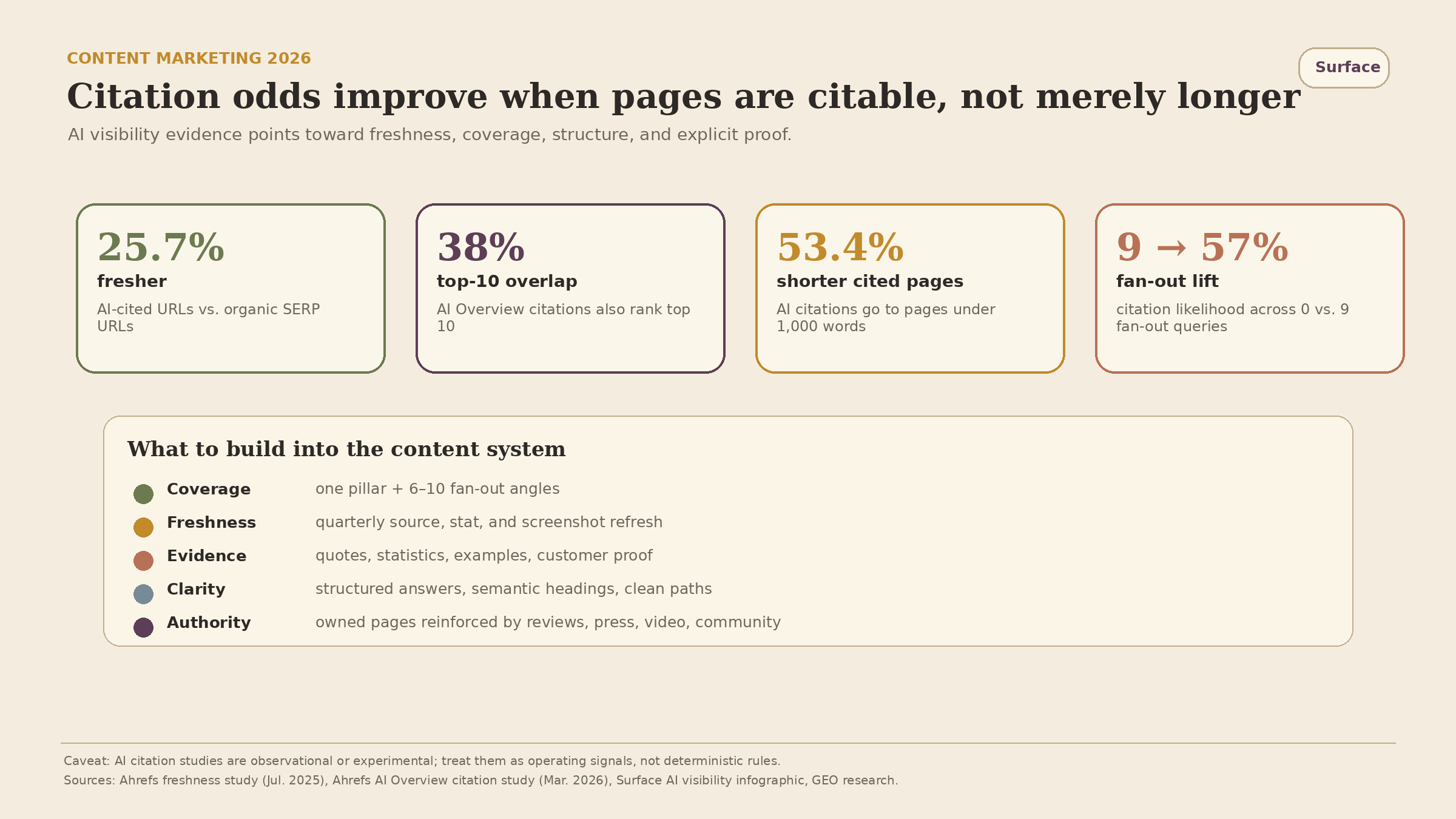
Ahrefs reported in 2026 that only about 38% of AI Overview cited pages also ranked in Google’s top 10 for the same query, while 36.7% did not rank in the top 100 blue-link results. The same research points toward fan-out query behavior, where AI systems use related sub-queries to identify useful sources. That finding should not make teams abandon SEO. It should make teams ask whether their SEO strategy covers the full question map around a buyer problem.
Freshness also matters more in AI-mediated discovery. Ahrefs analyzed nearly 17 million citations across seven AI search platforms and found that AI-cited URLs were 25.7% fresher than organic SERP URLs on average. Teams should read this as an operating mandate, not a growth hack. Marketers should update claims, screenshots, examples, benchmarks, and source notes because buyers need current evidence, and AI systems often seem to reward pages that look maintained.
Owned media also matters more than skeptics sometimes admit. Axios summarized Penta Group analysis reporting that roughly 60% of cited material in LLMs came from corporate-owned or business-produced sources, while noting that no one can fully pinpoint how LLMs choose sources. That caveat matters. Marketers should avoid magical claims about guaranteed AI citations. Still, the practical direction is clear enough: publish useful owned pages, make them easy to parse, keep them current, name responsible authors or experts where possible, cite sources, and support the page with credible off-site proof.
AEO windows change. Strong SEO practices still form much of the terrain beneath them. Teams that want AI visibility need clean site architecture, topical coverage, evidence blocks, structured answers, internal links, off-site mentions, video and community proof where relevant, and content that answers how buyers actually ask questions. Nobody wins the AI search game by forgetting that people and crawlers both prefer pages with clear paths.
Thinking about generative AI search optimization gives teams the useful, boring answer: AI visibility work still depends on crawlability, useful content, index eligibility, strong media, and pages that give visitors confidence. The new surface does not erase the old foundations.
Technical SEO as Supporting Infrastructure
Technical SEO should not eat the whole content strategy, but content teams ignore it at their own expense. A marketer can commission the best article in the category and still bury it inside a CMS that loads critical content through fragile JavaScript, creates duplicate URLs, hides internal links, or makes conversion pages painful to update. Teams need enough technical discipline to make strong content discoverable, renderable, indexable, and commercially useful.
Google’s crawl budget guidance focuses on large or frequently updated sites, but the operating lesson applies broadly: teams should keep sitemaps current, monitor index coverage, manage URL inventory, and avoid wasteful crawl paths when site scale or update frequency demands more discipline. Modern technical SEO has shifted from checklist hygiene toward governance across crawl paths, rendering, duplicate states, URL inventories, template behavior, and business measurement.
For content leads, the practical technical questions are simple. Can a person publish without breaking formatting? Can search systems find the page through HTML links? Can the CMS handle landing pages, conversion pages, product pages, and blog revisions without engineering tickets for every basic edit? Can the team update old content quickly when claims age out? Can analysts connect traffic and engagement to the pages that move buyers toward pipeline? Technical SEO supports the guide, the blog, the landing page, and the call request. It should create less friction for the people doing the marketing work.
Why Blogs Still Matter Only Inside a System
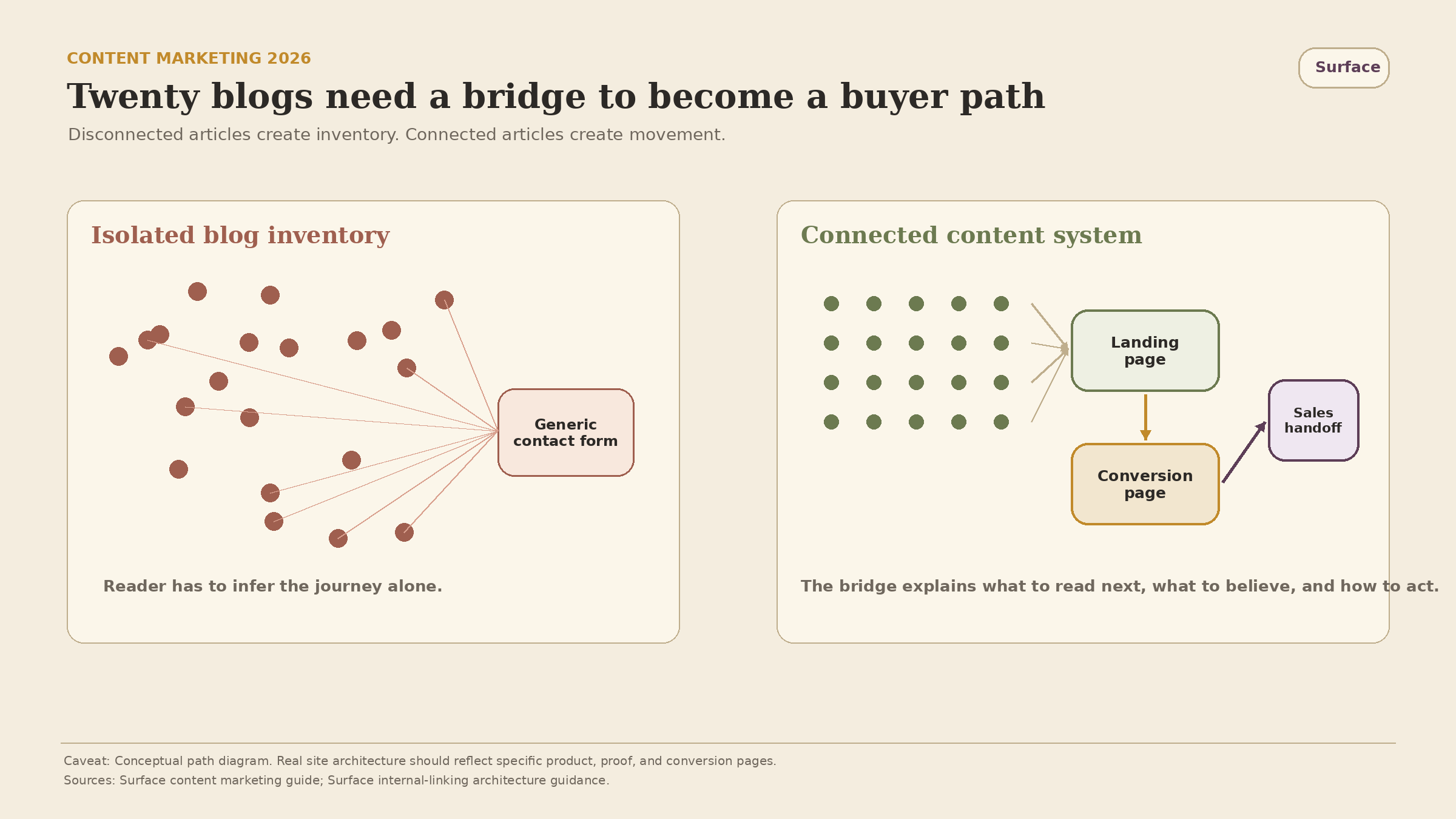
Blogs still matter. They help teams explain ideas, answer questions, test language, build topical authority, support email, equip sales, and create discoverable assets that accumulate relevance over time. The problem begins when leaders ask blogs to perform every job alone. A blog can attract a reader, but the team still needs a destination that explains the product, a proof asset that lowers risk, an email or nurture path that keeps memory alive, and a conversion page that lets the buyer act.
Twenty well-targeted blogs can help, but twenty blogs with one good landing page that ties them together will perform significantly better. Twenty blogs, one strong landing page, and one conversion page give buyers a path from research to belief to action. Teams should also turn the strongest material into email, social commentary, sales notes, and refresh cycles so each asset keeps earning new context after publication.
This is where many content teams accidentally underbuild the middle of the system. They publish educational content, then send every reader to a generic contact form. Buyers often need a more specific bridge. A person reading about content operations should land on a page that explains how lead capture, qualification, routing, recovery, and nurture work after the click. A person reading about generative engine optimization should find a useful explanation of generative engine optimization services. A reader who wants the broader market view can move into current marketing updates or related strategic commentary. Internal links should feel like a reader’s next thought, not like someone stuffed anchor text into a paragraph five minutes before publication.
Content teams should treat internal links as audience design. Search systems use them to understand relationships between pages. Buyers use them to decide whether the company understands their problem deeply enough to guide them forward. Sales teams use them when a prospect asks the same question for the sixth time. A content system becomes commercially useful when all three audiences can move without confusion.
Thought Leadership, Human Perspective, and the Anti-Template Rule
Everyone wants to be a thought leader because AI made the props cheap. Anyone can generate a research-style infographic, an executive LinkedIn post, a contrarian thesis, or a “state of the industry” draft. That ease makes the actual standard higher. Buyers do not need more people standing in front of synthetic scenery and calling themselves original. Buyers need someone who has spent enough time with the problem to say something useful, specific, and slightly risky.
True thought leadership does not require a founder to reinvent the industry every Thursday. Many teams confuse expertise with spectacle. A company can earn trust by explaining the obvious thing with unusual clarity, by documenting a customer pattern, by admitting a limitation, by showing where a common workflow breaks, or by helping a buyer understand a decision they already feel but cannot yet articulate. Personal POV can outperform generic commentary when a real person cares about the audience and knows the category well enough to hold a conversation.
Teams should also stop asking templates to impersonate perspective. AI can accelerate research, repurpose old assets, identify gaps, and help editors compare structure across pages. People still have to decide what is worth saying. People still have to hear the customer’s frustration, understand the internal sales handoff, recognize the category joke, and know which claim sounds impressive but fails under pressure. Tools do tool work. People do judgment work.
Google’s people-first guidance gives marketers a useful external standard here because it asks whether content provides original reporting, research, analysis, or additional value rather than simply copying or rewriting sources. Buyers use a less formal version of the same test. They may not name E-E-A-T, but they know when a page gives them something they could not get from the first three search results pasted into a prompt.
What We Mean by Content Operations
We use Content Operations to describe the whole system that turns strategic thinking into published, measured, revised, and commercially useful content. The work includes a content management system, blog revision workflows, visibility dashboards, results dashboards, strategic insights, publishing governance, internal linking discipline, and the editorial judgment needed to keep the machine from producing average work at impressive speed.
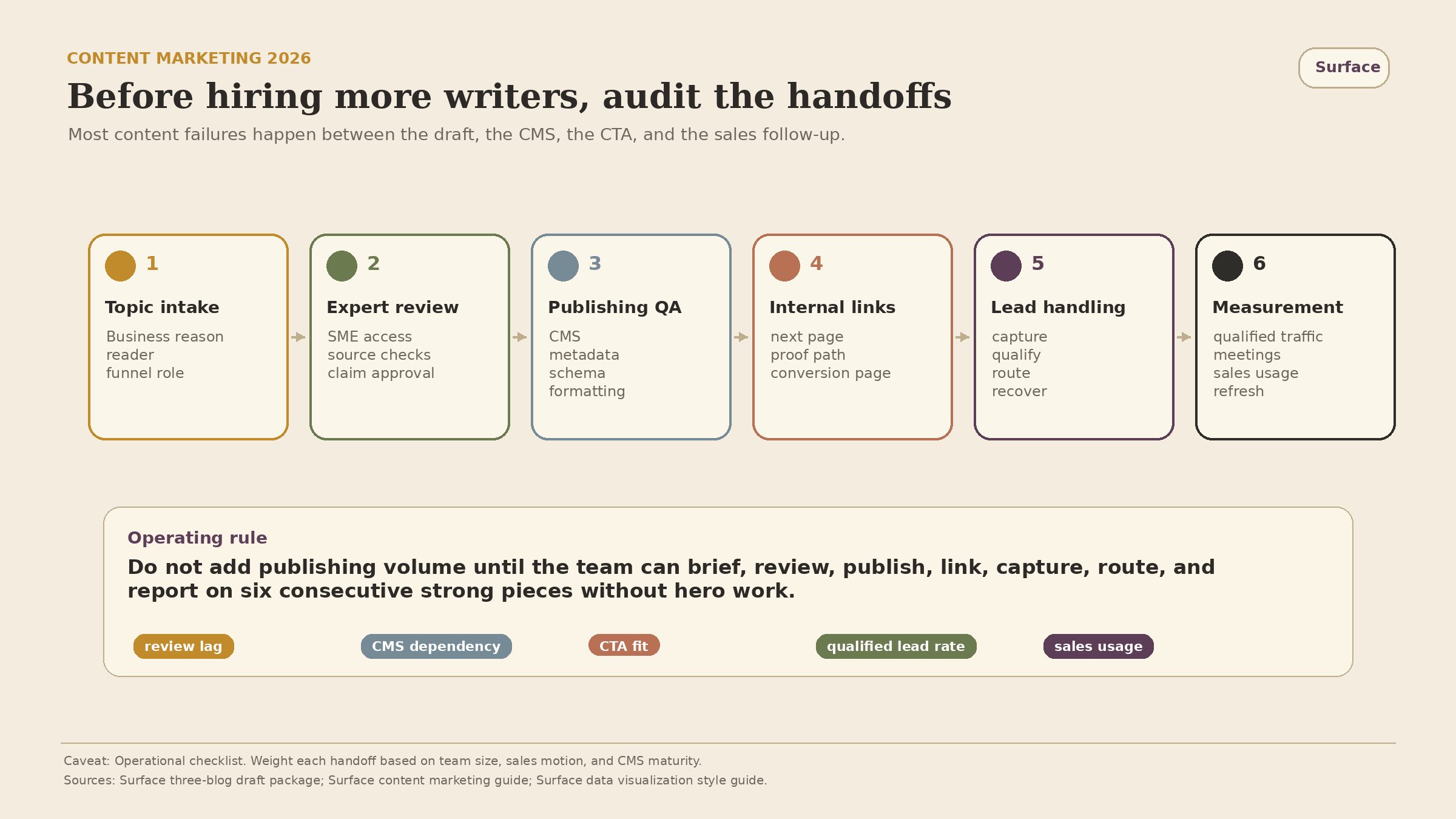 That work exists for the content lead who has too many tabs open and not enough operators, for the solo marketer carrying strategy, writing, CMS, analytics, and reporting at the same time, and for the GTM leader who needs content to support pipeline rather than decorate a website. Strong content operations build the connective tissue between SEO, AEO, AI visibility, owned media, email, sales enablement, and conversion paths.
The quiet promise is straightforward. Teams should not have to choose between search visibility and brand voice, between AI-aware structure and human usefulness, between publishing cadence and quality, or between strategic clarity and operational output. A serious content operation should serve every one of those goals because the audience landscape already includes every one of those goals.
A buyer path does not end with a blog. Someone reads, compares, leaves, returns, fills a form, waits, receives follow-up, and decides whether the company feels credible enough to talk to. Improving the form at the center of the funnel can matter as much as improving the article that drove the visit. Fixing inbound lead management can matter as much as winning another keyword. Reviewing B2B lead conversion benchmarks can help teams understand whether visibility is turning into qualified demand.
Teams that want to turn content from an archive into an operating system can review pricing and package options or book a demo.
FAQ
What is the best content marketing strategy for 2026?
The best content marketing strategy for 2026 combines classic SEO, AI-search visibility, owned media, expert perspective, internal linking, and conversion architecture. Teams should publish consistently, refresh evidence, map content to buyer intent, and connect blogs to landing pages, proof pages, email, sales enablement, and lead operations.
How many blogs should a company publish each week in 2026?
Most lean B2B teams should publish one to three high-quality pieces per week. One good blog per week keeps the program alive, two is strong, and three is usually enough. Quality, review, distribution, and conversion discipline often fall off when teams try to exceed three high-quality weekly pieces without the right operating support.
Does AEO replace SEO?
AEO does not replace SEO. AI search creates new visibility windows, but teams usually win those windows through strong SEO foundations: crawlable pages, useful content, topical coverage, internal links, structured answers, fresh evidence, brand authority, and off-site proof.
Do blogs still work for B2B marketing?
Blogs still work when teams connect them to a broader content system. A blog can create visibility and educate a buyer, but teams need landing pages, conversion pages, proof assets, email, sales enablement, and measurement to turn attention into pipeline.
Is longer content better for SEO and AI visibility?
Longer content helps only when the question deserves depth. A glossary answer may need a few hundred words, while a definitive guide may need several thousand. Teams should match content length to intent rather than fill pages with repeated answers.
How should companies use AI in content marketing?
Companies should use AI to accelerate research, repurposing, editing, structural analysis, and revision. People should still own judgment, voice, claims, examples, customer understanding, and final editorial accountability.
What is Content Operations?
Content Operations is the system that manages strategy, production, CMS workflows, revision, analytics, AI visibility, internal linking, publishing governance, and conversion reporting so content teams can create useful assets consistently instead of managing one-off deliverables.