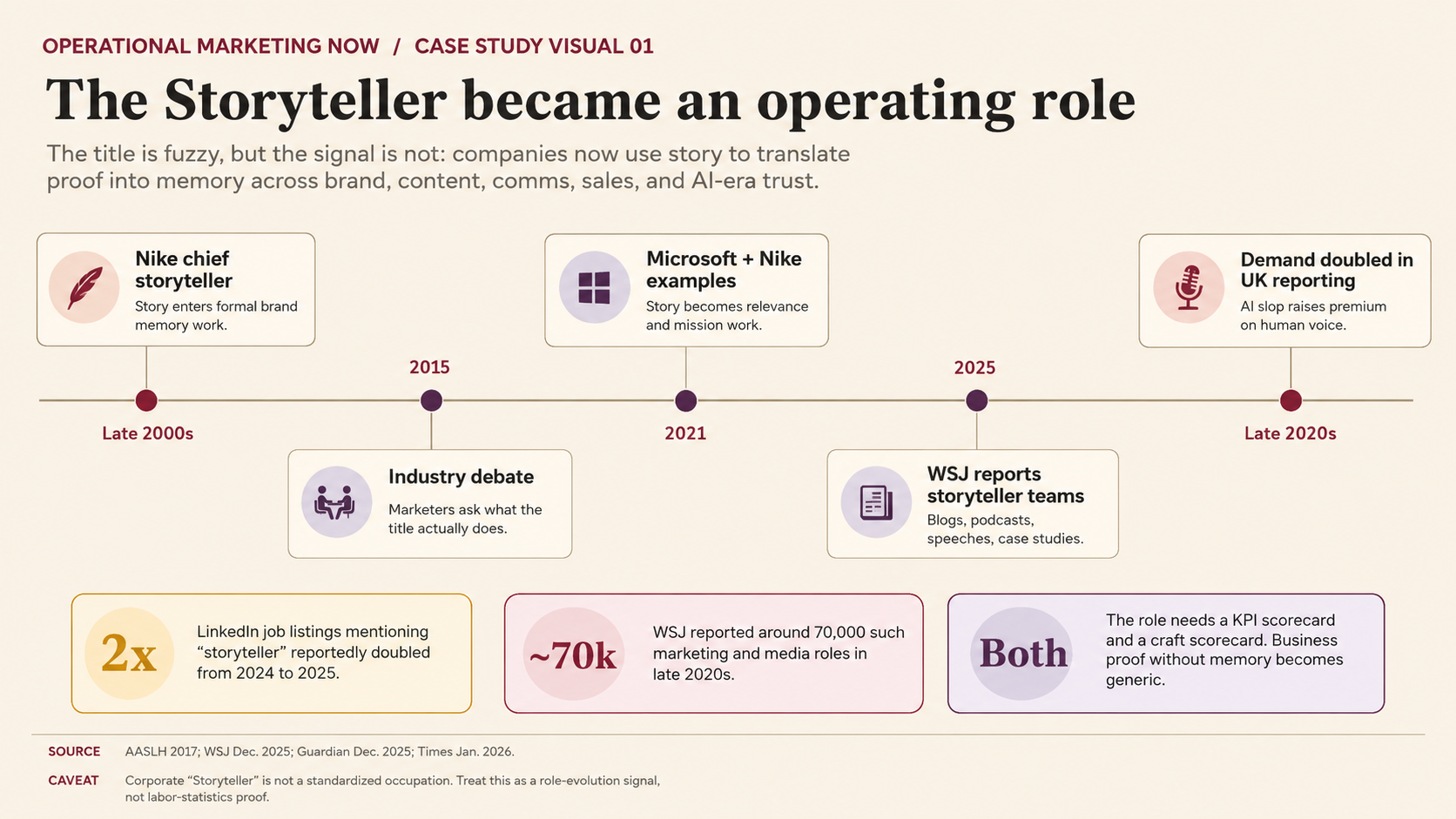
A strange thing happens when a marketing team says it needs a Storyteller. Usually, the team means it wants someone who can make the company feel less interchangeable, translate technical complexity into human stakes, and create a narrative that customers, sales teams, executives, analysts, and now AI systems can repeat. Then the same team evaluates that person almost entirely through MBA-style judgment: traffic, MQLs, pipeline influence, attribution, conversion, and quarterly performance.
Those measures matter. A brand story that never moves through the business eventually becomes decoration. Still, a company that asks for storytelling and only measures the role through performance dashboards has already misunderstood part of the job. Story also belongs to MFA-style creative traditions: voice, tension, scene, specificity, pacing, character, memory, contradiction, and the strange little detail that makes someone believe a sentence came from a real company staffed by real people.
This week’s Operational Marketing Now uses that tension as the opening frame. The retrieval era has made marketing more measurable in some ways and less measurable in others. AI search can cite, summarize, compare, and recommend without sending a clean click. Paid search is moving into AI interfaces before marketers have stable reporting models. Google keeps reminding teams that AEO and GEO still require SEO fundamentals. Through all of this, the Storyteller role starts to look less like a soft brand hire and more like a retrieval-era operator responsible for making the company legible across search, AI answers, sales conversations, customer proof, and buyer memory.
Recent marketing shifts have made the same pattern more visible: AI visibility now depends on coverage, freshness, evidence, clarity, and source mix, which changes how teams should think about weekly marketing intelligence. When AI systems retrieve meaning from clusters of sources, storytelling, SEO, paid media, and measurement start to collapse into one operating problem.
 ## The opening dialogue: why does marketing hire Storytellers, then measure them like growth analysts?
The “Storyteller” title has moved through corporate marketing for years, from brand narrative and customer storytelling to executive communications, data storytelling, employer brand, product marketing, and content strategy. The current resurgence makes sense. AI has made competent content easier to produce. It has also made sameness easier to recognize. When every company can generate a decent landing page, the real scarcity becomes judgment, specificity, and a story that can survive contact with a buyer.
The problem is not that marketers use business metrics. The problem is that many teams use only business metrics for a role they hired because business metrics could not solve the whole problem. Pipeline influence can tell a team whether a story moved through the revenue system. It cannot tell the team whether the story has a scene, whether the customer appears as a person rather than a persona, whether the language sounds owned, or whether the narrative can be repeated without turning into generic positioning mush.
A better model gives the Storyteller two scorecards. The business scorecard tracks sales reuse, branded search lift, customer proof coverage, citation quality, executive-message consistency, assisted conversions, and sales-cycle clarity. The craft scorecard tracks narrative coherence, specificity, voice, tension, audience dignity, proof integration, and memorability. That second scorecard does not make the work precious. It makes creative quality discussable before the market quietly punishes the company for sounding like everyone else.
This is also why B2B marketing has changed so sharply over the last few years. Buyers now research, compare, and form opinions before they ever talk to sales. Teams still need pipeline, attribution, and conversion systems, but they also need language buyers can remember after the tab closes.
 ### Theme one: query fan-out makes content architecture the work
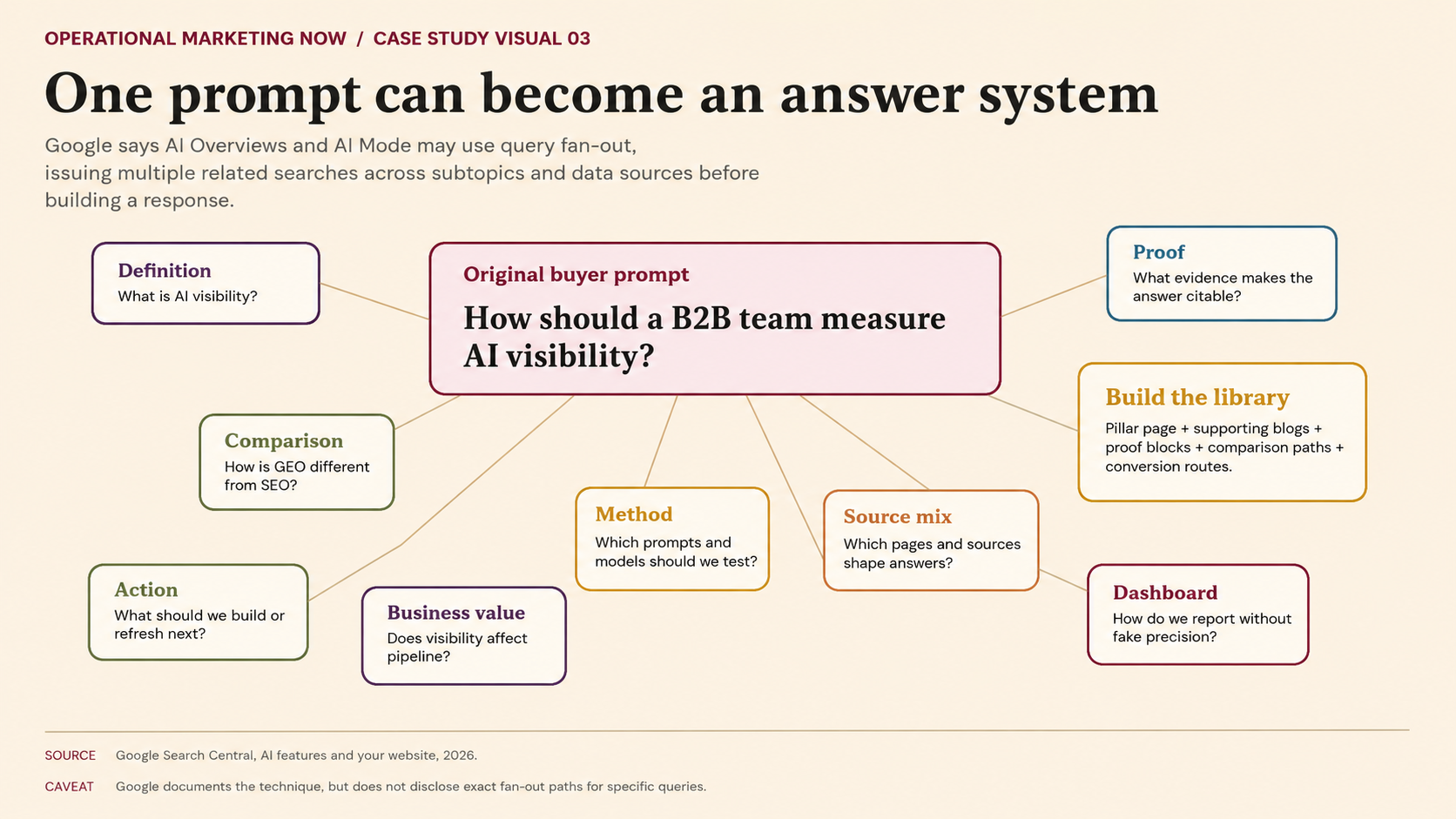
Google’s language around query fan-out gives marketers a useful phrase for something many content teams have already felt. A buyer’s single question can turn into a small research project inside an AI system. The system may need definitions, comparisons, use cases, objections, integrations, pricing context, risks, alternatives, and proof before it can assemble a useful answer.
That changes the content strategy question. Teams should stop asking whether one blog can rank for one keyword and start asking whether their owned and off-site source ecosystem can satisfy the question field around a buyer’s intent. A strong page still matters, but the surrounding architecture matters more than most editorial calendars admit. Content needs a pillar, supporting angles, internal links, evidence blocks, examples, customer proof, and a clean next step.
Marketers translating Google’s generative AI search guidance into content planning should start with a practical operating question: can a buyer or retrieval system move cleanly from the category question to the comparison question, the implementation question, the proof question, and the conversion question? The next move is to build fan-out maps before commissioning pages, then decide which buyer questions deserve first-party content, which belong in sales enablement, and which need third-party validation.
 ### Theme two: AI visibility measurement is messy because the unit of measurement changed
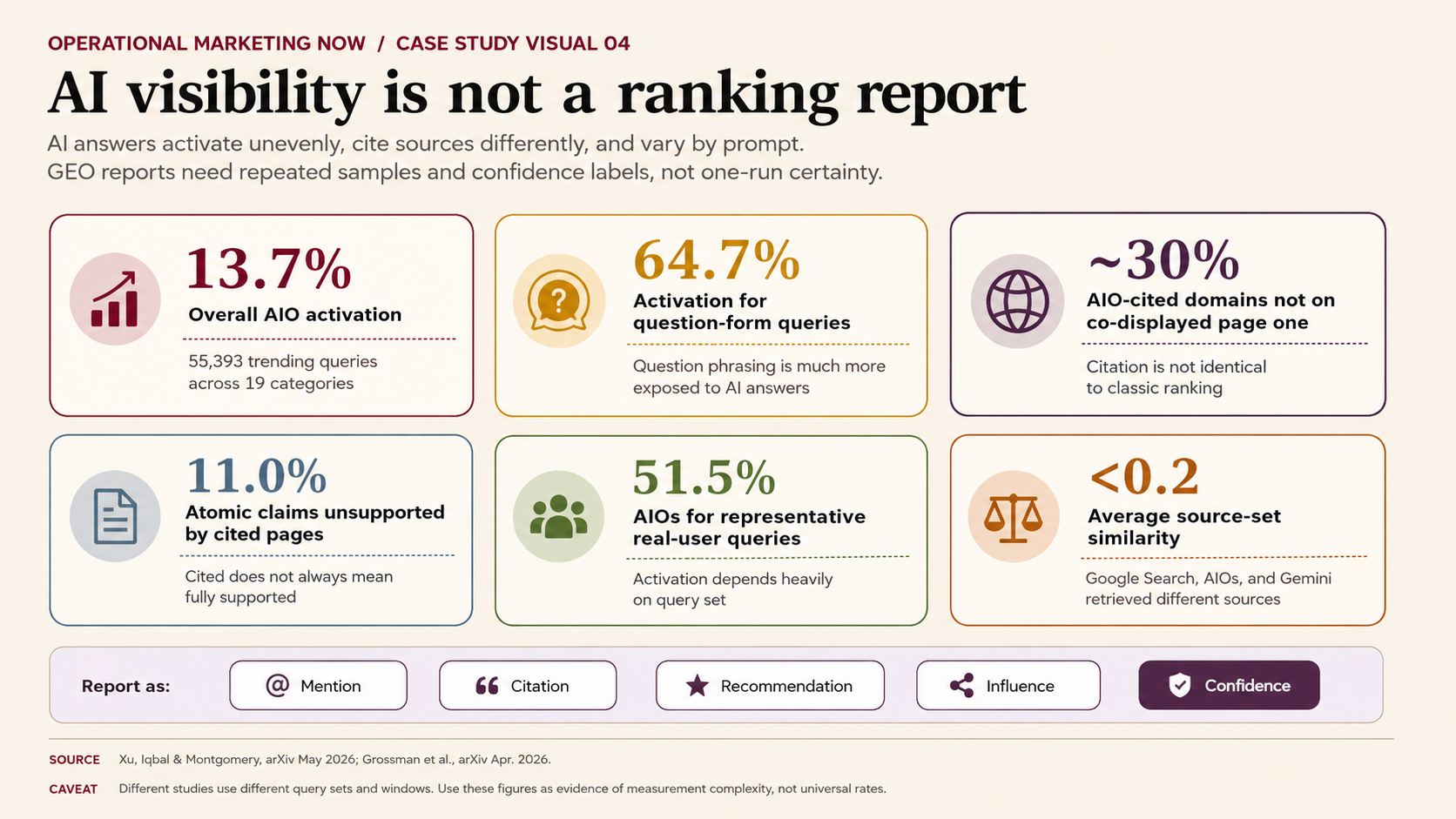
AI visibility does not behave like a stable ranking report. Answers vary across prompts, paraphrases, runs, models, interfaces, account states, and time. A team can rank well in classic search and still fail to appear in an AI recommendation. A brand can be mentioned without being cited. A page can be cited without meaningfully shaping the answer. A competitor can win because an off-site source, review page, video, or comparison article gives the system a cleaner path to confidence.
That is why AI visibility reporting should stop pretending it has the neatness of a ten-blue-links SERP. The useful unit is no longer a single keyword position. Marketers need to track prompt families, repeated samples, paraphrase coverage, source mix, brand mentions, citations, recommendations, narrative share, and confidence labels. The goal is not to create a dashboard that looks more certain than the market actually is. The goal is to help teams make better decisions without hiding uncertainty.
Thinking about AI citations vs. SEO rankings gives marketers a cleaner vocabulary for this problem because ranking, citation, mention, and recommendation should not collapse into one vague visibility score. Teams that want a more operational reporting layer can extend that thinking into an AI visibility dashboard that tracks model-by-model visibility, competitor presence, prompt families, source mix, and the gaps that should shape the next content sprint.
 ### Theme three: paid search is moving into AI interfaces before reporting models mature
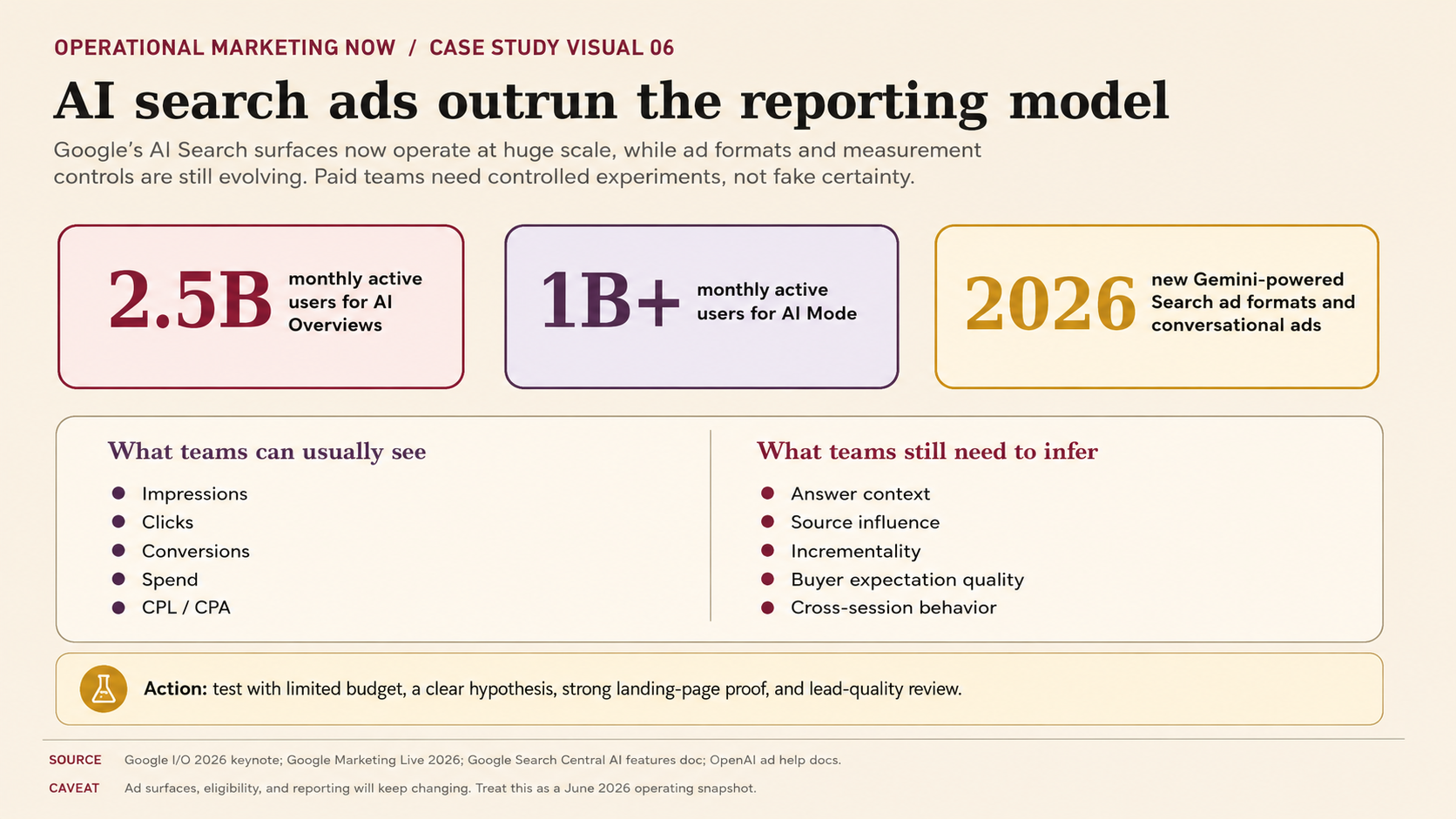
Paid search is also leaving the old container. The familiar unit was the keyword list, matched to ads, bids, landing pages, and conversion reporting. AI interfaces are pushing the paid unit toward briefs, feeds, prompts, product data, audience context, creative systems, landing page proof, and brand-safety instructions. Marketers can buy into AI-shaped surfaces faster than they can fully explain incrementality inside them.
This creates a serious operating problem for performance teams. Paid media leaders need to test new inventory without pretending the reporting is mature. They need clean feeds, current product data, proof-backed landing pages, comparison assets, review hygiene, exclusion logic, and a measurement plan that can handle assisted behavior. The old comfort of keyword-to-click-to-conversion reporting will not disappear entirely, but it will describe a smaller share of the paid discovery experience.
As ads move into the answer layer, marketers need to connect media testing to the actual economics of acquisition. Asking what it costs to book one meeting becomes more important when interfaces get harder to measure, because paid teams need to judge cost per meeting, lead quality, expectation-setting, and what happens after the paid interaction.
 ### Background theme: AEO and GEO still need SEO bones
The sober reminder underneath this issue is that AEO and GEO do not replace SEO. Google’s guidance keeps pulling the conversation back toward crawlable, indexable, useful, well-structured pages that can be retrieved, understood, and shown with confidence. AI visibility work adds new layers: prompt testing, citation tracking, source-mix analysis, fan-out coverage, off-site proof, and narrative consistency. Those layers work poorly when the site itself is technically weak, thin, stale, or confusing.
This is where acronym culture can become expensive. A team can buy an AI visibility tool, run prompt tests, and build dashboards, but if the core pages are hard to crawl, poorly linked, unsupported by evidence, or inconsistent in product language, the program will keep diagnosing symptoms. Strong AEO/GEO work begins with SEO reality: indexability, internal links, text availability, snippet eligibility, structured content, page experience, current claims, and a clear answer path.
Teams evaluating generative engine optimization services should look past the acronym and ask whether the work creates a real content strategy, a clearer source ecosystem, and a stronger retrieval path. AI visibility rewards systems of trust. It does not reward teams for renaming old work while leaving the actual site, story, and conversion path unchanged.
 ## Operational takeaway
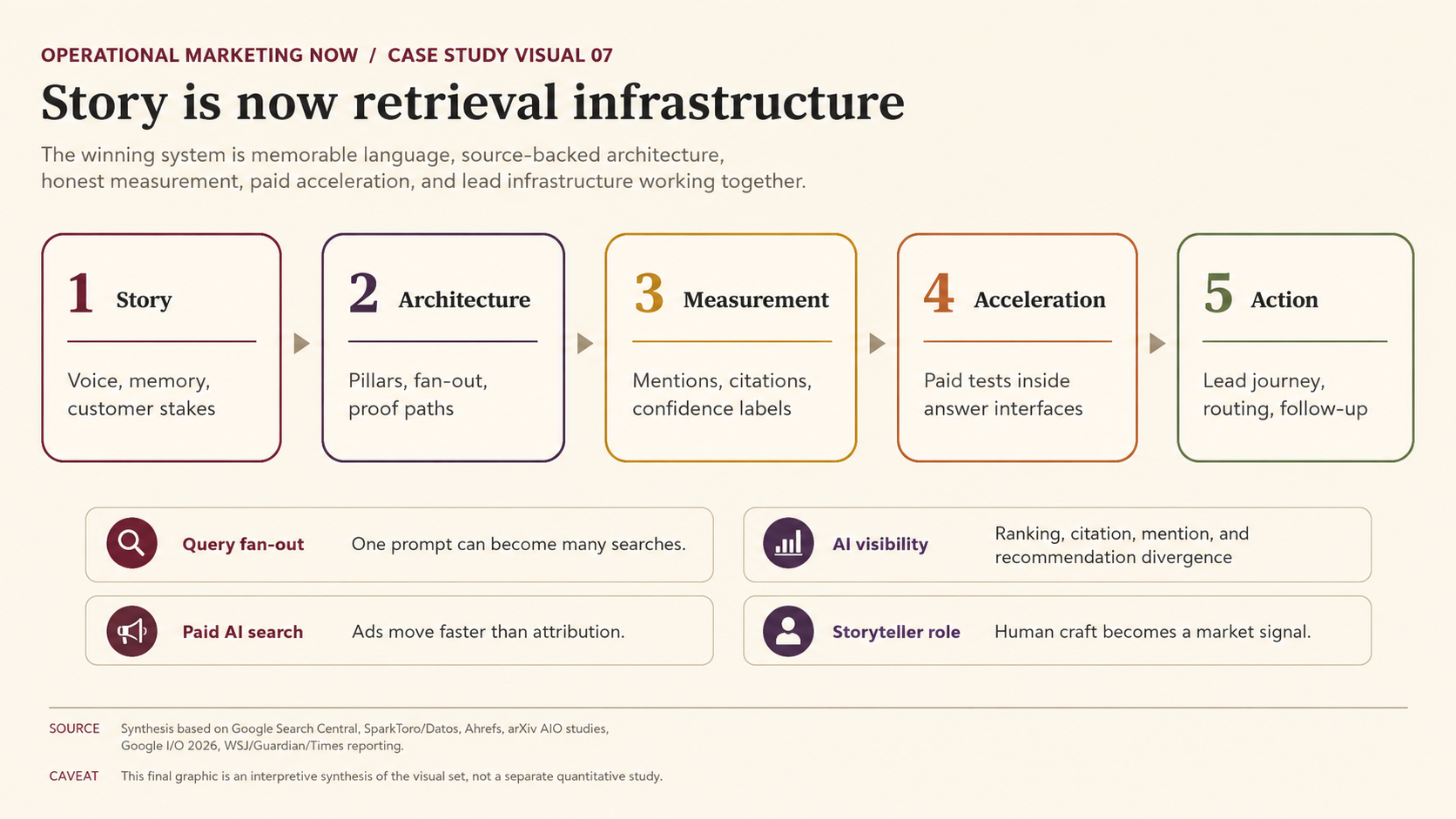
This issue should leave marketers with one main idea: retrieval-era marketing rewards companies that can make themselves easier to understand, verify, retrieve, cite, and choose. That is a technical problem, because crawlers and AI systems need clean access to useful pages. It is a measurement problem, because old dashboards do not fully describe AI-shaped discovery. It is a paid media problem, because ads are entering answer-like interfaces faster than attribution can settle. It is also a storytelling problem, because a company still needs language, proof, and narrative shape that a buyer can remember.
We believe that lead journey tracking matters because the path after visibility matters just as much as the moment of discovery. Sales teams need to understand what a buyer read, compared, and considered before conversion, while inbound lead management connects that context to speed-to-lead, enrichment, scoring, routing, and follow-up. In the retrieval era, content does not finish its job when it earns a citation, ranking, or click. The stronger question is whether the entire system helps a buyer move from recognition to confidence to action.
Recommended actions for marketers this week
Build a dual Storyteller scorecard
Evaluate storytelling work through both business performance and creative craft. The business side should track sales reuse, message consistency, branded search lift, citation quality, assisted conversions, customer proof coverage, and whether sales teams actually use the narrative in live conversations. The craft side should track specificity, voice, tension, narrative coherence, audience dignity, proof integration, and memorability.
A useful Storyteller should make the company easier to understand, remember, trust, and repeat. Do not reduce that work to traffic and pipeline alone. Those outcomes matter, but they only capture the downstream evidence. Teams also need a way to judge whether the story itself is any good before the market delivers the verdict.
Turn priority topics into query fan-out maps
Before assigning another blog, map the full question field around each priority category. Start with the main query, then list the adjacent questions a buyer or AI system would need answered: definitions, comparisons, implementation concerns, risks, alternatives, pricing context, proof requirements, integration questions, and “why now” arguments.
From there, decide what deserves a pillar page, what deserves a supporting blog, what belongs in a product page, what belongs in sales enablement, and what needs third-party validation. Query fan-out rewards connected coverage. A single strong page helps, but a clearly structured answer system is much harder for competitors to displace.
Report AI visibility as a confidence model
Stop treating AI visibility like a cleaner version of keyword ranking. Build reports around prompt families, paraphrase tests, repeated runs, model-by-model behavior, citation frequency, brand mentions, competitor recommendations, source mix, and answer sentiment. Mark what is known, what is directional, and what remains unstable.
A useful AI visibility report should help a team decide where to invest next. It should show whether the brand is absent, mentioned, cited, recommended, misrepresented, or losing to competitors through third-party sources. That means the report needs enough humility to admit uncertainty and enough structure to guide action.
Separate citations, mentions, and recommendations
Track three different visibility states instead of blending them together. A citation means the system used or displayed a source. A mention means the brand appeared in the answer. A recommendation means the brand was positioned as a viable or preferred option. Each one has different business value.
For each priority prompt set, record whether the brand appears, how it appears, which sources support the answer, which competitors appear nearby, and whether the answer frames the category accurately. This gives marketers a cleaner view of where the problem lives: content gaps, source authority, off-site proof, product positioning, or competitor narrative strength.
Treat paid AI-interface tests as controlled experiments
As ads move into AI-shaped interfaces, marketers should avoid treating early results like mature paid search benchmarks. Start with controlled tests: limited budget, clear audience assumptions, clean landing pages, specific conversion events, and a written hypothesis for what the campaign should prove.
Measure more than click-through rate. Watch assisted conversions, meeting quality, search lift, branded query changes, downstream lead quality, and whether the paid experience creates better or worse expectation-setting. AI interfaces may compress discovery, comparison, and recommendation into one environment. Reporting needs to account for that messiness rather than pretending every touch behaves like a classic paid search click.
Audit SEO fundamentals before chasing AEO or GEO tactics
AEO and GEO work poorly when the site has weak SEO foundations. Before buying another tool or creating another AI visibility dashboard, confirm that priority pages are crawlable, indexable, internally linked, text-accessible, current, and clear. Make sure core product language is consistent across landing pages, blogs, case studies, documentation, and comparison pages.
Technical SEO still acts as the retrieval layer. If AI systems and search engines cannot access, parse, trust, or contextualize the page, the brand will struggle to earn visibility no matter how polished the content strategy sounds. Treat SEO fundamentals as the floor under AI visibility, rather than an older discipline that can be skipped.
Add evidence blocks to high-value pages
Update priority pages with clearer proof: statistics, customer examples, screenshots, benchmarks, expert quotes, comparison tables, implementation notes, methodology explanations, and source citations. The goal is to make each page easier for a human buyer to trust and easier for an AI system to cite.
Evidence blocks are especially important on pages that make category claims, product claims, or comparison claims. Unsupported assertions are cheap now. Proof is the differentiator. A good page should not merely say the company is credible. It should show why someone would be reasonable to believe it.
Connect visibility work to lead journey infrastructure
AI visibility, SEO, and paid media should not stop at the moment of discovery. Review what happens after someone lands on the site: CTAs, routing logic, forms, enrichment, qualification, nurture, sales handoff, and follow-up timing. A citation or click has limited value if the visitor enters a broken conversion path.
For each major content cluster, define the intended next action. Some readers should visit a product page. Some should read a case study. Some should subscribe. Some should book a meeting. Some should enter a nurture path. Retrieval-era content needs a clear human path after the machine finds it.
Refresh source-sensitive content on a recurring cadence
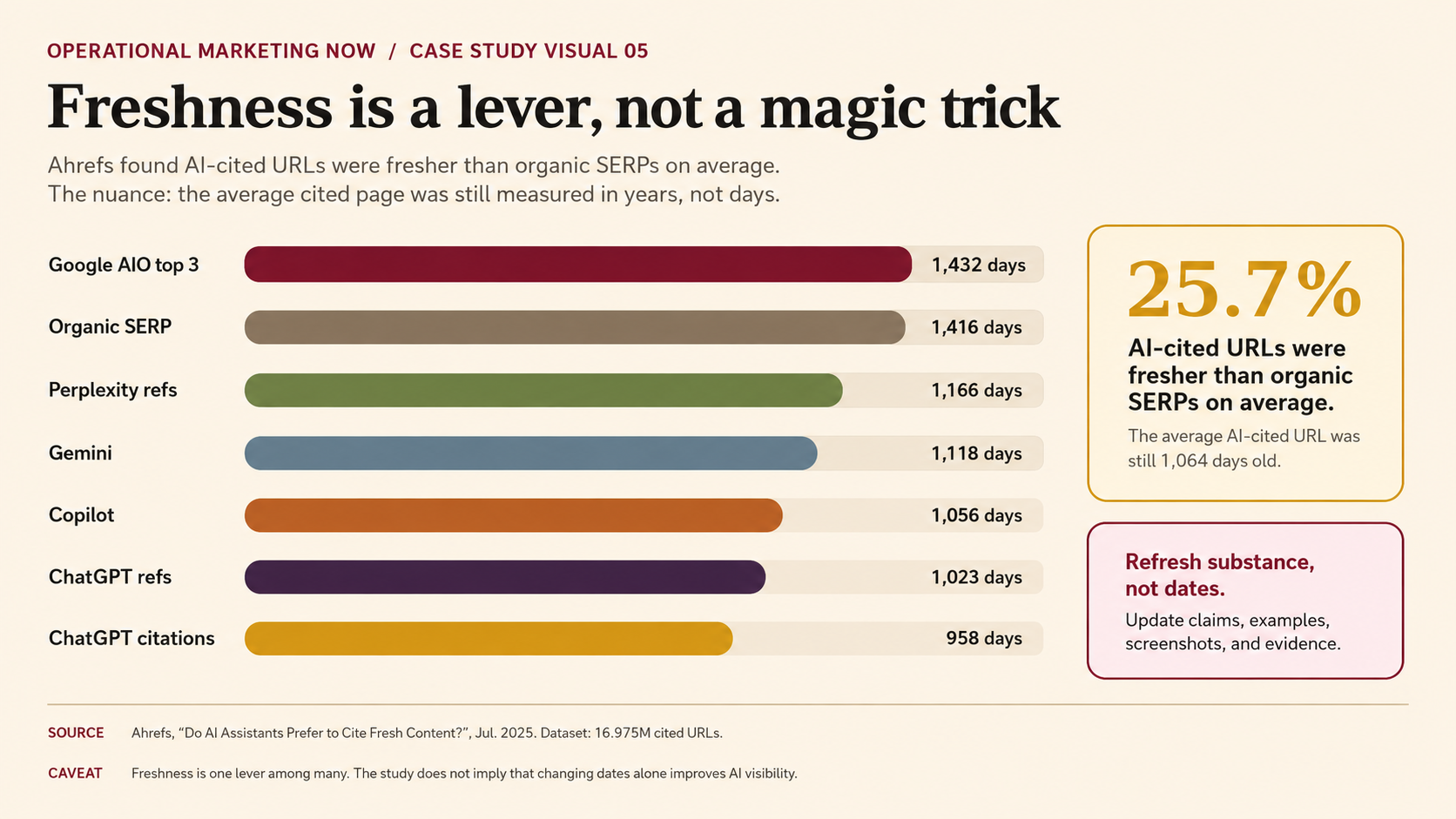
AI visibility depends partly on freshness, especially in fast-moving categories like SEO, paid media, AI search, and marketing technology. Build a refresh queue for pages that contain statistics, product claims, platform guidance, screenshots, pricing references, or regulatory commentary.
Each refresh should update the claim, source, date, internal links, and recommendation. Do not only change the publication date. Teams should make the page materially more useful each time they revisit it. Freshness without substance turns into maintenance theater.
Create one operating owner for retrieval-era visibility
Assign someone to own the connective tissue across SEO, AEO/GEO, paid search, content, storytelling, and measurement. This does not need to be a new executive role, but someone needs responsibility for how the company appears across search engines, AI systems, ads, source ecosystems, and sales conversations.
Without that owner, teams tend to split the work into disconnected fragments. SEO owns rankings. Content owns blogs. Demand gen owns ads. Product marketing owns messaging. Sales owns objections. AI visibility exposes the weakness of that structure because retrieval systems do not respect internal org charts. They assemble the brand from whatever evidence they can find.